Antagonists in Our Discernments

04E 2 choiceAs we look through our life with a storytelling lens, we might ask ourselves: do good followers of Jesus have antagonists?

Yes, we do!

Keep in mind that antagonist doesn’t mean villain or enemy, although in a story they might be. Rather, an antagonist is anyone or anything that stands in the way to the protagonist achieving his or her goals. An antagonist can be an enemy, but doesn’t need to be, as an antagonist can oppose our goal for many reasons (their reasons may be good or bad or neutral). An antagonist may not even be a person but force, and have no reason at all. In my experience, many of us have antagonists but few of us have the kinds of real enemies or villains that we see in the movies.

It’s helpful to think about how we, as followers of Jesus, may want to respond to those people in our lives who, in some way, distract us from or stand in the way of our discernment. (Later, we’ll look at other obstacles to discerning.)

In addition to a loving relationship with God, the most important condition for a genuine discernment is freedom: freedom to hear God’s invitation, and freedom to choose how to respond. The people in our lives can either help us towards freedom, or block our journey to freedom. Yet, even when someone seems to “block” our discernment and our freedom, their antagonism may be the resistance we need to discover a deeper freedom. Their resistance may also push us to a new level of commitment in seeking God’s will.

For example, Joe, a husband and father, is discerning if God is calling him to move from his current stable job to a new kind of work—perhaps as an entrepreneur doing the kind of work that has always been his dream. The people in Joe’s life will be important in his discernment. His wife, his parents, his friends, his children, his co-workers—each person will have his or her own idea about what Joe should do. Their ideas may be motivated by love for Joe, selfish concerns, or a mix of any number of motives, ranging from the desire for support and stability for his family, to fear of the new or unknown, doubts in an unproven ability, a desire to maintain the status quo, etc. Most likely Joe’s wife will have the most important role and influence—she has a unique prominence in Joe’s discernment as his wife. Ideally, Joe and his wife will discern God’s will for their family together.

Let’s suppose that, while Joe’s wife is fearful of how a change of work will affect their family’s financial stability, she loves Joe and shares his faith, so she supports his discernment. But a close friend—perhaps someone who has always been Joe’s strongest support—is adamant that Joe should continue doing exactly what he’s doing. Joe respects his friend’s opinion, and owes him alot for the support he has given to Joe and his family in the past. What does Joe do with the friend’s unhelpful advice and expectations?

It’s pretty clear that, as an adult responsible to God, his wife, and his children for living his life and call, Joe cannot simply listen to his friend blindly, even though their friendship means a lot to him. This friend is not just not helping Joe discern; the friend is antagonistic to Joe’s discernment, and has become a force against discerning at all. How does Joe handle this so that he can freely discern?

Depending on their friendship, Joe may use his friend’s negative response to explore his own feelings and motivations—whether during or after their conversations. After several attempts at discussion—perhaps after his second or tenth conversation—Joe might simply want to close this topic with his friend until he has completed his discernment. He may even call or visit his friend a little less frequently so that he is able to detach somewhat from the pressure of his expectations. Note that the friend’s resistance to Joe’s desire to discern can actually help him to focus and deepen his own reflection.

(Also note that it’s not the relationship itself that ends; Joe simply tries to put an end to fruitless discussion about his discernment. While there may be cases where we decide that it’s better to end a relationship or put it on hold so that we can freely discern, this usually has more to do with how the relationship has been developing, rather than the discernment itself. The discernment just becomes the “breaking point” where a shift or end of a relationship is recognized is inevitable.)

In any discernment, we want to choose carefully when and with whom we share our journey. We need the input of others, but we also need to be free to hear and listen to the other ways that God might be speaking to us—especiallyl interiorly. This is especially true for a young person discerning a vocation to marriage, religious life, priesthood, or single life, as pressures are sure to arise from all directions. Many people don’t understand well the vocation to priesthood or religious life, which makes it hard for them to be supportive even when they want to be.

For a number of reasons, I didn’t share my discernment journey with too many people—just several sisters and a few family members. But afterwards, when I shared my decision to enter religious life with family and friends, I was sometimes surprised by their reactions. Some friends whom I thought wouldn’t understand were supportive, pleased at how happy I was. Others—relatives who were faithful Catholics—surprised me by strongly opposing my decision, expressing concern that I was “wasting my life” by choosing religious life. Some of them tried to pressure me to change my mind.

Everyone with whom we are connected can influence our discernment. People can be supportive, cautionary, resistant, encouraging…the responses are as varied as the people you know. Choosing how and when to share our discernment, and with whom, is what we will explore next.

The Novena Continues…and 5 Things I’ve Learned About Holiness


Regina apostoli edit col bal - Version 2Day 5 of the Novena to Mary, Queen of Apostles

Prayer to Mary for a Listening Heart

Mary, when the Angel gabriel surprised you one day, you listened to his words with an attentive heart. You said “yes” to God’s invitation…

Intercede for us, that we, too, may have listening hearts: hearts that seek to hear the voice of God in every detail of our lives, hearts ready to respond to the needs of those around us…. Pray that we, like you, may treasure God’s word in our hearts and act on it. Amen. – excerpt from Live Christ! Give Christ! Prayers for the New Evangelization edited by Sr. Margaret Kerry, FSP.


FacebooknovenapicIn addition to the online Novena to Mary Queen of Apostles that I’m running here, our sisters are also running one on our Daughters of St. Paul Facebook Page here.  Now you can choose between two online novenas to our loving Mother and Queen!

I don’t know how I missed this lovely article by Daughter of Saint Paul Sr. Theresa Aletheia Noble on her Pursued by Truth Patheos Blog, but here it is for you: Five Things I’ve Learned About Holiness in the Convent.

What’s My “Character Arc”? Personal & Spiritual Growth in Discernment

 © Daughters of St. Paul, by Sr. Chelsea Moxley-Davis

© Daughters of St. Paul, by Sr. Chelsea Moxley-Davis

Picking up from Monday’s post about how discovering our desires is part of our “character arc” (or personal growth) as we continue to be the co-protagonists with the Holy Spirit on our discernment journey:

The character arc in the discernment journey—the inner part of our journey towards choosing God’s will in our lives—is twofold:

1) a journey towards understanding ourselves and our deepest desires and needs

2) a progressive freeing of our minds, wills, and hearts from anything that will limit our free choice and availability to God’s call

Our character arc—the personal and spiritual growth that is needed for a wise and authentic discernment—is often what requires the most time on our discernment journey. This is why we need patience, faith, and trust in God for the discernment journey, because it’s a spiritual journey that goes largely unseen, and is hard to explain to others and even harder to understand from the outside.

Coming to know ourselves—as we’ve been exploring—is not easy. It takes prayer, self-reflection, and courage. But coming to freedom, which is so essential—even critical—to our discernment, can be even more challenging. It’s critical because our full and free assent is the only kind of “yes” that God wants. God wants our greatest joy and happiness—but to be truly joyful and happy, we need to be truly free. Growing in freedom—from sinfulness, selfishness, old ways of thinking and acting, past habits of relating to others and accomplishing our goals, old and limited ways of seeing things—letting go of all of these can be extraordinarily challenging!

Becoming truly free is a lifelong journey, and it doesn’t need to be fully accomplished in order to make a good discernment. But lacking in freedom in certain areas can make it very difficult to discern God’s invitations in our lives. When we pray for the light and grace that we need on our discernment journey, we are often mostly praying for the grace of spiritual freedom.

Send in Prayer Intentions for Novena to Mary, Queen of Apostles

queenofapostlesToday, we begin the novena to Mary, Queen of Apostles. This feast day is celebrated on May 23rd this year–the Saturday before Pentecost, when Mary gathered the apostles in prayer to await the coming of the Holy Spirit. Of course, when the Holy Spirit descended, the Apostles received very special graces to go forth and carry out their mission!  It’s a very special feast day for my community as communicators of the Gospel, because Mary is the ultimate Communicator of the Word of God. 

Our Pauline website has an explanation of what the title means. In the images of Mary, Queen of Apostles, Mary is holding Jesus out–as if to give him away. Blessed James Alberione describes the meaning of this gesture very specifically: “In the ‘Hail, Holy Queen,’ the Church describes her [Mary] to us with very beautiful titles, but the most beautiful is the one we see portrayed in the new painting of the Queen of the Apostles, in which the Madonna does not clasp Jesus to her heart, but holds him out to the Apostles, as her most sweet fruit, in order that they, in turn, will hold him out to humanity.”

For our purpose as discerners, Mary is also known as the “Spouse of the Spirit” because she so closely listened to, treasured, and responded to the invitations of the Spirit.

I invite each of you to send in your prayer intentions–you can email me if you want to remain anonymous, or send me a message on Twitter. (@SisterMPaul) If you add it in as a comment below, I will cut and paste all the prayer intentions (including the initials of those who wish to be anonymous), and we can all pray for each other on our discernment journeys.

I will post up a short prayer each day of the novena, so that if you check in over the next nine days, we can unite not just in intention, but also focus our prayers. The prayer below is an excerpt from our Founder’s prayer of entrusting to Mary–his own version of Consecration to Mary. It’s a beautiful prayer to begin our novena:

Receive me, Mary, Mother, Teacher and Queen,
among those whom you love, nourish, sanctify and guide,
in the school of Jesus Christ, the Divine Master.
You identify in God’s mind those whom he calls,
and for them you have special prayers, grace, light and consolations.
My Master Jesus Christ entrusted himself wholly to you,
from the Incarnation to the Ascension.
For me this is doctrine, example and an ineffable gift.
I too place myself entirely into your hands.
Obtain for me the grace to know, imitate and love always more
the Divine Master, Way and Truth and Life.

                                                                                                                – Blessed James Alberione

Discerning with Deep Despires


04A 2As we explore how God might be speaking through our deep desires, it might be helpful to describe “deep desires” a little more, as compared to other kinds of desires:

  • a sudden sharp craving for ice cream on a hot day
  • a yearning to spend time with a loved one
  • a fancy for a new gadget
  • a pining for some peaceful moments in the midst of a busy day or week
  • a physical attraction to someone we find good-looking
  • an impulsive “itch” to clean the house or do something else we find immediately satisfying
  • a passionate love for our spouse
  • a longing to be immersed in creativity—writing, music, art
  • a yearning for a real, profound relationship with God
  • a devotion to someone(s) else; a dedicated giving of ourselves in love to someone(s) in need

We all have many kinds of desires every day. Because we are body and soul, our deepest desires often manifest themselves physically even when the desire isn’t for something material. We may say that we “ache” for something, or experience restlessness when a desire goes unfulfilled. Whenever we desire something, we perceive it as good. Eating unlimited chocolate feels good on some level, and so we might desire to eat two pounds of chocolate in one sitting, even though it is not actually good for us.

Our desires can be good and healthy, or they can be evil, disordered by original sin. The Catechism of the Catholic Church speaks about feelings, desires, and passions in #1768. If you are interested in exploring a bit more about the morality of feelings and desires, you may want to read up in the Catechism or other sources. (If you need references, send me an email or visit a Pauline Book & Media Center!)

Because in any discernment, we are discerning between good things (see my January 23 post on four essential principles for discernment), this blog isn’t the place to address evil desires that are sinful or lead to sin beyond the obvious fact that evil desires are to be avoided, and that God doesn’t “speak” through sinful desires.

However, for the purpose of discernment, we distinguish different kinds of desires. We look at their source, how lasting they are, how connected they are with our identity. If we feel a craving for chocolate (can you tell that I have the potential to become a choc-a-holic?), we know that is a physical desire that arises from our body—perhaps a need for certain nutrients, or a desire for the gratifying pleasure of a delicious bite. But a desire for chocolate has nothing to do with my God-given identity, and while it may arise periodically, it is not a lasting desire.

Our deep desires are longings that are profound, lasting, and entwined in our very identity. The reason that we look more carefully at how God might be speaking through deep desires is because we know that God wants our happiness, and fulfilling a deep desire often leads to happiness. Personally, the further I go in life, the more I see how my deepest desires are given to me by God.

A deep desire is something that we will long for and be passionate about for a long time…perhaps our entire lives. Many people would agree that the deepest desire of the human heart is to love and be loved. (This is definitely a God-given desire!) Since God is Love, this can be rephrased to say that the longing for God himself is the deepest desire of the human heart. In discernment, we acknowledge this deep desire for God, and we look for the specific, unique “how” God is calling me personally, to love and be loved in my daily life.

We all desire love, goodness, beauty, etc. Getting to know our deep desires and the unique “how” we feel called to fulfill them is really helpful and important to living God’s invitations. Here is a personal example from my own life. All human beings desire not only beauty, but to express beauty. For me, that desire to express beauty is specified in one way by my deep desire to write. I’ve wanted to write for a long time, but it took me years to discern that my desire to write was not just a personal desire but also a call from God. Eventually, my community confirmed my discernment when sisters and superiors affirmed my written works and gave me writing assignments.

I still love other forms of beauty, and I dabble in music, but writing seems to come from (and go back to) the core of who I am.

To Pray & Journal With

  • Pray with Psalm 63: “My soul thirsts for you.”
  • How do you experience your longing for God?
  • What are your deepest desires?

More on Alberione: “Vibrant Media Apostle”

It’s a delight to be able to share with you so many resources on the Pauline spirit and our lives as consecrated Daughters of St. Paul. Just after I posted yesterday’s update from our interview on CatholicTV, I found out about Sr. Sean Marie David’s interview on New York’s Net TV about our new film on Blessed James Alberione, Media Apostle: The Father James Alberione Story. She does a fantastic job explaining about our charism and our Founder:


How Are You Celebrating the Year of Consecrated Life?

CTVlogoSo much has been going on, I’m taking a quick break from my regular discernment post to share some of the good news:

We are so blessed to have been invited by Catholic TV to come in for a show about the Year of Consecrated Life, and what we’re doing to celebrate it (and our centenary year of the founding of the Daughters of Saint Paul).

http://www.catholictv.com/shows/this-is-the-day/consecrated-life-daughters-saint-paul

Sr. Marianne Lorraine Trouvé talks about the anniversary edition of arguably the most beautiful document on religious life: Vita Consecrata by St. John Paul II, and I talk about our centenary year and all the great things we’re doing for the 100th “birthday” of the Daughters of Saint Paul–100 years of media evangelization, 100 years of living and communicating Christ, our Way, Truth, and Life! Here are a few–a comprehensive list will go up on our www.pauline.org website soon!

BOSTON AREA

  • World Communications Day Mass for communication arts professionals in the New England area on May 17, 2015, at our convent chapel here in Boston with CatholicTV’s own Father Robert Reed: www.pauline.org/WCDMass
  • Centenary Mass of Thanksgiving on June 14, 2015, with Cardinal Séan O’Malley at St. Theresa of Avila Parish in West Roxbury, MA. (RSVPs requested at: fspcentenary@gmail.com

NEW YORK AREA

  • Day of Recollection and Centenary Mass of Thanksgiving on the afternoon and evening of Saturday, June 6, at Holy Family Parish, New York, NY. (Email me if you’re interested in more information.)

ONLINE & MEDIA

DiscernItIcon_largerI was privileged to help in a small way with developing our Discern It! App, which we created for discerners for this Year of Consecrated Life. I’ve mentioned it here before, but on the show I have a chance to show a few screenshots and explain how helpful it can be–not just as a novena for when someone is at the beginning of their vocational discernment, but also for helping them through some of the most challenging moments of their discernment, with wise advice offered:

  • from the Scripture
  • from sisters’ experience of how Jesus speaks to us in prayer
  • from journaling and follow-up prompts
  • from your prayer and time with Jesus
  • from audio clips from wise vocations director, Sr. Margaret Michael

The Discern It! App offers real accompaniment for anyone discerning their vocation, and it’s free to download and use–for iOS and Android. 


final_ycl_logo_en_newOur interview ended with a request for our thoughts on the Year of Consecrated Life. Personally, I want to make this year a year of gratitude to God for the gift of my vocation as a consecrated religious. I also want to use it:

  • as an opportunity to thank the sisters, brothers, and priests who so generously make a gift of themselves in religious consecration
  • a time to focus my prayer for young people: that this year highlighting religious life will encourage young people to be open to God’s call to the religious life
  • a way to encourage parents and others who will encourage young people to consider religious life as a real possibility for their future

Living Our Vocation “to the Full”

"The Good Shepherd" by Joseph Ritter von Führich, c. 1840

“The Good Shepherd” by Joseph Ritter von Führich, c. 1840

Yesterday, “Good Shepherd” Sunday, was the World Day of Prayer for Vocations. If you are discerning your vocation, I hope that you could feel the support of the Church’s prayers for you, lifting you up from all over the world!

Pope Francis offered a really beautiful reflection for the day in his Message for the 52nd World Day of Prayer for Vocations.  One of the coolest things about it is that he describes “vocation” in such a dynamic way, comparing the living of our vocation with the exodus experience. Thus, Pope Francis’ message for the World Day of Prayer for Vocations isn’t just for those discerning their vocations, but an invitation for all of us to live the gift of our vocations fully. I’d like to share three points that particularly struck me and that I’ve been praying with:


Following One’s Vocation (whether for the first time, or as a renewal of our commitment): 

Belief means transcending ourselves, leaving behind our comfort and the inflexibility of our ego in order to centre our life in Jesus Christ. It means leaving, like Abraham, our native place and going forward with trust, knowing that God will show us the way to a new land.

Living One’s Vocation “To the Full”:

The exodus experience is paradigmatic of the Christian life, particularly in the case of those who have embraced a vocation of special dedication to the Gospel. This calls for a constantly renewed attitude of conversion and transformation, an incessant moving forward, a passage from death to life like that celebrated in every liturgy, an experience of passover…. Vocation is always a work of God. He leads us beyond our initial situation, frees us from every enslavement, breaks down our habits and our indifference, and brings us to the joy of communion with him and with our brothers and sisters. Responding to God’s call, then, means allowing him to help us leave ourselves and our false security behind, and to strike out on the path which leads to Jesus Christ, the origin and destiny of our life and our happiness.

The Model for Every Vocation:

The Virgin Mary, model of every vocation, did not fear to utter her “fiat” in response to the Lord’s call. She is at our side and she guides us. With the generous courage born of faith, Mary sang of the joy of leaving herself behind and entrusting to God the plans she had for her life. Let us turn to her, so that we may be completely open to what God has planned for each one of us, so that we can grow in the desire to go out with tender concern towards others (cf. Lk1:39).  

If you can, go and read the entire message here. It’s not just beautiful, but challenging and encouraging, reminding us that the Christian vocation is to love, and that living the fullness of the Gospel message does not limit us but leads us to the fullest possible freedom. I also was struck by his comparing each Christian’s vocation to the Exodus experience, because in doing so, Pope Francis is indirectly validating the “storytelling” lens that I’m using on this blog to talk about discernment!

Discernment in Images: Entrusting Self to God

Discernment quote 4This is one of my very favorite insights into discernment: we trust God because God–in Christ–first trusts us! Discernment: a relationship of love, trust, and freedom.


Blessed Easter! I have taken this week away from this blog to catch up on another project for our centenary year (yes, 2015 is the 100th anniversary of the foundation of the Daughters of Saint Paul!), but I’ll be back next week. Thanks for your patience.

In the meantime, Sr. Margaret Michael Gillis, vocation director for the Daughters of Saint Paul in the USA and Canada, offers a two-minute audio reflection about discerning religious life here.


Mary at the Annunciation: Model of Discernment

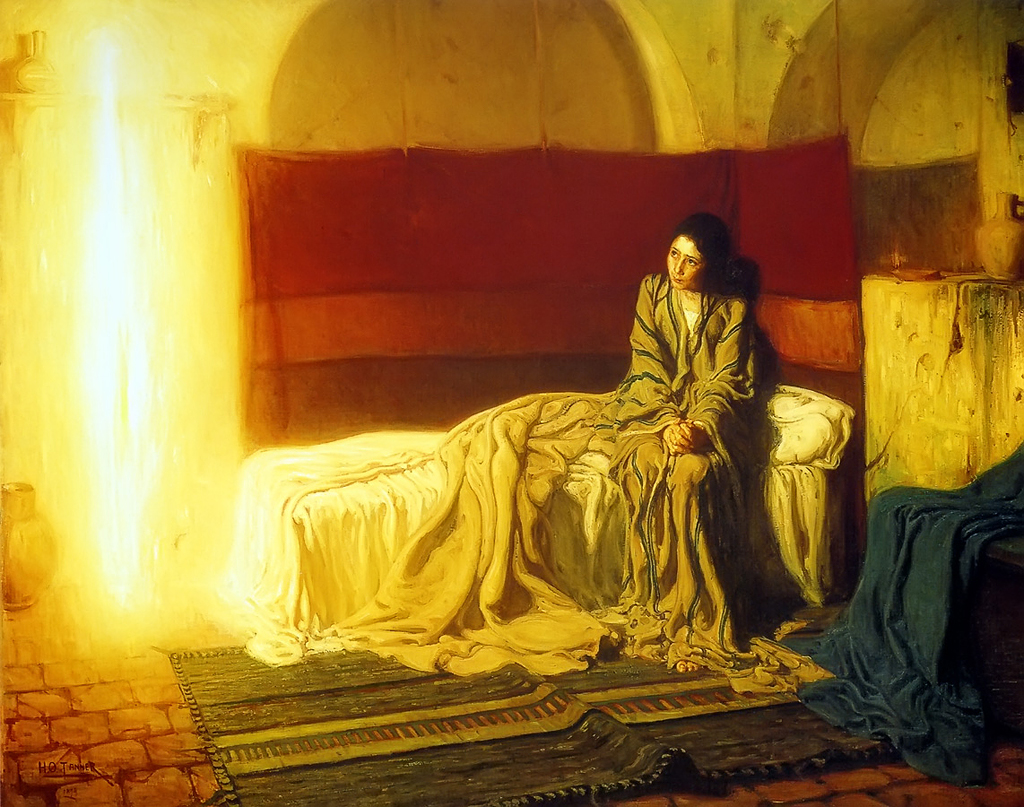
The Annunciation by Henry Ossawa Tanner, 1897

The Annunciation by Henry Ossawa Tanner, 1897

Mary, God’s Mother and mine,
you joyfully and fully responded to God’s call in your life.
Help me to respond to God’s plan for me with all my being,
as you did.
                                                                                                               – prayer taken from Discern It! app 

Happy Feast of the Annunciation! I was so deeply into the spirit of Lent and preparing for Holy Week that it was a bit of a shock this morning to pray the Gloria at Mass this morning…but how fitting to pray this canticle of praise on the feast of the Incarnation, the feast of Mary’s “yes” to becoming the Mother of God!

This is one of my favorite images of the Annunciation because it seems to capture Mary at a very ordinary, prosaic moment in her life, while at the same time emphasizing the mystery of the announcement–the angel Gabriel is brilliant but we cannot even distinguish the shape of his figure. At some point, I hope to offer here a guided meditation on discernment in the light of Luke 1:26-38 with this painting of the Annunciation. But for today as I seek to live in a spirit of discernment, I will carry in my heart Mary’s attentive gaze, her hands clasped in prayer, and her head tilted in wonder as she begins to grasp the radiance of God’s love for her and for all humanity.