Discernment & the People in Our Lives

characters-setI hope you had a blessed Easter week. It’s a felt joy to be back here, blogging. This post will pick up where we left off a couple of weeks ago, when we were exploring looking at our lives through a storytelling lens. Today, we’ll begin to look at how the people in our lives affect our discernment. We’ll do this in a fun way by exploring the concept of characters in dramatic storytelling. 

In any good story, the characters—hopefully a diverse and lively cast!—are the most important part.

Our lives—the truest, most important story to us—are brimming with characters! The main character—the protagonist—is key. After all, it’s the protagonist’s story! But we will also look at other “characters” or forces, in our lives, such as the antagonist who seeks to thwart the protagonist either because of a personal issue, or because he or she opposes the protagonist’s mission. Most of us have many “supporting characters” in our lives than would fit in the longest Dickens novel (people whom we count on as friends, rivals, mentors, or sidekicks).

The interplay between God and each person—and how God works through the freedom, words, choices, growth, and personality of each person—is too complex for us to fully grasp. But we know that God often chooses to work through people, so much so that he sent his only Son to take on our human nature and share our human life with us. Today, the Church offers the salvation Jesus won for us by his Passion, Death and Resurrection through human beings: through sacraments administered by a priest, within a community made up of flawed and beloved human beings each on their journey towards salvation.

We never make our discernment journeys alone. The people in our lives play an important role in that journey. We’ll begin with the most important “character” of all: the protagonist.

Discernment in Images: Entrusting Self to God

Discernment quote 4This is one of my very favorite insights into discernment: we trust God because God–in Christ–first trusts us! Discernment: a relationship of love, trust, and freedom.


Blessed Easter! I have taken this week away from this blog to catch up on another project for our centenary year (yes, 2015 is the 100th anniversary of the foundation of the Daughters of Saint Paul!), but I’ll be back next week. Thanks for your patience.

In the meantime, Sr. Margaret Michael Gillis, vocation director for the Daughters of Saint Paul in the USA and Canada, offers a two-minute audio reflection about discerning religious life here.


Good Friday Silence

On Good Friday, we make a day of silent retreat, contemplating the great gift of love that Jesus has made of himself. Here is a Good Friday reflection from our Pauline blog’s Lenten series, I Follow Light: 

You are in my prayers today!

Wonderful App for the Examen

GoodFriBlessings for Holy Week! You will all be in my prayers even though I’m taking a bit of a break from posting the book this week.

In the meantime I wanted to share with you an app that teaches and reminds us how to do the examen, a wonderful discernment tool and spiritual practice. The examen is a wonderful way to listen to God’s invitations in our life, helping us to look over our day and to be aware of how God is acting in our life, and how we’ve responded. The examen comes to us from the famous expert on discernment, St. Ignatius of Loyola, the founder of the Jesuits, who has influenced the Church greatly with his spirituality that focuses on discerning the will of God. One of the tools for discernment are his Spiritual Exercises–an in-depth retreat where the retreatant seeks to discover God’s will. A practical tool that everyone can use in everyday life is the examen of consciousness. 

The examen is a bit like the examination of conscience–examining our thoughts, words, actions, and omissions at the end of every day, or before we go to confession. But the examen is a bit different. Rather than  focusing on what we’ve done or haven’t done, the examen helps us to look over the day and focus on how God has invited us and worked in our lives during the day.

At http://www.theprodigalfather.org/ Father Michael Denk hosts the Examen App for iPhones, android phones, and tablets that can guide you through the examen–with written steps on the screen and videos. The app is free and contains a full explanation of how to pray the examen. It even has reminders that you can set so that you remember to take the time to pray the examen! If you have a moment, just visit his site now and download the app!

For those of you who don’t have a device with which to use the app, I’ll briefly share the steps of the examen below. Later, I’ll do a whole blog post on this powerful prayer and tool for discernment.

Steps for the Examen: 

1. Gratitude
Note the gifts of love God has given this day; give thanks

2. Petition
Ask God for insight and an open heart; ask God to show you what God wants of you this day

3. Review
With God, look over your day; pay attention to the stirrings of your heart; review your choices and responses

4. Forgiveness
Accept the love and forgiveness God gives you

5. Renewal
With God plan concretely how to live in accord with God’s desire for you

Journaling with the steps of the examen is very helpful, and Father Michael’s Examen app encourages you to do just that. For more explanations of the examen prayer, visit: http://www.ignatianspirituality.com/ignatian-prayer/the-examen/


God’s Will Is Love

Discernment quote 6

A fitting quote from Father Rupnik as we enter into Holy Week on Sunday! May we discover the Father’s love for us in a renewed and deeper way as we contemplate Jesus’ great love for us on the Cross. (Quotation from Discernment: Acquiring the Heart of God by Father Marko Ivan Rupnik, SJ.)

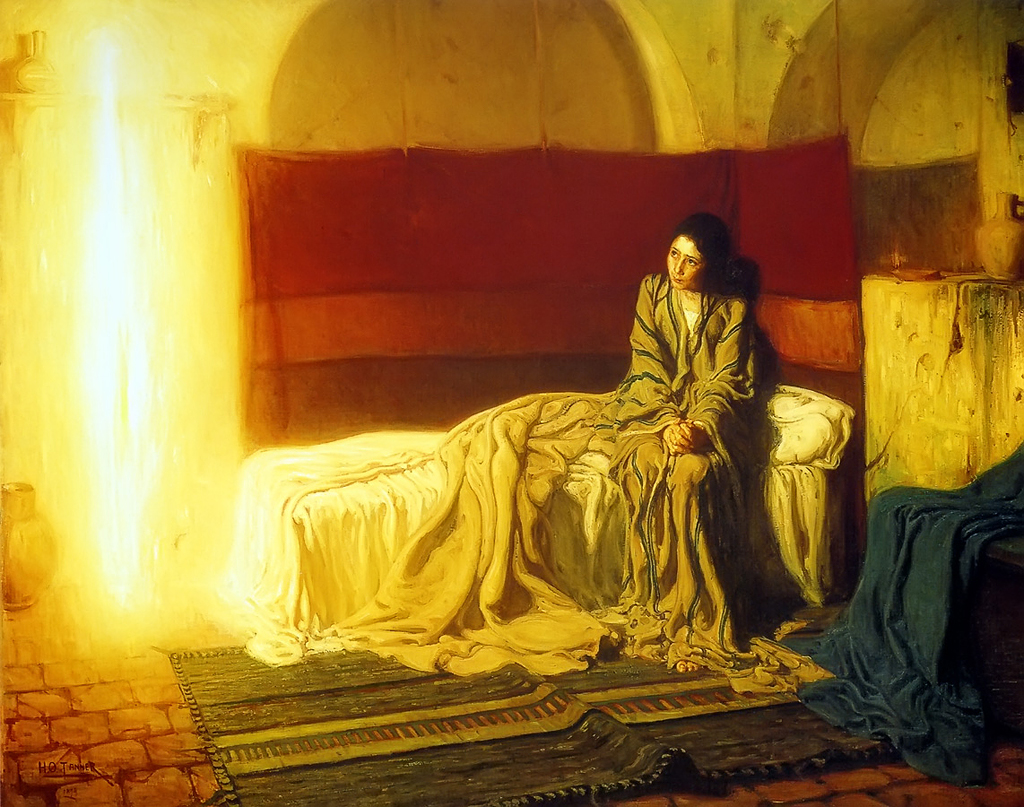
Mary at the Annunciation: Model of Discernment

The Annunciation by Henry Ossawa Tanner, 1897

The Annunciation by Henry Ossawa Tanner, 1897

Mary, God’s Mother and mine,
you joyfully and fully responded to God’s call in your life.
Help me to respond to God’s plan for me with all my being,
as you did.
                                                                                                               – prayer taken from Discern It! app 

Happy Feast of the Annunciation! I was so deeply into the spirit of Lent and preparing for Holy Week that it was a bit of a shock this morning to pray the Gloria at Mass this morning…but how fitting to pray this canticle of praise on the feast of the Incarnation, the feast of Mary’s “yes” to becoming the Mother of God!

This is one of my favorite images of the Annunciation because it seems to capture Mary at a very ordinary, prosaic moment in her life, while at the same time emphasizing the mystery of the announcement–the angel Gabriel is brilliant but we cannot even distinguish the shape of his figure. At some point, I hope to offer here a guided meditation on discernment in the light of Luke 1:26-38 with this painting of the Annunciation. But for today as I seek to live in a spirit of discernment, I will carry in my heart Mary’s attentive gaze, her hands clasped in prayer, and her head tilted in wonder as she begins to grasp the radiance of God’s love for her and for all humanity.

Begin Where We Are

Happy little girlAt any point in our journey—especially when we begin or deepen our discernment, it’s important to begin where we are, because God is always “here” with us (wherever “here” is). This is true for two reasons:

1) First, God is faithful and would never abandon us, and

2) Because wherever we find ourselves, God wills or allows us to be here and is at work in our life at this precise time and place. The present moment is where we can find God and do God’s will. “Now is the day of salvation!” Saint Paul reminds us (2 Cor. 6:2)

Beginning where we are can be hard for us if we’re not happy or struggling. It’s easy to recognize God’s presence in the good things in our lives, when we’re happy. It’s harder for some of us to discover God’s presence when we’re struggling, because we think the struggle is an obstacle to God. We may want our “new beginning” to be an escape from the struggles in our life, but it’s more likely that beginning anew will help us to see our challenges in a new way, so that the struggle can become the very thing that helps us draw closer to God. Our worst struggle can actuallyl become a steppingstone to God.

Several years ago, a friend of mine started suffering from a respiratory illness. She repeatedly caught the flu, which lasted for two months and agitated her usually dormant asthma. Used to walking twelve miles a week, she now struggled to walk up one flight of stairs. Some days, breathing took so much effort that she stayed in bed.

For two years, she suffered this illness off and on. At first, the restrictions of her activity agitated and frustrated her. Although she was forced to slow down physically, she continually focused on all of the things she couldn’t do, or had to give up doing. And she’d push herself to get up sooner, to be more active, and then end up sicker than before.

But during the second year, she finally accepted her condition. And when she did, she started seeing possibilities. Being forced to slow down gave her an opportunity to pray, read, and reflect more. She became more present to her family because she wasn’t always rushing off. She started to realize that, whether she was well or ill, she didn’t want to rush around as much as she had been doing. Accomplishing more was not what was most important to her. She had the time to think about what was most important in her life, and to set those as her priorities for both when she was sick and when she got well.

Accepting her illness didn’t just enable my friend to take care of herself and recover, but it also became a gift, an opportunity for her to reset her priorities in life. Her illness became a steppingstone towards discerning a more serene lifestyle.

Pen_Uncapped

To journal with:

What do I have trouble accepting in my life right now?
How might God be inviting me or challenging me to grow through this struggle?

Using a Storytelling Lens in Discerning

OLYMPUS DIGITAL CAMERA

In discerning where God is calling us, it can be helpful to see our lives within this context of God’s Story of Love. In this blog/book, I’d like to continue using the storytelling lens to help us to explore discernment. What are the various elements common to every story?

  • Premise—Our story’s beginning or set up, which includes a story promise that will be fulfilled. In this case, the story promise is made by, and will be fulfilled by, God!
  • Setting—The world and circumstances in which the story takes place
  • Worldview—the perspective from which the story is told. We looked at this earlier, calling it God’s Storyview.
  • Plot—What happens in our story and why (the series of events that take place in the story; the plot could also be called the story)
  • Story Structure — How a story is organized. Whatever the structure, every story always has a beginning, middle, and end.
  • Theme—What our story is really about
  • Characters—Who is in the story
  • Protagonist—The main character of our story; often this is the character who changes the most
  • Antagonist—The character or force that prevents the protagonist from reaching his or her goal
  • Supporting characters: Friend, Rival, Sidekick, Mentor, Trickster, etc.
    (Each character has:

    • Character goal—What the character wants
    • Character need—What the character needs in order to be truly happy or fulfilled. This is often very different from what the character wants
    • Character arc—How the character grows or changes (often interiorly) through the the story

I think there are a lot of parallels between various story elements and certain aspects of discernment. For example, we can look at the concept of “supporting characters” in light of discernment. No discernment happens in a vacuum, and in bigger discernments—such as a vocational discernment—we surely need the support of others. But sometimes we forget this, and we can try to discern all alone. Reflecting on the support we have and the support we need in our discernment can really help us on our discernment journeys.

Pen_Uncapped

To Journal About:

Revisit our “Story Premise”—the truth upon which we base our discernment: Our all-good God loves us and always wants what is good and best for us. How would you re-phrase this for the story of your life?