Wonderful App for the Examen

GoodFriBlessings for Holy Week! You will all be in my prayers even though I’m taking a bit of a break from posting the book this week.

In the meantime I wanted to share with you an app that teaches and reminds us how to do the examen, a wonderful discernment tool and spiritual practice. The examen is a wonderful way to listen to God’s invitations in our life, helping us to look over our day and to be aware of how God is acting in our life, and how we’ve responded. The examen comes to us from the famous expert on discernment, St. Ignatius of Loyola, the founder of the Jesuits, who has influenced the Church greatly with his spirituality that focuses on discerning the will of God. One of the tools for discernment are his Spiritual Exercises–an in-depth retreat where the retreatant seeks to discover God’s will. A practical tool that everyone can use in everyday life is the examen of consciousness. 

The examen is a bit like the examination of conscience–examining our thoughts, words, actions, and omissions at the end of every day, or before we go to confession. But the examen is a bit different. Rather than  focusing on what we’ve done or haven’t done, the examen helps us to look over the day and focus on how God has invited us and worked in our lives during the day.

At http://www.theprodigalfather.org/ Father Michael Denk hosts the Examen App for iPhones, android phones, and tablets that can guide you through the examen–with written steps on the screen and videos. The app is free and contains a full explanation of how to pray the examen. It even has reminders that you can set so that you remember to take the time to pray the examen! If you have a moment, just visit his site now and download the app!

For those of you who don’t have a device with which to use the app, I’ll briefly share the steps of the examen below. Later, I’ll do a whole blog post on this powerful prayer and tool for discernment.

Steps for the Examen: 

1. Gratitude
Note the gifts of love God has given this day; give thanks

2. Petition
Ask God for insight and an open heart; ask God to show you what God wants of you this day

3. Review
With God, look over your day; pay attention to the stirrings of your heart; review your choices and responses

4. Forgiveness
Accept the love and forgiveness God gives you

5. Renewal
With God plan concretely how to live in accord with God’s desire for you

Journaling with the steps of the examen is very helpful, and Father Michael’s Examen app encourages you to do just that. For more explanations of the examen prayer, visit: http://www.ignatianspirituality.com/ignatian-prayer/the-examen/


Mary at the Annunciation: Model of Discernment

The Annunciation by Henry Ossawa Tanner, 1897

The Annunciation by Henry Ossawa Tanner, 1897

Mary, God’s Mother and mine,
you joyfully and fully responded to God’s call in your life.
Help me to respond to God’s plan for me with all my being,
as you did.
                                                                                                               – prayer taken from Discern It! app 

Happy Feast of the Annunciation! I was so deeply into the spirit of Lent and preparing for Holy Week that it was a bit of a shock this morning to pray the Gloria at Mass this morning…but how fitting to pray this canticle of praise on the feast of the Incarnation, the feast of Mary’s “yes” to becoming the Mother of God!

This is one of my favorite images of the Annunciation because it seems to capture Mary at a very ordinary, prosaic moment in her life, while at the same time emphasizing the mystery of the announcement–the angel Gabriel is brilliant but we cannot even distinguish the shape of his figure. At some point, I hope to offer here a guided meditation on discernment in the light of Luke 1:26-38 with this painting of the Annunciation. But for today as I seek to live in a spirit of discernment, I will carry in my heart Mary’s attentive gaze, her hands clasped in prayer, and her head tilted in wonder as she begins to grasp the radiance of God’s love for her and for all humanity.

Begin Where We Are

Happy little girlAt any point in our journey—especially when we begin or deepen our discernment, it’s important to begin where we are, because God is always “here” with us (wherever “here” is). This is true for two reasons:

1) First, God is faithful and would never abandon us, and

2) Because wherever we find ourselves, God wills or allows us to be here and is at work in our life at this precise time and place. The present moment is where we can find God and do God’s will. “Now is the day of salvation!” Saint Paul reminds us (2 Cor. 6:2)

Beginning where we are can be hard for us if we’re not happy or struggling. It’s easy to recognize God’s presence in the good things in our lives, when we’re happy. It’s harder for some of us to discover God’s presence when we’re struggling, because we think the struggle is an obstacle to God. We may want our “new beginning” to be an escape from the struggles in our life, but it’s more likely that beginning anew will help us to see our challenges in a new way, so that the struggle can become the very thing that helps us draw closer to God. Our worst struggle can actuallyl become a steppingstone to God.

Several years ago, a friend of mine started suffering from a respiratory illness. She repeatedly caught the flu, which lasted for two months and agitated her usually dormant asthma. Used to walking twelve miles a week, she now struggled to walk up one flight of stairs. Some days, breathing took so much effort that she stayed in bed.

For two years, she suffered this illness off and on. At first, the restrictions of her activity agitated and frustrated her. Although she was forced to slow down physically, she continually focused on all of the things she couldn’t do, or had to give up doing. And she’d push herself to get up sooner, to be more active, and then end up sicker than before.

But during the second year, she finally accepted her condition. And when she did, she started seeing possibilities. Being forced to slow down gave her an opportunity to pray, read, and reflect more. She became more present to her family because she wasn’t always rushing off. She started to realize that, whether she was well or ill, she didn’t want to rush around as much as she had been doing. Accomplishing more was not what was most important to her. She had the time to think about what was most important in her life, and to set those as her priorities for both when she was sick and when she got well.

Accepting her illness didn’t just enable my friend to take care of herself and recover, but it also became a gift, an opportunity for her to reset her priorities in life. Her illness became a steppingstone towards discerning a more serene lifestyle.

Pen_Uncapped

To journal with:

What do I have trouble accepting in my life right now?
How might God be inviting me or challenging me to grow through this struggle?

Listening to the Word of God: Lectio Divina guide

IMG_0005A wonderful way of listening to the Lord—and perhaps one of the first that we should practice—is praying with the Bible. For the past fifty years, the Church has encouraged all Catholics to re-discover lectio divina, a particular way of praying with the Bible that has its roots in the third century (with Origen specifically encouraging it as the way to read Scripture), and then later in the early monastic communities (especially the Benedictines). Lectio divina continued to be practiced through the ages by monastic communities, but in his Apostolic Exhortation Verbum Domini, Pope Benedict XVI highly encourages all of us to do lectio divina. Why? Because lectio divina is “capable of opening up to the faithful the treasures of God’s word, but also of bringing about an encounter with Christ, the living word of God.” (Scroll down to #87 for Pope Benedict’s description of how to do lectio.)

Traditionally, lectio divina has four steps, but Pope Benedict recommended adding a fifth without which lectio divina wouldn’t be complete. (There are other methods of lectio divina that have developed over time, too, but here we’ll stay with the traditional structure.) The five-step structure isn’t meant to be rigidly followed; rather, it’s meant to help us to engage with the Word of God with our whole being. It’s important when praying to follow where the Holy Spirit leads us; if we are drawn to stay or “rest” on one step during our prayer, that’s what we should do!

Here is a very short guide to making lectio divina, inspired by Pope Benedict’s short description in Verbum Domini and my own experience of prayer.

*To prepare, set aside some quiet time for prayer, and choose a Scripture passage. If you are new to lectio divina, a passage from the Gospels is a good place to start. Choosing the Gospel reading from Sunday or daily Mass can often be helpful.

Step 1. Lectio (Reading). Read the passage slowly and reflectively, listening attentively. What is the biblical text saying? 

Step 2. Meditatio (Meditation). Re-read the passage a second time, asking the question, What does the biblical text say to me in my circumstances? Listen especially for a particular word or phrase that strikes you more than the others—perhaps a word resonates with you; perhaps a sentence raises a question or even some disquiet. Let that word or phrase enter deep into your awareness and then reflect on it: why does this word appeal to me or disturb me? How is the Lord speaking to me?

Step 3. Oratio (Prayer). Speak to God about what is happening inside of you as you spend time with his Word. Prayer is a dialogue with God, and this is where you can respond to God’s Word. Perhaps the Word of God is comforting you—thank God for his comfort and strength. If the Word is challenging you or raising questions in you, ask God for the grace to understand and live his Word.

Step 4. Contemplatio (Contemplation). Contemplation is a time to take on God’s way of seeing. As you rest under God’s loving gaze, ask the Lord how he is inviting you to convert. What needs to change in your mind, will, life?

Step 5. Actio (Action) Take the Word of God with you back into your daily life. You can live the Word of God in your day by choosing to take on an attitude or particular action in the spirit of the invitation God extended to you as you prayed with the Scripture passage. 

The guided lectios provided on this blot are meant to help those who are just beginning with lectio divina. If  you choose to pray with them, I encourage you to go back later and pray with the Scripture passages on your own, using the above simple guide.

Listening to Our “Silent” Co-Author

02E choice 2How do we listen to God’s voice when for most of us most of the time, God seems silent? How do we partner with a silent Co-Author?

We may experience God as silent, but God does communicate with us. We may need to learn to listen better, but we also may need to learn to understand how God speaks to us, and recognize when God is speaking. Each of us has a unique relationship with God, but there are also common ways in which God communicates with us.

If we look at the Bible, how does God communicate to his People?

  • Directly to the heart—sometimes in prayer, sometimes through intuition, sometimes in words
  • Through Divine Revelation: through his Word and the teaching of the Church
  • Through silence
  • Through other people (God sends prophets or other people to communicate his love, his warnings, and his invitations)
  • Through the beauty and power of nature (for one example, see Psalm 8)
  • Through the community, most especially through the community of the Church (the Acts of the Apostles is full of examples)
  • Through wise mentors
  • Through the needs of others
  • Through the ordinary circumstances of our lives
  • And sometimes through the extraordinary: visions/appearances/dreams/miracles (Sometimes we may experience a miracle but not recognize it as miraculous.)

God speaks to us today, in our own lives. How am I listening?

Pen_Uncapped

To Journal About

  • How does God communicate with me?
  • When have I heard God “speaking” to me?

Put Out into the Deep! Lectio for Those Discerning

“Put Out into the Deep!”

Discerning with the Word: A Guided Lectio Divina for Those Discerning
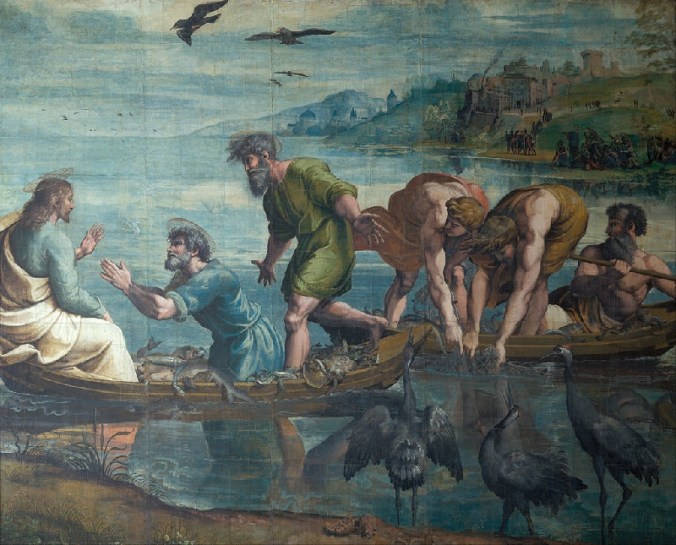
The Miraculous Draft of Fishes – Raphael – Public Domain


Introduction: At certain moments in our discernments, the lack of clarity about the path ahead and the letting go of past ways of doing things to make room for the “new” that God is working in our lives, can cause a sense of timidity, uncertainty, or fearfulness within us. Jesus reminds us, “Do not be afraid!” 

(As noted in the Lectio Divina Guide for Those Discerning, a wonderful way of listening to the Lord—and perhaps the first that we should practice—is praying with the Bible through lectio divina. This guided lectio is provided to help those who are just beginning with lectio divina. If  you choose to pray with this guide, I encourage you to go back later and pray with this passage from Luke on your own, using this simple guide.)

Lectio: Luke 5:1-11

Once while Jesus was standing beside the lake of Gennesaret, and the crowd was pressing in on him to hear the word of God, he saw two boats there at the shore of the lake; the fishermen had gone out of them and were washing their nets. He got into one of the boats, the one belonging to Simon, and asked him to put out a little way from the shore. Then he sat down and taught the crowds from the boat. When he had finished speaking, he said to Simon, “Put out into the deep water and let down your nets for a catch.” Simon answered, “Master, we have worked all night long but have caught nothing. Yet if you say so, I will let down the nets.” When they had done this, they caught so many fish that their nets were beginning to break. So they signaled their partners in the other boat to come and help them. And they came and filled both boats, so that they began to sink. But when Simon Peter saw it, he fell down at Jesus’ knees, saying, “Go away from me, Lord, for I am a sinful man!” For he and all who were with him were amazed at the catch of fish that they had taken; and so also were James and John, sons of Zebedee, who were partners with Simon. Then Jesus said to Simon, “Do not be afraid; from now on you will be catching people.” When they had brought their boats to shore, they left everything and followed him.

Read through this reading slowly and attentively at least twice. Take your time with it.

Meditatio

This reading has a wealth of meanings. For this lectio, let’s focus on three lines of the conversation between Jesus and Simon Peter:

  • Put out into the deep
  • Go away from me, Lord, for I am a sinful man!
  • Do not be afraid; from now on you will be catching people.

“Put out into the deep.” Up to this point in the Gospel of Luke, Simon Peter doesn’t know Jesus very well yet, except that Jesus healed his mother-in-law (Luke 4). It seems this is the first time that Jesus invites Simon to do something, and it is to step forward in faith in him. It’s an unusual request probably for a number of reasons; the impulsive fisherman mentions only two of them—the fish aren’t biting, and night time is better for catching fish. What is it about Jesus’ request or in his gaze that makes Simon Peter continue on, “…yet if you say so…” and follow Jesus’ invitation?

While Simon Peter was probably pretty familiar with the lake, I am not so familiar with “the deep.” It’s hard for me sometimes to follow Jesus’ invitation when I can’t clearly see the path ahead, when I don’t know “how deep,” or “how far” I’m being asked to go. But I have no need to be afraid because, like Simon Peter, I have Jesus in the boat with me. Jesus would never ask me to take a step forward in faith and then abandon me. He will be with me every moment of my discernment, every moment of my journey.

“Go away from me, Lord, for I am a sinful man!” I really identify with Peter’s words as he witnesses Jesus’ goodness and miraculous power. Peter is in touch with his humanity and his sinfulness. And it’s fitting that we acknowledge our need for forgiveness, for conversion, not just in the challenging moments of our journey, but also in the seemingly miraculous ones.

The truth is that none of us are “worthy” of Christ. Yet our relationship with Jesus is not about being worthy, or becoming worthy. Our relationship with Christ is about Christ loving us first. Jesus is not concerned with “how” unworthy I am, because it only means that I am more aware of how much I need his saving love. And Jesus delights in saving us.

“Do not be afraid; from now on you will be catching people.” Jesus repeats “Do not fear,” in the Gospels over and over again. It might be tiresome to others, but for me, it’s a message I need to hear especially when I’m invited to take a step of faith, when I’m invited to “put out into the deep.” The reason we do not have to be afraid? Because from now on, we are Christ’s. When we belong to Christ, we can trust in his faithful love for us.

Christ’s invitation to follow him is implied here. And Christ’s invitation isn’t just for Peter alone. In essence, Jesus is inviting them, “Help me with my mission of ‘catching people,’ of attracting people to salvation in me.” It was an irresistible invitation for Simon and the other fishermen who were called.

Our call and our mission are so deeply connected that usually we cannot discern one without the other. Often, it’s just when we feel least worthy that Jesus calls us to share in his mission! And his call to us to be close to him is genuine: there is no way to draw closer to Jesus than by sharing in his thirst for others’ salvation.

Contemplatio

“Put out into the deep water.” What is the “deep water” that Jesus invites me to? How do I need to change or grow to respond to Jesus’ invitation?

Oratio – Prayer To Live God’s Loving Plan

Lord, from all eternity,
You know me, choose me,
love me, and call me.

Every day You invite me
to a life full of joy, love, and meaning!
You call me to become more truly myself,
and more of You.

You who love me through and through, 
and know every stirring of my heart,
have gifted me with a unique calling
where the world’s deepest needs
meet my deepest joy.

Grant me the openness to hear Your invitation,
the faith to trust Your love,
the courage to choose You, Master, as You have chosen me,
and a generous heart 
that falls ever more deeply in love with You.

Mary, God’s Mother and mine,
you joyfully and fully responded to God’s call in your life.
Help me to respond to God’s plan for me with all my being,
as you did. Amen.

Actio

Choose a way in which to respond to Christ’s invitation to you today in your daily life.

Note: I apologize for not posting the past week: I came down with the flu, and am only now feeling better. Over the next three months, I am doing some traveling for promoting my book, Soul of Christ: Meditations on a Timeless Prayer, but hopefully I’ll still be able to post three times a week…  God bless you!

2015 Reminds Us: God Re-Creates Us Every Day!

2015 has begun. I love new beginnings (perhaps that’s why I love early mornings!). The freshness of a new year reminds us that God re-creates us every day! I begin this New Year, praying for all of you who are reading this blog, have emailed me, commented, or started to follow the blog: that you will receive the grace to hear and respond generously to God’s invitation. And I entrust all of us (including myself) to the intercession of Mary, our Blessed Mother and Queen, whose generous yes is the model for our yes: “Behold the handmaid of the Lord.” This is one of my favorite hymns to Mary, who always leads us to Christ:


The WordPress.com stats “helper monkeys” prepared a 2014 annual report for this blog. Considering that the blog is just over a month old, the stats are pretty amazing. A big thanks to all of you readers who have helped get this blog off the ground! I look forward to posting in the new year…

Here’s an excerpt from the report:

A New York City subway train holds 1,200 people. This blog was viewed about 7,800 times in 2014. If it were a NYC subway train, it would take about 7 trips to carry that many people.

Click here to see the complete report.

God Dreams with Us – Part 2

01A choice 1In discerning God’s will, neither scruples nor a careless “whatever goes” attitude is helpful. God is close and wants to reveal himself to each of us. Discerning God’s story for us involves a lot of listening, but that’s because we are usually spiritually hard of hearing. God not only wants to communicate his love and his plan for us, he wants to work out that plan with our full participation, which includes our making choices. Our full participation doesn’t, however, mean that we can see the whole picture: seeing the full story is a surprise that awaits us in heaven. (Read Newman’s “I am created to do something or to be something for which no one else is created” for Blessed John Henry Newman’s take on this.) Instead, God’s story for us unfolds step by step, giving us what we need to know to do his will, to live his dream for us.

There are many times when I’ve been grateful for how God has led me through a particular circumstance, and afterwards I see how it was really important for me to go through. But I’m really glad I didn’t know all of what was involved ahead of time, because I know I would have worried so much about it that my fear would probably have made me resist God’s plan for me. I might not have truly believed that God’s grace would be there for me to help me.

God gives us the grace to live the present moment, not the future. For me, worrying ahead of time can lead to fear and resistance to God’s grace. And then the gifts and the growth that could come from that experience would be lost.

Most likely, we will not fully understand all of God’s plan for us while we’re here on earth. The best choice and the most important attitude we have is to seek God’s will. As we figure out what that means, and as our heart is purified to ignore other distractions and truly seek God’s will, God can work with our faltering steps.

* * *

Prayer Corner: Pray with Your Dreams

Have you ever prayed about your dreams? Take a few moments and journal:

  • What were your childhood dreams? What did you picture yourself doing when you were younger? How did you see yourself living your life?
  • What are your dreams now?

Bring this list of dreams to prayer and share them with God. Take a few moments to offer each dream individually to God. 

After your prayer, how do you feel about your dreams for your life?