How Does God See Us?

KONICA MINOLTA DIGITAL CAMERAA second way to grow in our true and deeper understanding of ourselves is to pray with Scripture passages that help us to understand who we are: who we are created to be, who we are called to be. From Genesis to Revelation, the Bible is full of God’s understanding of who we are, God’s love for us, God’s invitation for us to grow into “other Christs.”

If we have been praying with the Scriptures for several years or more, we might find it helpful to look back at our spiritual journey and make note of the Scripture passages that were foundational for our journey in Christ. These key Scripture passages resonated with us in part because they told us who we are in God’s eyes, and how God is inviting us to become our best selves in Christ. Picking 5 or 6 of these Scripture passages to go back to and pray with can be very helpful in reaffirming our true identity: as children of God, as disciples of Christ, as sent by the Spirit.

For those who’d like, here is a short list of passages from the Bible that affirm our identity in God, in Christ. Please add your favorite passage to this list in the comments below, and I’ll add them in!

  • Isaiah 43:1-7
    God speaks to us: “You are precious in my eyes, and honored, and I love you.”
  • Psalm 139
    “O Lord, you search me and you know me.”
  • Ephesians 1:3-10
    “He chose us in him before the world began.”
  • Ephesians 2:4-5
    “But God, who is rich in mercy, out of the great love with which he loved us, even when we were dead through our trespasses, made us alive together with Christ.”
  • Zephaniah 3:17
    “The Lord your God is in your midst,
         a warrior who gives victory;
    he will rejoice over you with gladness,
    he will renew you in his love;
    he will exult over you with loud singing.”
  • John 15:15
    “No longer do I call you servants, for the servant does not know what his master is doing; but I have called you friends, for all that I have heard from my Father I have made known to you.”
  • 1 Corinthians 6:19
    “Do you not know that your body is a temple of the Holy Spirit within you, which you have from God? You are not your own; you were bought with a price. So glorify God in your body.”
  • Ephesians 2:10
    “For we are his workmanship, created in Christ Jesus for good works, which God prepared beforehand, that we should walk in them.”
  • 1 Peter 2:9
    “But you are a chosen race, a royal priesthood, a holy nation, God’s own people, that you may declare the wonderful deeds of him who called you out of darkness into his marvelous light.”

SeeYourselfCoverFor guided meditations on discovering who we are in God’s eyes, you can check out my book, See Yourself Through God’s Eyes: 52 Meditations To Grow in Self-Esteem.  You can also check out the app (free on iTunes, .99 on GooglePlay) or other free resources here.

Discovering Our True Identity: Essential for Discerning

06 AA Sr EmmaualIf our “false self”—the self driven by sin and by a false identity—is sometimes our greatest obstacle on our discernment journey, our “true self” is one of our greatest allies in our discernment journey.

The closer we grow to Christ, the more we start to see the world, others, and ourselves, with the eyes of Christ. What is our true identity? As discussed earlier, we find our true identity in God. Two ways to come to a truer sense of ourselves immediately stand out: Seek self-knowledge and learn to see ourselves through God’s eyes.

1. Seek self-knowledge

Getting to know ourselves—without false vanity, without the shadow of sin—is true humility. Self-knowledge is often marred by two opposite tendencies—sometimes simultaneously. Either 1) we ignore our faults altogether and become prideful, attributing our gifts to ourselves rather than God, or 2) we fall into the slump of seeing ourselves too negatively, only seeing our faults and limitations.

Genuine self-knowledge comes through prayer, living reflectively (especially through the examen), and openness to discovering the truth about ourselves.

Humility is knowing ourselves as graced and weak, blessed and sinful. If we can become comfortable in this truth about ourselves, then we are much less likely to get in our own way on our discernment journey. Humility can be uncomfortable, especially when our illusory image of ourselves as overly powerful and in control is shattered. In these moments, it can be helpful to cling to God’s love, in which we can find the true anchor of our identity. Isaiah 43:4 is a great reminder: “You are precious in my sight, and honored, and I love you.”

We can pray for self-knowledge to the Holy Spirit, asking especially for the gifts of the Holy Spirit. In his Confessions, Saint Augustine offers a prayer for self-knowledge: “Let me know Thee, O Lord, who knowest me: let me know Thee, as I am known” (Confessions, Book X). The following Petitions of Saint Augustine is a beautiful and powerful prayer that is helpful to pray regularly. I’ve adapted it slightly for today’s usage.

LORD JESUS, may I know myself and know You, and desire nothing else but You.

May I hate my [false] self and love You.

May I do everything for the sake of You.

May I humble myself and exalt You.

May I think of nothing except You.

May I die to myself and live in You.

May I receive whatever happens as from You.

May I banish self and follow You, and ever desire to follow You.

May I fly from myself and fly to You, that I may deserve to be defended by You.

May I fear for myself and [be in awe of] You, and be among those who are chosen by You.

May I distrust myself and trust in You.

May I be willing to obey on account of You.

May I cling to nothing but to You.

May I be poor for the sake of You.

Look upon me that I may love You.

Call me that I may see You, and ever and ever enjoy You.  Amen.

Back from Hiatus

hand-226358_1280for being so patient with me these past few weeks!

I’m back from my blogging/mostly offline hiatus. It is a real joy to be back online and blogging again! Posting three times a week has really pushed me to  come quite far writing the book on discernment, but it’s also proven to be quite challenging to keep up with. By the end of summer, I know I was barely hanging in there. I think I finally went into “overload” mode these past couple of weeks—in part because I’d fallen behind posting, but also because of other responsibilities that have arisen.

One benefit to all of this is that out of sheer necessity, I’ve been trying to live in the spirit of discernment even more than usual during these past couple weeks. So I have some more personal experiences and stories to share with regard to discerning day-to-day. Another (probably the best) benefit to you is that when I miss a blogpost, I pray extra for you, that you will receive the insights and graces that you need for your next step in your discernments! You have been in my prayers more than usual.

But I’m really excited to be back here writing. I’m trying to plan things out so that if it once again becomes impossible to blog regularly, I can at least post once or twice a week until I’m able to make time again.

From November 1-7, 2015, we celebrate National Vocation Awareness Week here in the USA. The United States Conference of Catholic Bishops (the USCCB) designated this week to encourage a culture of vocations specifically for priesthood, diaconate, and religious life. (In general, a vocational culture also includes discerning a possible vocation to marriage or single life.) Here are some recommended resources for parishes, families, and religious education–click on the link for National Vocational Awareness Week, English or Spanish. During that week, I hope to highlight a few other resources for encouraging openness to the call to consecrated or ordained life in the family that I’ve recently come across.

And just a reminder, please feel free to share your insights about discernment and your discernment journey with other readers through the comments. I love hearing from you, and also receiving your questions! The best way to reach me is here on the blog or via email. (Although you can find me on Twitter and Facebook, I am not able to maintain a consistent enough presence to be sure that I will receive your messages in a timely manner.)

Discernment Tip: Give Everything Its Proper Place

The best discernments are those in which the person discerning makes a journey towards interior freedom. In other words, they are no longer constrained by unhealthy attachments to nonessentials—things like others’ opinions, our comfort, or anything other than God’s loving will.

Everything has its place in creation, and God has given us many gifts in order to live fully. When we give a created thing more importance than it deserves, we call that an unhealthy attachment. Unhealthy attachments prevent us from having the freedom to recognize and respond to God’s will.

Here’s a petty (but realistic) personal example: I like sitting in the same place in chapel every day. The prayerbooks that I keep at that place, and the familiar view helps me to enter into prayer. But our chapel is free for everyone to use, and sometimes another person will take the place I usually take. When I find someone sitting there, I pay attention. If I’m mildly irritated because I’m inconvenienced, that’s normal. If however, I become upset because someone took “my place,” then I’ve got a problem. I’ve become attached to a particular spot of a wooden pew. I’ve made it more important than it really is.

As human beings, it’s really easy for us to become too attached to things that really aren’t very important. If you have a favorite book, movie, dessert, or sport, you know this temptation—even if you haven’t given in to it! It’s also easy for us to become unhealthily attached to other people—for example, we can rely too much on what someone else thinks of us. If we enjoy a particular friendship but find ourselves jealous when that friend spends time with someone else, we may have an attachment to our friend that is unhealthy.

The attachments that are hardest for me to recognize, though, are the interior ones—for example, to my own way, opinions, or desires.  Certain work by its very nature requires flexibility. If someone cannot be flexible about the way that they work, becoming angry whenever they collaborate with someone else, this is a sign that they could be too attached to their way of doing things. It’s fine to have a preference for a way of doing something, but when we overreact or refuse to try something a new or different way, then it’s possible that we’ve become too attached to our own way. This attachment can prevent us from receiving God’s inspiration.

A disordered attachment to anything or anyone can become an obstacle to freedom because it puts something else in the place of God’s will. Healthy detachment can help us to regain our freedom.

To Pray With

We can begin by listening to Jesus’ words in the Gospel, where Jesus reminds us that where our treasure is, our heart will also be. Pray with Matthew 6: 19-21. What do we treasure in our life? Do we truly treasure our relationship with God above everything else?

NOTE: For the rest of this week, I’m taking a break from blogging to cover Pope Francis’ visit to the U.S., and I’d like to encourage you to take a break, too. Let’s truly listen and take in the words of Pope Francis to us! Especially if you are discerning your vocation or a decision about ministry, God may inspire you through the Pope’s words and presence. I’ll return to blogging about discernment after the Pope’s visit, on September 30th.

Mary: the Freest Woman Who Ever Lived

06P pixabay 2As we continue our discernment journey, striving for the freedom to see, understand, and live God’s Story for us, we find both helps and obstacles along the way. Many of the helps which can guide us we have already looked at: praying—especially with the Word of God, self-knowledge, the examen, our friends, a spiritual director, other mentors, the community, the Church, the circumstances of our daily life. The obstacles may be unexpected, especially because if we seek God’s will, God should clear the path for us, right? Unfortunately, doing God’s will has nothing to do with how easy or hard something is, nor how many obstacles we face.

Because of original sin, our own tendency towards sin, and our personal history of sin, none of us live the full potential of God’s Story for us. Original sin has “messed up” not just us individually but God’s creation. Yet, original sin has not changed God’s desires or ultimate plan for us, not has it taken away our freedom.

The consequences of sin in our lives make it harder for us not only to see God’s viewpoint, but also to live our stories in all their fullness and beauty. But they don’t change our call, nor our potential. Getting to know the obstacles in our discernment—obstacles to listening, to freedom, to responding generously to God’s call—is helpful for facing them, especially when they are unexpected.

virgin-335500_1280One guide to freedom is Mary, the Mother of Jesus. The saints remind us frequently that devotion to Mary is the surest and quickest way to grow in our following of Christ, in seeking and doing God’s will. Perhaps this is because Mary, whom we as Catholics believe was preserved free from all sin, is the freest human being who ever lived! She was free enough to receive the angel Gabriel’s impossible announcement and then to give an impossible yes—a yes which she must have known would lead her not just to tremendous joy, but also to great suffering as the Mother of the Suffering Servant.

Mary was not stifled by selfishness, pride, or any other of sin’s enslavements. She who listened to and lived the Word of God most freely and attentively in her life is eager to help us to draw closer in freedom to her Son.

To Pray With

Pray a decade of the Rosary, asking Mary for the grace to be free enough to listen to and respond to Jesus’ invitations in all the events of your daily life. (If you aren’t familiar with praying the Rosary, you can find an easy “how to” here: http://www.usccb.org/prayer-and-worship/prayers-and-devotions/rosaries/how-to-pray-the-rosary.cfm) I highly encourage you to consider praying the Rosary—which is a wonderful way of praying with Scripture and the mysteries of the lives of Jesus and Mary— and making it a frequent part of your prayer routine.

The Mission Entrusted To You by God

This beautiful reflection by Blessed John Henry Newman can inspire us and offer direction to us both as we discern our mission, or as we struggle to respond to the challenges of taking the next step forward in our mission:

06N PixabayGod has created me to do Him some definite service;
He has committed some work to me which He has not committed to another. I have my mission—I never may know it in this life, but I shall be told it in the next. Somehow I am necessary for His purposes, as necessary in my place as an Archangel in his—if, indeed, I fail, He can raise another, as He could make the stones children of Abraham. Yet I have a part in this great work; I am a link in a chain, a bond of connexion between persons. He has not created me for naught. I shall do good, I shall do His work; I shall be an angel of peace, a preacher of truth in my own place, while not intending it, if I do but keep His commandments and serve Him in my calling.

Therefore I will trust Him. Whatever, wherever I am, I can never be thrown away. If I am in sickness, my sickness may serve Him; in perplexity, my perplexity may serve Him; if I am in sorrow, my sorrow may serve Him. My sickness, or perplexity, or sorrow may be necessary causes of some great end, which is quite beyond us. He does nothing in vain; He may prolong my life, He may shorten it; He knows what He is about. He may take away my friends, He may throw me among strangers, He may make me feel desolate, make my spirits sink, hide the future from me—still He knows what He is about.

O Adonai, O Ruler of Israel, Thou that guidest Joseph like a flock, O Emmanuel, O Sapientia, I give myself to Thee. I trust Thee wholly. Thou art wiser than I—more loving to me than I myself. Deign to fulfil Thy high purposes in me whatever they be—work in and through me. I am born to serve Thee, to be Thine, to be Thy instrument. Let me be Thy blind instrument. I ask not to see—I ask not to know—I ask simply to be used.

– From Blessed John Henry Newman. The complete meditation can be found online here: http://www.newmanreader.org/works/meditations/meditations9.html

Mary, Model Discerner

As mentioned earlier, when we discern we pay special attention to where we are at the present moment. We don’t begin our discernment from where we’d like to be, or from unrealistic expectations, but from where we are right now.

Because who we are and where we are has been shaped by the past, we also prayed with our past—with significant moments in our lives that have shaped us as persons, and with significant moments of grace in our lives. We may need to continue to pray about significant moments in our lives, but as we go forward in our discernment, it is time to bring all of who we are, here and now—the present—to prayer. In the past two months, we been reflecting on cultivating a listening attitude in our daily life, listening intently intently to God speaking to us through:

  • our prayer
  • our deep desires
  • our relationships
  • our conversations with others
  • our current situation
  • the Church
  • the needs of the world.

But we face any number of obstacles in this deeper listening. In the next few posts, we’ll look at some of those obstacles that can “stump” us or detour us on our discernment journey, and how we can respond to or overcome these obstacles.

The Annunciation by Henry Ossawa Tanner, 1898.

The Annunciation by Henry Ossawa Tanner, 1898.

Our first response in facing any obstacle on our discernment journey (or our spiritual journey) is to entrust our spiritual lives and any special intentions to Mary, the Mother of Jesus. This is especially true for our discernment. Mary is the disciple who most faithfully listened to and responded to God’s invitations in her life, and she wants to accompany us as we seek to do the same.  The Founder of the Daughters of Saint Paul, Blessed James Alberione, used to say, “Mary is the way to go to Jesus, the easiest way.” Mary wants to draw us closer to her Son, so we can ask her in a very particular way to accompany us throughout the rest of our discernment, and ultimately, the rest of our lives as we seek to live God’s call in fidelity as she did.

Suggestion for Prayer

The Angelus is a beautiful and rich prayer that is so helpful for discerners, as it helps us to recall the moment when Mary received and responded with her generous “yes” to God’s call. Traditionally, the Angelus is prayed three times a day—morning, noon, and evening. Make time today to pray the Angelus at least once today. (If you aren’t familiar with this beautiful prayer, you can pray it with this lovely music version:

You can also find the Angelus in almost any Catholic prayer book. Once you have been praying the Angelus for a while, you may enjoy meditating on a beautiful work of art depicting the Annunciation while you are praying: http://calltoprayer.blogspot.com/

Lectio Divina for Discerners: What do you seek?

06C wikipedia (3)

Discerning with the Word: A Guided Lectio Divina for Those in Discernment
“What do you seek?”

Introduction: We may not notice, but many times when Jesus encounters someone, he asks them a question about what they want. In this reading, Andrew and John, who would become two of Jesus’ chosen apostles, meet Jesus for the first time. As you pray with this reading, imagine Jesus directing this question to you. How would you answer?

Lectio: John 1:35-42

The next day John again was standing with two of his disciples, and as he watched Jesus walk by, he exclaimed, ‘Look, here is the Lamb of God!’ The two disciples heard him say this, and they followed Jesus. When Jesus turned and saw them following, he said to them, ‘What are you looking for?’ They said to him, ‘Rabbi’ (which translated means Teacher), ‘where are you staying?’ He said to them, ‘Come and see.’ They came and saw where he was staying, and they remained with him that day. It was about four o’clock in the afternoon. One of the two who heard John speak and followed him was Andrew, Simon Peter’s brother. He first found his brother Simon and said to him, ‘We have found the Messiah’ (which is translated Anointed). He brought Simon to Jesus, who looked at him and said, ‘You are Simon son of John. You are to be called Cephas’ (which is translated Peter).

Read through this reading slowly and attentively at least twice. Can you imagine yourself as one of the people in this story, and how you might feel? Take your time praying with it.

Meditatio

Jesus begins his relationship with Andrew and John by asking them what they want. Andrew and John answer Jesus in a way that seems ordinary but that actually expresses their desire to get to know Jesus better, to “stay” with him. Jesus responds to their desires–both spoken and unspoken. This initial encounter was so transformative for Andrew that he immediately went off and convinced his brother Simon to meet Jesus. The meeting between Jesus and Simon is even more dramatic, as Jesus doesn’t just call Simon by name, but gives him a new name, “Peter.”

As we begin to discern, Jesus asks us this same question, “What are you looking for?”

What are your dreams? What are you looking for? Share one of your deep desires or dreams with Jesus now.

Contemplatio

You have shared with God a dream or desire important to you. Now, take some quiet time to listen. How might God communicate to you his dreams for you?

God may respond in word, in a feeling, in making things work out…or God may respond in silence. But God always responds to us.

Oratio

God’s Dream for Me based on the writings of Bl. James Alberione

Your dream, O Master, is to lay hold of me with your divine life.
Your dream is to purify me, to recreate me,
to make me a new person in your image.
Your dream is to fill me with your love, to make me love the Father and all my brothers and sisters just as you do.
Your dream is to draw me to you with the closest of bonds, to unite my heart with yours, to make me strong,
to impart to me your divine power
so that I can overcome evil and be constant in doing good.
Your dream is to inflame me with an untiring zeal to spread your kingdom.
Your dream is to possess me in this life and in the life to come.
O Master, may your dream come true!
May I be able to give all you ask of me. Amen.*

* From Live Christ! Give Christ! Prayers for the New Evangelization 

Actio

Try to be aware of your hopes for the day each morning.
Next, start to bring your “hopes” to prayer.
Imagine Jesus looking at you and asking you, “What do you want me to do for you today?”

How To Pray the Examen Prayer

imag0079Here is an example of how you can pray the examen during an Hour of Adoration or a longer time of prayer—perhaps in the evening.

1. Place Yourself in God’s Presence

This is a moment like that of the Transfiguration on Mount Tabor: Jesus is here before you, wishing to bathe you in the radiance of his love, wanting to speak to you. This is a moment of very personal encounter between you and Jesus. Take this moment to rest in the light of his gaze of unconditional love for you. Allow his love to fill you—perhaps with awareness of his presence, or peace, or joy—whatever grace he wishes to give you at this moment.

2. In Gratitude

In the light of his love, look over your day or the past week, with gratitude. What are the gifts you have received this day/week? Give thanks to God for the blessings that immediately spring to mind. Now look deeper. Have you received a special grace this day or week for which you want to thank God? A hidden gift that you took for granted until now? Or a little joy that reminded you of how loved you are? Remember also to thank God for the special gifts that he has given you, in your person—whether it’s a talent to serve or to cook, or to listen, or your patience, or a gift to encourage others… Thank God for these gifts.

3. Petition

Confident in God’s desire to draw you closer to himself, now ask the Holy Spirit to come into your heart and to help you gently look over the day or week in the light of his grace and your response to his grace.

4. Gently Review Your Day/Week

Look through your life in these days/week. A particular event might spring to mind right away—that might be God’s invitation to spend some time with him reflecting on it. If nothing comes to mind, look through the events of your day, especially noticing what’s going on inside of you—your motivations and feelings.

Good questions to ask yourself:

  • When did you feel loved today? How were you able to show love to someone else?
  • What drew you closer to God today?
  • What drew you away from God today?
  • What kind of moods were present in you today? Why?
  • What regrets do you carry for today?
  • Where were God’s invitations to you today? How did you respond?
  • Do any events seem to be unfinished, requiring some reflection or making you feel uncomfortable, angry, or fearful? How might God be inviting you in this situation?

5. Renewal of love and resolve

Express whatever is in your heart to Jesus—how you feel about the events of this day or week, how you have grown closer to him, asking forgiveness for your sinfulness and failures. In a particular way, ask him to be with you in the coming day or week.

Close with a prayer for the grace to live in his love, such as the Our Father.

3D Listening to God: with the Examen Prayer

bible study and notesOne of the reasons we seek to pray through the day is so that we can hear God’s daily invitations to us. How can we cultivate this attitude of listening to God in our daily life? The examen prayer is one of the best tools to help us listen to God’s invitations to us in our daily life. It is recommended by the saints—St. Francis de Sales, St. John Chrysostom, St. Basil, and most notably St. Ignatius of Loyola, who developed this prayer in the way we discuss it below.

Foundationally, the examen is a way to recognize God’s presence in our life today. As a tool to help us to listen to God in my daily life, it’s best used as a daily practice. St. Ignatius recommends making the examen “formally” twice a day: around noon and in the evening; in his Examen App, Fr. Michael Denk provides an easy option to schedule it into your day. As I mentioned in an earlier post, I totally recommend Father Denk’s Examen App, which will guide you through the whole process—either through words on the screen, or through his videos.

The Jesuits have developed many wonderful resources to help someone learn and use this powerful practice of prayer, and many are available online. You can find videos, audio files, articles, and printed materials here.

For those who are hesitant about making the exam, not interested in the app, or already pray the examen and would like to explore it further, let’s take a deeper look.

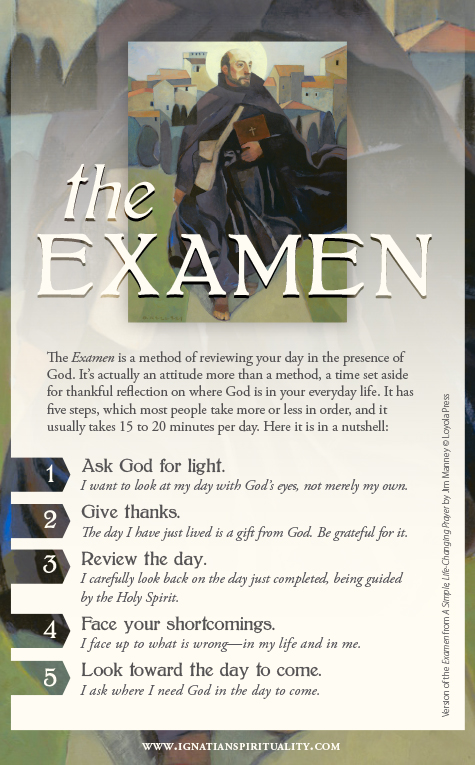
To get started, you may wish to look over the five steps for the examen I posted earlier, or read through this attractive printable PDF card provided by www.ignatianspirituality.com:


examenprayerignatianspirituality

The five steps may be described differently, but the basic “movements” of the examen are:

  • Remember that we are in the presence of God
  • Note and thank God for God’s gifts to us
  • Ask for divine light to discern God’s presence in our day and in our life, and to gain insight into our own choices and hearts
  • Review the events of our day, paying attention to how we responded to God’s gifts and invitations, and especially noting our thoughts and the stirrings of our heart. We ask forgiveness for the times that we have turned away from God’s gifts and invitations.
  • Renew my love for God, my trust that God is with me, and my resolve to act in accord with God’s invitations as I look forward to tomorrow (or the rest of my day)

Blessed James Alberione (Founder of the Daughters of Saint Paul) told us that praying the examen is crucial  for growing in the spiritual life. He advocated praying it preventively in the morning during meditation, making the examen during our daily Hour of Adoration, again at noon, and again at evening prayer. For him, the practice of the examen is one of the best ways to grow in self-knowledge and in humility.

To make the examen well, Blessed James Alberione recommends writing down the main points: the gifts that God has given us, the events of our day and how we have responded, and our renewal of our resolve. The Examen App actually gives you a place to journal on your phone or tablet, but non-digital folks can use a small notebook.

Above all, Blessed James saw the examen as a path towards what he called “the habitual examen.” In other words, praying the examen through the day is meant to bring us to living mindfully, aware of our thoughts and desires, our words and choices, as we are living them. For Alberione, the goal of the examen is to bring us to a place where “my heart is with Jesus,” where the desires of Jesus become our desires. In other words, to live continuously in a spirit of discernment.

“The important thing is that the strings of my heart are tuned for the melody we want to play, that is the hymn: ‘Glory to God and peace to humanity.’ The essential purpose of the exam is to see whether or not these strings play this melody well. The strings of my heart are my interior dispositions. Therefore, they need to be played in order to know what they sound like. Do they sing of the glory of God? Or do they sing my self-love?” – Bl. James Alberione

As a follow-up to this post, try to make the examen prayer today or this week. Please feel free to contact me in the comments or via email with any questions you have about this beautiful and helpful form of praying that can draw us deeper into a spirit of discernment. In my next post, I’ll share a personal example of how I pray with the examen prayer during my Hour of Adoration.