Mary: the Freest Woman Who Ever Lived

06P pixabay 2As we continue our discernment journey, striving for the freedom to see, understand, and live God’s Story for us, we find both helps and obstacles along the way. Many of the helps which can guide us we have already looked at: praying—especially with the Word of God, self-knowledge, the examen, our friends, a spiritual director, other mentors, the community, the Church, the circumstances of our daily life. The obstacles may be unexpected, especially because if we seek God’s will, God should clear the path for us, right? Unfortunately, doing God’s will has nothing to do with how easy or hard something is, nor how many obstacles we face.

Because of original sin, our own tendency towards sin, and our personal history of sin, none of us live the full potential of God’s Story for us. Original sin has “messed up” not just us individually but God’s creation. Yet, original sin has not changed God’s desires or ultimate plan for us, not has it taken away our freedom.

The consequences of sin in our lives make it harder for us not only to see God’s viewpoint, but also to live our stories in all their fullness and beauty. But they don’t change our call, nor our potential. Getting to know the obstacles in our discernment—obstacles to listening, to freedom, to responding generously to God’s call—is helpful for facing them, especially when they are unexpected.

virgin-335500_1280One guide to freedom is Mary, the Mother of Jesus. The saints remind us frequently that devotion to Mary is the surest and quickest way to grow in our following of Christ, in seeking and doing God’s will. Perhaps this is because Mary, whom we as Catholics believe was preserved free from all sin, is the freest human being who ever lived! She was free enough to receive the angel Gabriel’s impossible announcement and then to give an impossible yes—a yes which she must have known would lead her not just to tremendous joy, but also to great suffering as the Mother of the Suffering Servant.

Mary was not stifled by selfishness, pride, or any other of sin’s enslavements. She who listened to and lived the Word of God most freely and attentively in her life is eager to help us to draw closer in freedom to her Son.

To Pray With

Pray a decade of the Rosary, asking Mary for the grace to be free enough to listen to and respond to Jesus’ invitations in all the events of your daily life. (If you aren’t familiar with praying the Rosary, you can find an easy “how to” here: http://www.usccb.org/prayer-and-worship/prayers-and-devotions/rosaries/how-to-pray-the-rosary.cfm) I highly encourage you to consider praying the Rosary—which is a wonderful way of praying with Scripture and the mysteries of the lives of Jesus and Mary— and making it a frequent part of your prayer routine.

The Mission Entrusted To You by God

This beautiful reflection by Blessed John Henry Newman can inspire us and offer direction to us both as we discern our mission, or as we struggle to respond to the challenges of taking the next step forward in our mission:

06N PixabayGod has created me to do Him some definite service;
He has committed some work to me which He has not committed to another. I have my mission—I never may know it in this life, but I shall be told it in the next. Somehow I am necessary for His purposes, as necessary in my place as an Archangel in his—if, indeed, I fail, He can raise another, as He could make the stones children of Abraham. Yet I have a part in this great work; I am a link in a chain, a bond of connexion between persons. He has not created me for naught. I shall do good, I shall do His work; I shall be an angel of peace, a preacher of truth in my own place, while not intending it, if I do but keep His commandments and serve Him in my calling.

Therefore I will trust Him. Whatever, wherever I am, I can never be thrown away. If I am in sickness, my sickness may serve Him; in perplexity, my perplexity may serve Him; if I am in sorrow, my sorrow may serve Him. My sickness, or perplexity, or sorrow may be necessary causes of some great end, which is quite beyond us. He does nothing in vain; He may prolong my life, He may shorten it; He knows what He is about. He may take away my friends, He may throw me among strangers, He may make me feel desolate, make my spirits sink, hide the future from me—still He knows what He is about.

O Adonai, O Ruler of Israel, Thou that guidest Joseph like a flock, O Emmanuel, O Sapientia, I give myself to Thee. I trust Thee wholly. Thou art wiser than I—more loving to me than I myself. Deign to fulfil Thy high purposes in me whatever they be—work in and through me. I am born to serve Thee, to be Thine, to be Thy instrument. Let me be Thy blind instrument. I ask not to see—I ask not to know—I ask simply to be used.

– From Blessed John Henry Newman. The complete meditation can be found online here: http://www.newmanreader.org/works/meditations/meditations9.html

Mary, Model Discerner

As mentioned earlier, when we discern we pay special attention to where we are at the present moment. We don’t begin our discernment from where we’d like to be, or from unrealistic expectations, but from where we are right now.

Because who we are and where we are has been shaped by the past, we also prayed with our past—with significant moments in our lives that have shaped us as persons, and with significant moments of grace in our lives. We may need to continue to pray about significant moments in our lives, but as we go forward in our discernment, it is time to bring all of who we are, here and now—the present—to prayer. In the past two months, we been reflecting on cultivating a listening attitude in our daily life, listening intently intently to God speaking to us through:

  • our prayer
  • our deep desires
  • our relationships
  • our conversations with others
  • our current situation
  • the Church
  • the needs of the world.

But we face any number of obstacles in this deeper listening. In the next few posts, we’ll look at some of those obstacles that can “stump” us or detour us on our discernment journey, and how we can respond to or overcome these obstacles.

The Annunciation by Henry Ossawa Tanner, 1898.

The Annunciation by Henry Ossawa Tanner, 1898.

Our first response in facing any obstacle on our discernment journey (or our spiritual journey) is to entrust our spiritual lives and any special intentions to Mary, the Mother of Jesus. This is especially true for our discernment. Mary is the disciple who most faithfully listened to and responded to God’s invitations in her life, and she wants to accompany us as we seek to do the same.  The Founder of the Daughters of Saint Paul, Blessed James Alberione, used to say, “Mary is the way to go to Jesus, the easiest way.” Mary wants to draw us closer to her Son, so we can ask her in a very particular way to accompany us throughout the rest of our discernment, and ultimately, the rest of our lives as we seek to live God’s call in fidelity as she did.

Suggestion for Prayer

The Angelus is a beautiful and rich prayer that is so helpful for discerners, as it helps us to recall the moment when Mary received and responded with her generous “yes” to God’s call. Traditionally, the Angelus is prayed three times a day—morning, noon, and evening. Make time today to pray the Angelus at least once today. (If you aren’t familiar with this beautiful prayer, you can pray it with this lovely music version:

You can also find the Angelus in almost any Catholic prayer book. Once you have been praying the Angelus for a while, you may enjoy meditating on a beautiful work of art depicting the Annunciation while you are praying: http://calltoprayer.blogspot.com/

Call out for prayer requests: what can I pray for you during my retreat?

IMG_20140722_081126629_HDRThis weekend, I begin my annual 8-day retreat. I won’t be blogging or posting these days.

My annual retreat has become one of my very favorite times of the year, after which I usually return home deeply refreshed, renewed, and recommitted to my journey towards Christification. Something about the silence, the intense focus on prayer and my relationship with God, and the lack of the daily hustle and bustle, really fills my soul. I have come to treasure this beautiful week when I can focus all of my attention on my Beloved Master.

I invite you to send in any prayer requests you’d like me to pray for during this week–via email,  in the comments below, or on Facebook! 

May your week be deeply blessed by the knowledge and embrace of Christ.

Three ways the Church helps us discern

06H Sr Margaret JosephBelonging to the Church and being active in the Church is one of the best ways to live and grow in our faith, and can be invaluable in helping us discern God’s call. Our faith community can be as small as a prayer group, as large as a parish, or a midsize group that centers around a form of ministry or nurturing our faith and spirituality in every day life. Virtual faith communities can also support us spiritually and help us to grow, although in more limited ways. We may belong to more than one faith community.

Faith communities that really nurture us can be difficult to find, and they take many shapes. If you do not have a faith community—for example, you go to Sunday Mass but are not more involved in living and sharing your faith in your parish or in other ways—I encourage you to actively seek one. Your own parish is a good place to start. (If you don’t feel that your parish is nurturing your faith deeply enough, there are many other ways to connect with the Church.)

Why is belonging to a faith community so important to our discernment?

1. Because we need to be actively involved in building the Church in order to fully live our faith. Jesus doesn’t call us as isolated individuals, but calls us into community, to serve one another and to live in communion with each other. How can we do that if we aren’t actively involved? An essential part of our baptismal call is to evangelize, to witness, and share our faith with others. And the first place that we can do that is within the Church.

We cannot nurture and grow in our faith alone; we need others to help us, to inspire us, to motivate us, to call us to greater self-giving. Finding a dynamic faith community where we are nurtured spiritually can be challenging, but it’s worth the search. If we cannot find a vibrant parish nearby, we can start looking for other kinds of Catholic faith communities. Retreats, lay movements, or connecting with religious communities of priests, brothers, or sisters, are three ways we can find people who are committed to growing in holiness in ways that we can identify with and share. In a dynamic faith community where we truly share the height and depths of our Faith, we can more easily hear and respond to God’s invitations to us—whether they are to a particular ministry or initiative, or a deeper relationship with Christ. Especially if we are discerning our vocation or ministry, Jesus will call us and affirm our call in and through the Church.

2. We often receive Christ’s call in and through his Church: through receiving the Word of God, through our sacramental life, through the Eucharist, in the homilies, in the calls of our pastors, in the service that we give, in the holy examples of the saints and perhaps in the inspiring lives of someone we know. For those discerning their vocations, the Church has the best understanding of how to receive, respond to, and live the call to marriage, single, priestly and religious life.

3. Usually it is in the Church that we can best learn how to serve with the mind and heart of Christ. Despite the reality that the Church is Christ’s Body, we will find many people in the Church whose humanity and sinfulness irritate, disturb, and perhaps even appall us. But we know that Christ died to redeem us and sanctify us, and that the Church’s holiness comes from Christ. If we look attentively, we will also find people in the Church who are truly holy: who are receptive to the Word of God in the Scripture and in the Eucharist, and who humbly serve—often without being acknowledged. We are called to build up the Church—sometimes the irritating or wounded part of the Church that would normally turn us away—with our faith and service. In turn, certain members of our faith community will invite and/or challenge us to serve. And they will also affirm us in our service.

As Catholic Christians, we are called to listen to the invitations the Church makes–because Christ speaks through his Church. Our last few popes have wisely and unapologetically called the Church to take specific actions. Coming from pastors who most clearly represent Christ on earth, these are calls from God. Today, Pope Francis sometimes startles us with the vividness of his invitations of how we are to called to love the world as Christ did. His wise and pastoral invitations to holiness and service are not just for the bishops and clergy, but for all of us Catholic Christians to bring to prayer and discernment.

Our Gifts and Weaknesses Help Us Discern Our Way of Being in the World

06D RGBstock 2 choiceDiscernment can be approached in many ways. Personally, I’ve found it easier when I begin with my own heart, my identity, and experience (as at the center of a circle) and then gradually expand outwards to my situation, my family, community and workplace, the calls of the Church, and the needs of the world.

If we imagine discernment as a series of concentric circles, the innermost circle would be my interior life, including: my God-given identity, my feelings, thoughts, deep desires, my gifts and limitations. We discover these in prayer and also by praying with our history, the needs of the world, and our current situation.

In particular, reflecting on and praying with our gifts and limitations—the ways that God has given us to be and to act in the world—is extremely helpful in discerning a course of action or our vocation. One of the most popular sayings of St. Thomas Aquinas is: “Grace does not destroy nature but perfects it.” This is helpful in understanding that we are called be holy in a way that respects our humanity, although grace also enables us to transcend the merely human and to selflessly sacrifice for the sake of love.

A superficial examination of the lives of several saints quickly reveals how unique each saint’s path to holiness was. (I give a quick example between St. Pio and St. Frances Cabrini in this earlier post.) Sanctity certainly has many common elements: faith, hope, and love; the works of mercy; the Beatitudes. But how each individual is specifically called to live holiness is unique, partly according to that person’s gifts and limitations.

Taking into account our gifts and limitations, therefore, is an important part of understanding God’s call for us. There are certain roles that require certain aptitudes or skills. If we are discerning our call to a role that has such requirements, we need to reflect on whether we have the aptitudes or the ability to acquire the needed skills. We don’t discount the reality that grace can help us to do something that would ordinarily be beyond us, but we also don’t seek to work against the foundational inclinations of our personality, unless we have a compelling reason to do so.

* * *

As a college student, Sarah is currently discerning her future career. At heart, Sarah is an artist and idealist who feels called to serve others. For some reason—perhaps because of her family background—she believes that being a doctor is the best way to serve others. Yet, she finds herself dismayed when she starts to fill out an application for medical school because she feels no personal inclination towards a medical profession: she isn’t good at science, and she becomes faint not just at the sight of blood, but at the thought of blood. If Sarah’s interest in becoming a doctor is based solely on her theory that being a doctor is the best way to help others, then she is basing her discernment on a faulty assumption, and her resistance to filling out that application is a real indication of that. The clue here is not that being a medical doctor is hard, or a lot of work, but that it actually goes against Sarah’s personal inclinations and gifts. Sarah may indeed be called to serve others, but in another way.

* * *

When we discern, we want to take our personalities, gifts, limitations, and inclinations into account. Part of the work of vocation directors for priesthood and religious communities is to see if the candidate is a “good fit.” For example, as Daughters of Saint Paul we share life closely—not just daily life, but also in the ways we carry out our daily mission together. It can be quite demanding to live and work so closely together, even for those of us who are called to it. (One of the greatest “daily miracles” in religious life is the reality that five women, who all take turns cooking the meals, can share the same small kitchen and still be friends at the end of the day!)

Since a young woman needs to have a certain amount of flexibility and sociability to be happy as a Daughter of Saint Paul, this becomes part of her discernment with our community. If she doesn’t have those particular qualities, it doesn’t mean she isn’t a wonderful person called by God to a special mission, but it’s an indication that she might be called somewhere else—perhaps to another congregation of sisters who don’t live community life together so closely, or perhaps to single life, or married life.

On the other hand, someone who hastily dismisses an invitation to be involved in something good–such as their parish’s outreach program–only because it’s “too hard,” is not really discerning. The amount of sacrifice involved is not the question; as followers of Christ, we will always have something to offer because we seek to love selflessly as Christ does. Instead, the question is how God is calling us to use our particular gifts and our limitations to serve others’ needs in the way that only we can.

How To Pray the Examen Prayer

imag0079Here is an example of how you can pray the examen during an Hour of Adoration or a longer time of prayer—perhaps in the evening.

1. Place Yourself in God’s Presence

This is a moment like that of the Transfiguration on Mount Tabor: Jesus is here before you, wishing to bathe you in the radiance of his love, wanting to speak to you. This is a moment of very personal encounter between you and Jesus. Take this moment to rest in the light of his gaze of unconditional love for you. Allow his love to fill you—perhaps with awareness of his presence, or peace, or joy—whatever grace he wishes to give you at this moment.

2. In Gratitude

In the light of his love, look over your day or the past week, with gratitude. What are the gifts you have received this day/week? Give thanks to God for the blessings that immediately spring to mind. Now look deeper. Have you received a special grace this day or week for which you want to thank God? A hidden gift that you took for granted until now? Or a little joy that reminded you of how loved you are? Remember also to thank God for the special gifts that he has given you, in your person—whether it’s a talent to serve or to cook, or to listen, or your patience, or a gift to encourage others… Thank God for these gifts.

3. Petition

Confident in God’s desire to draw you closer to himself, now ask the Holy Spirit to come into your heart and to help you gently look over the day or week in the light of his grace and your response to his grace.

4. Gently Review Your Day/Week

Look through your life in these days/week. A particular event might spring to mind right away—that might be God’s invitation to spend some time with him reflecting on it. If nothing comes to mind, look through the events of your day, especially noticing what’s going on inside of you—your motivations and feelings.

Good questions to ask yourself:

  • When did you feel loved today? How were you able to show love to someone else?
  • What drew you closer to God today?
  • What drew you away from God today?
  • What kind of moods were present in you today? Why?
  • What regrets do you carry for today?
  • Where were God’s invitations to you today? How did you respond?
  • Do any events seem to be unfinished, requiring some reflection or making you feel uncomfortable, angry, or fearful? How might God be inviting you in this situation?

5. Renewal of love and resolve

Express whatever is in your heart to Jesus—how you feel about the events of this day or week, how you have grown closer to him, asking forgiveness for your sinfulness and failures. In a particular way, ask him to be with you in the coming day or week.

Close with a prayer for the grace to live in his love, such as the Our Father.

3D Listening to God: with the Examen Prayer

bible study and notesOne of the reasons we seek to pray through the day is so that we can hear God’s daily invitations to us. How can we cultivate this attitude of listening to God in our daily life? The examen prayer is one of the best tools to help us listen to God’s invitations to us in our daily life. It is recommended by the saints—St. Francis de Sales, St. John Chrysostom, St. Basil, and most notably St. Ignatius of Loyola, who developed this prayer in the way we discuss it below.

Foundationally, the examen is a way to recognize God’s presence in our life today. As a tool to help us to listen to God in my daily life, it’s best used as a daily practice. St. Ignatius recommends making the examen “formally” twice a day: around noon and in the evening; in his Examen App, Fr. Michael Denk provides an easy option to schedule it into your day. As I mentioned in an earlier post, I totally recommend Father Denk’s Examen App, which will guide you through the whole process—either through words on the screen, or through his videos.

The Jesuits have developed many wonderful resources to help someone learn and use this powerful practice of prayer, and many are available online. You can find videos, audio files, articles, and printed materials here.

For those who are hesitant about making the exam, not interested in the app, or already pray the examen and would like to explore it further, let’s take a deeper look.

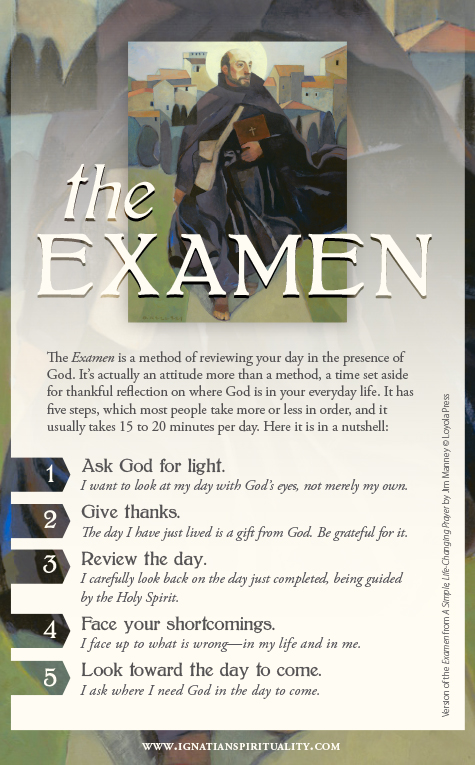
To get started, you may wish to look over the five steps for the examen I posted earlier, or read through this attractive printable PDF card provided by www.ignatianspirituality.com:


examenprayerignatianspirituality

The five steps may be described differently, but the basic “movements” of the examen are:

  • Remember that we are in the presence of God
  • Note and thank God for God’s gifts to us
  • Ask for divine light to discern God’s presence in our day and in our life, and to gain insight into our own choices and hearts
  • Review the events of our day, paying attention to how we responded to God’s gifts and invitations, and especially noting our thoughts and the stirrings of our heart. We ask forgiveness for the times that we have turned away from God’s gifts and invitations.
  • Renew my love for God, my trust that God is with me, and my resolve to act in accord with God’s invitations as I look forward to tomorrow (or the rest of my day)

Blessed James Alberione (Founder of the Daughters of Saint Paul) told us that praying the examen is crucial  for growing in the spiritual life. He advocated praying it preventively in the morning during meditation, making the examen during our daily Hour of Adoration, again at noon, and again at evening prayer. For him, the practice of the examen is one of the best ways to grow in self-knowledge and in humility.

To make the examen well, Blessed James Alberione recommends writing down the main points: the gifts that God has given us, the events of our day and how we have responded, and our renewal of our resolve. The Examen App actually gives you a place to journal on your phone or tablet, but non-digital folks can use a small notebook.

Above all, Blessed James saw the examen as a path towards what he called “the habitual examen.” In other words, praying the examen through the day is meant to bring us to living mindfully, aware of our thoughts and desires, our words and choices, as we are living them. For Alberione, the goal of the examen is to bring us to a place where “my heart is with Jesus,” where the desires of Jesus become our desires. In other words, to live continuously in a spirit of discernment.

“The important thing is that the strings of my heart are tuned for the melody we want to play, that is the hymn: ‘Glory to God and peace to humanity.’ The essential purpose of the exam is to see whether or not these strings play this melody well. The strings of my heart are my interior dispositions. Therefore, they need to be played in order to know what they sound like. Do they sing of the glory of God? Or do they sing my self-love?” – Bl. James Alberione

As a follow-up to this post, try to make the examen prayer today or this week. Please feel free to contact me in the comments or via email with any questions you have about this beautiful and helpful form of praying that can draw us deeper into a spirit of discernment. In my next post, I’ll share a personal example of how I pray with the examen prayer during my Hour of Adoration.

3D Listening: Connecting with God Every Day

Various spiritualities offer support in living in greater awareness of God’s presence in our day to day life. You can get really creative with this, depending on your schedule and what helps you! I hope that you share in the comments below what you are already doing, or what you might try to increase your awareness of God’s love for you daily. Here are a few practices that I have found useful.

* Begin the day with meditation on a Scripture passage that concludes with a preview of how I want to live what I meditated on through this day. As I look forward to my day and the responsibilities I will face, I resolve how to  respond with love in the various situations that might arise

* Use everyday events to remind myself to pray a one-line pray (or aspiration) frequently. For example, I  set my watch to beep on the hour. When my watch is silenced, I try to remember to pray every time I stand up from my desk. I’ve also used other reminders, such as beginning or switching to a new project/file, as a reminder to pray

* Use part (or all) of my lunch break for prayer: go to Mass, pray the Angelus, make a spiritual communion or visit Jesus in the Eucharist in a nearby church, or take a prayer-walk (during which you can simply rejoice in God’s love for you, or pray the Rosary, etc.). I know people whose work is flexible enough that they can stop at 3 PM to pray the Divine Mercy chaplet

* Use times when I have to make a decision or am not sure what to do to pray for guidance from the Holy Spirit

* Close my day by putting on my “Sherlock Holmes” hat to look for one way that God revealed himself to me today. It might not be obvious or expected. For example, God often “speaks” to me through nature, such as a chickadee that chirps a greeting. A friend’s support at just the right moment, a film or song that deeply moves us, or a sudden insight—any of these can reveal God’s love.

Often, at the end of these mini prayer breaks, I will ask Jesus to guide me to respond to his call through the next hour/minute/project.

A favorite prayer practice that I use daily is the examen, and I hope to blog more in detail about that next.

Guided Lectio Divina for Discerners: He Loved Me and Gave Himself for Me

“He Loved Me and Gave Himself for Me!”

453px-Caravaggio-The_Conversion_on_the_Way_to_DamascusIntroduction: St. Paul, who was known as “Saul” before his encounter with Christ, was a good man and a devout Jew who was quite conscientious about keeping the Law of God. He desired to serve God, but was too focused on what he wanted to do for God, rather than on what God was doing. Saul’s zeal was so misguided that he sought to persecute the Christians, whom he felt were destroying the Jewish religion. On his way to Damascus, instead of accomplishing this task, he encountered Jesus the Savior, who revealed to Paul the depth of God’s mercy and love. Paul’s foundational experience of Christ’s saving and merciful love for him and for the people to whom he would send Paul shaped Paul’s entire life and mission. It was an experience of love, light, and beauty to which Paul returned to over and over again.

For this lectio divina, we’ll pray with one of the Scriptural accounts of Paul’s encounter with Christ from Acts, followed by a short description of the experience from a letter of Paul.

Lectio: Acts 9:1-19 and 1 Tim. 1:12-17

Acts 9:1-19 (Read from your Bible or click here for this first reading.)

1 Tim. 1:12-17

I am grateful to Christ Jesus our Lord, who has strengthened me, because he judged me faithful and appointed me to his service, even though I was formerly a blasphemer, a persecutor, and a man of violence. But I received mercy because I had acted ignorantly in unbelief, and the grace of our Lord overflowed for me with the faith and love that are in Christ Jesus. The saying is sure and worthy of full acceptance, that Christ Jesus came into the world to save sinners—of whom I am the foremost. But for that very reason I received mercy, so that in me, as the foremost, Jesus Christ might display the utmost patience, making me an example to those who would come to believe in him for eternal life. To the King of the ages, immortal, invisible, the only God, be honor and glory forever and ever. Amen.

Meditatio

The Acts of the Apostles gives three different accounts of the conversion of Saint Paul because of its importance in the early Church (see Acts 9:1-19, Acts 22:3-16, and 26:2-18). In his letters, Paul often refers to his encounter with Christ, although often indirectly (see 1 Cor. 15:8, Gal. 1:11-16, 2 Cor. 4:6).

Initially, Paul had found fulfillment in living the Law to the point of perfection. But his encounter with Jesus changes all that. The brilliance of Jesus’ love and truth blinds Paul initially. He thought he had been able to see, but his temporary blindness enables him to see himself and his relationship with God and others in a whole new way. Paul must have felt great distress for being so wrong, for recognizing that he was persecuting the followers of Jesus, whom he now recognizes as the Messiah, the Son of God, his Light.

In his encounter with Jesus, Paul truly listens. He discovers that God’s merciful love in Christ gives the deepest meaning to his life, and he doesn’t have to do anything to win or earn that love. He just has to believe in it and receive it. Paul’s response is the beautiful and moving response of a discerning disciple, even though his world has just been turned upside down: “Lord, who are you? What do you want me to do?”

Praying with Paul’s dramatic encounter with Jesus, we can see that God may communicate to us in many ways: through an interior whisper or an insight, through others such as Ananias, or through an unexpected event that shakes us up. Jesus’ gaze of mercy on Paul transformed his life forever. But this profound transformation in Paul is not easy, nor is it over in three days. Paul’s growth in Christ and carrying out the call of Christ was lifelong.

In our times of discernment, we may experience similar moments to Paul in his encounter with Christ:

  • disturbance/shake-up (Paul fell to the ground)
  • great light
  • listening/attentive (light and voice)
  • dialogue
  • fasting (from both food and human sight)
  • absorbed in prayer and in one’s relationship with Christ
  • obedient to Christ’s call
  • receiving grace through the community and the celebration of the sacraments
  • guidance of an “elder” of the community
  • community confirms God’s call
  • obedience to the community
  • commitment to the entrusted mission of proclaiming/witnessing to Christ

How do we experience Christ’s invitations in our lives? When we are confronted with interruptions, unexpected changes, or times of transition, it can be difficult to see God’s light or invitation. But suppose we “refocused” our gaze from the distress of the unexpected experience to seeing it as an invitation from God, as Paul did? What insights would we receive if we did this? Discovering that we need to convert, change, or grow is an inherent part of receiving God’s call. How do I want to respond to God’s invitation?

Contemplatio

I am grateful to Christ Jesus our Lord, who has strengthened me, because…I received mercy. (See 1 Tim. 1:12-13)

From the second reading (from 1 Timothy) it’s clear how Paul’s encounter with Christ on the way to Damascus shaped his whole life. Paul’s descriptions of his relationship with Christ are marked by thanksgiving for Christ’s merciful love. It’s a deeply warm and personal relationship. This invites us to reflect:

  • What are our earliest memories of our relationship with God?
  • How have our encounters with Christ “marked” our lives, transformed us? How have I experienced Christ’s mercy, and how have I responded?
  • How would we characterize our relationship with Christ? How do we feel Jesus is inviting us to grow in our relationship with him?

Oratio

My favorite prayer posture is to sit or kneel on the floor near the tabernacle. As I was praying, I suddenly realized that this receptive and adoring posture–sitting at the feet of the Master–characterizes my relationship with Christ. At the feet of the Master, I am receptive to his call and his sending me; I listen, adore, love, receive his love, learn his way of gentleness, plead with him, receive forgiveness. I am blessed to be at his feet.

Sometimes when I’m coming to the end of my prayer time, I will joyfully remind Jesus, “I’m not going anywhere” — meaning that I will stay at his feet always. It’s a little renewal of my fidelity to the All-Faithful One.

Renew your relationship with Jesus in your own words. 

Actio

Be mindful of Jesus’ merciful love for you throughout your day today, choosing at least three times throughout the day where you will stop and thank Jesus for the gift of his love for you.