Discernment: a Matter of Trust & Retreat with #MediaNuns


Discernment quote 4

One of my favorite quotes about discernment from Father Rupnik’s book, Discernment: Acquiring the Heart of God, reminding us that discernment is all about trust: discovering that God first trusts us, and then entrusting ourselves to God to lead us.


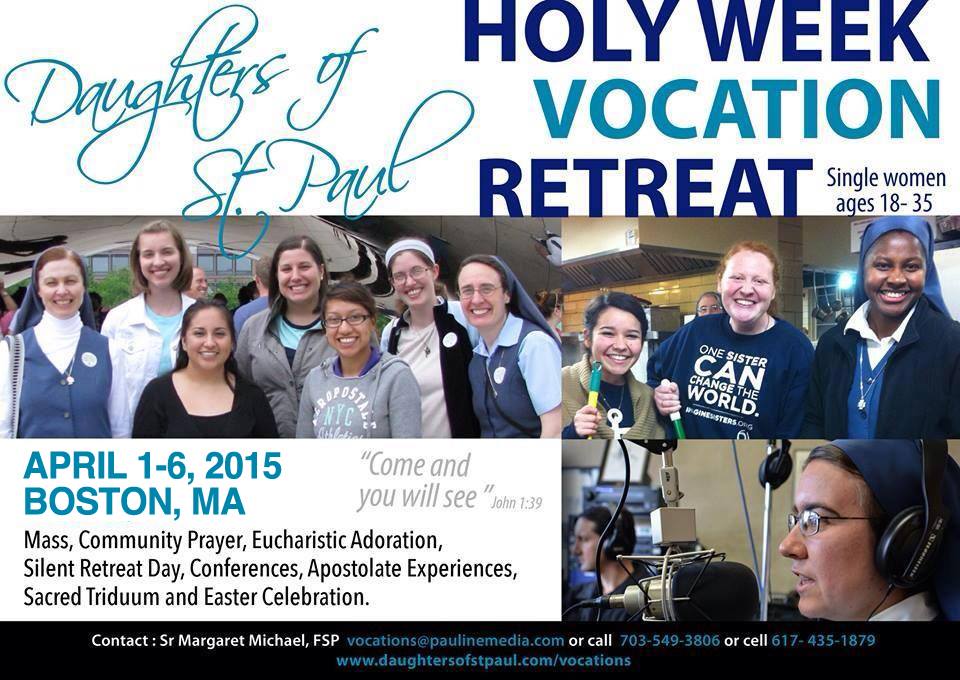
And for young women looking for an opportunity to discern with my wonderful community, the Daughters of Saint Paul, known on Twitter as #MediaNuns, this is a shout-out for our  Holy Week Retreat that will be held at our large convent in Boston, MA:
HolyWeek2015Ad

Practical Steps for a Daily Discernment

02G choice 2

When we feel the need to discern something big—such as our vocation—then ordinarily we need to take our time with it, and there are a number of steps we can follow. Discerning about smaller, daily choices may take merely moments to make. For me, it often takes just a few minutes to do the following:

  • an evaluation of the need(s) presented to me
  • a short prayer to the Holy Spirit
  • an honest glance at my heart, to make sure I’m aware of my desires and to uncover any unconscious “agenda” that may sway me
  • a renewal of my deepest desire: to live in union with Christ
  • a check-in with my current schedule/responsibilities and, when needed, with a mentor and the people who will be affected by my decision (e.g. the team I’m working with)
  • good old common sense

Then, I put all those together and make a decision.

This may seem like a lot of steps for a smaller choice, but they’ve gradually become automatic for me as I’ve grown in the art of discernment, and they help me to pay more attention to seeking God’s will. Becoming proficient in this spiritual art means that seeking God’s will becomes as habitual as breathing.

To Think About

What would be your list of steps for a discernment about a smaller, daily matter? If you can, share them in the comments or via email (and I’ll post them)!

Discernment is…a living relationship with all creation!

Every once in a while, I’ll post one of my favorite quotations from Father Marko Ivan Rupnik’s book, Discernment: Acquiring the Heart of God. I had a little problem with the size, but if you click on the title or image, you can read it more easily. Here is today’s quotation:

Discernment Blog Backgrounds

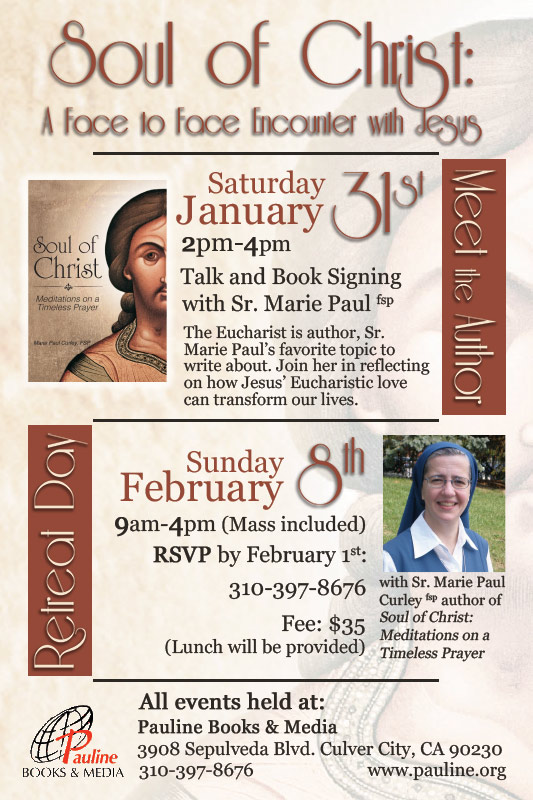
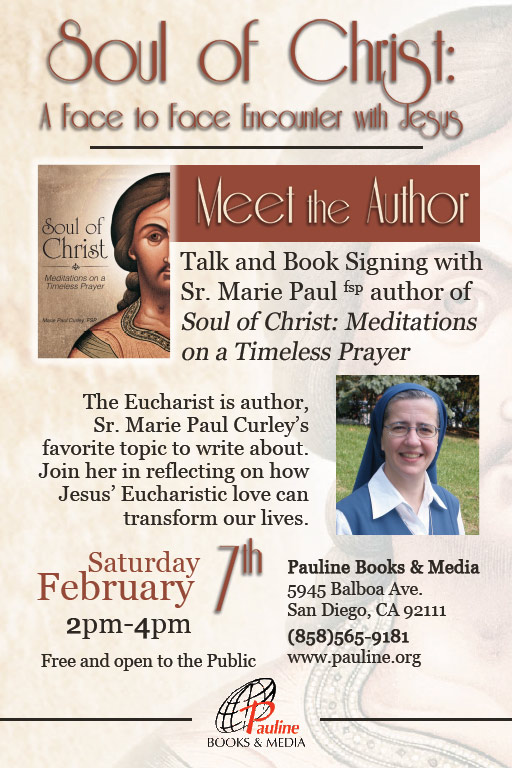
California Soul of Christ Talks & Book-signings

For those in California, I just wanted to let you know I’m visiting on a book promotion tour for the next two weeks. If you can, join me–I love meeting those discerning and readers of my books and blogs! I’m posting up the events below. As you know, Eucharistic adoration is one of the best ways to pray when you are making a discernment!

San Francisco Area:

SMPSoulOfChristReduced

Los Angeles Area (Culver City): 

SMP-Culver-City

San Diego:

SMP-San-Diego


Four Essential Principles for Discernment

02 CAs we’ve been reflecting in the past few posts, discernment begins—and makes sense—only in the light of God’s point of view: God’s unconditional love for us. From God’s storyview flow the “key principles of discernment” that we will explore in the next few blogposts. In classic or traditional terms, these are essential to authentic discernment:

Between two (or more) good choices. It’s not a good choice vs. a bad choice. God would never want us to choose to do something bad.

In the context of a vibrant relationship with God. Discernment is more than making a choice or a decision—it’s seeking God’s will. How will we come to know or want what God wants, unless we come to know and love God?

“3D” listening. As we discern, we need to pay attention to our whole being, our loved ones, our circumstances, and the world around us, because the Holy Spirit lives and works within us, around us, and through others. Our thoughts, feelings, situations, others’ needs and concerns, the needs of the world, the insights of others, the voice and needs of the community, the guidance of a mentor or guide–all of these help us to listen to God’s invitations.

Free. Making a free choice is the aspect of discernment that can take the most time, wisdom, reflection, and guidance.

Please Chime In!

Do these points make sense to you? In the next few posts, we’lll explore each of these key principles of discernment, but it’d be great to hear your questions! You can post them here in the comments, or email them directly to me.

Discernment Attitude: Trusting God Wants the Best for Us

BibleAs looked at in the last post, we know that the Bible reveals to us God’s basic story premise:

Our all-good God loves us and always wants what is good and best for us.

What does this mean for us? Unpacking God’s story premise gives us a couple more important foundations for our discernment:

1) God is good and always wants what is good. So whatever we are discerning must in itself be good; it must conform to God’s law. Our all-good God would never want us to do something morally wrong. God doesn’t contradict himself. When we are making a choice between good and evil, we are making a moral judgment or moral choice. This is different from discernment in the spiritual sense. God always want us to choose what is good.

2) God loves us as we are. Our Creator God wants what is good and best for us. Having created us in his own image, with intelligence and free will, God invites us to live our full potential, to “become our best selves” by loving fully and freely. While God will never violate our free will, evil in the world around us and our own tendency towards sin condition us to make choices that are not always truly free. This is why God sent his Son into the world. Jesus Christ is God’s “Yes!” to humanity, God’s “Yes” to the question of whether God loves us.

A big part of discernment—and why a good discernment often takes time—is our becoming interiorly free enough to receive God’s love. Receiving God’s love and letting it transform us means  letting go of fear, guilt, outside pressures, or anything else that can distract us from God’s invitation and dream for us.

3) God is always, actively, seeking what’s best for us. The Gospel of John reminds us that God is love. For God, love is not a noun but an active verb. Whether we know it or not, whether we see it or not, God takes an active part in our lives. Because God is pure Being, whatever God wants is also what God acts to bring about. God doesn’t just drop us into the world and walk away. Jesus reminded us of this concretely at the Last Supper, when he promised to send the Holy Spirit, and that he would be with us always.

The Holy Spirit is God at work in the world around us and in the people around us, including family, friends, enemies, mentors. This means that: Authentic discernment always takes place within the context of this vibrant relationship with God. The more we seek out a vital connection with God, the better our discernment will be. True discernment means listening for how the Holy Spirit is speaking to us, how the Spirit is inviting us, how the Holy Spirit is acting in our lives. One of the key places where the Holy Spirit speaks to us is in the depths of our own hearts.

Put Out into the Deep! Lectio for Those Discerning

“Put Out into the Deep!”

Discerning with the Word: A Guided Lectio Divina for Those Discerning
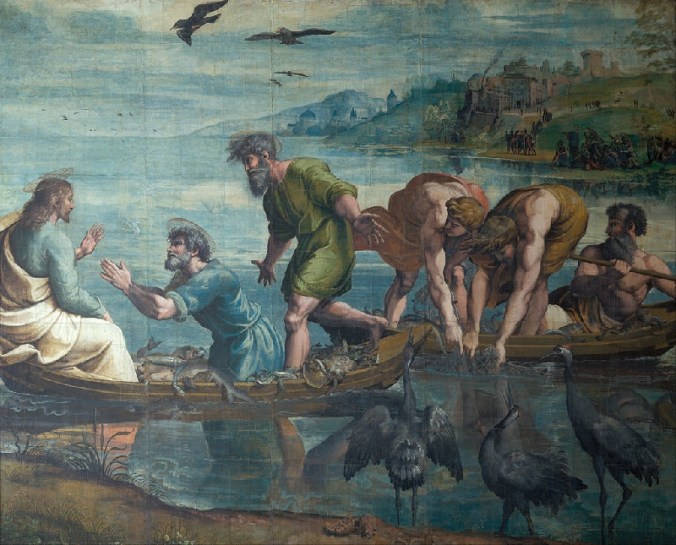
The Miraculous Draft of Fishes – Raphael – Public Domain


Introduction: At certain moments in our discernments, the lack of clarity about the path ahead and the letting go of past ways of doing things to make room for the “new” that God is working in our lives, can cause a sense of timidity, uncertainty, or fearfulness within us. Jesus reminds us, “Do not be afraid!” 

(As noted in the Lectio Divina Guide for Those Discerning, a wonderful way of listening to the Lord—and perhaps the first that we should practice—is praying with the Bible through lectio divina. This guided lectio is provided to help those who are just beginning with lectio divina. If  you choose to pray with this guide, I encourage you to go back later and pray with this passage from Luke on your own, using this simple guide.)

Lectio: Luke 5:1-11

Once while Jesus was standing beside the lake of Gennesaret, and the crowd was pressing in on him to hear the word of God, he saw two boats there at the shore of the lake; the fishermen had gone out of them and were washing their nets. He got into one of the boats, the one belonging to Simon, and asked him to put out a little way from the shore. Then he sat down and taught the crowds from the boat. When he had finished speaking, he said to Simon, “Put out into the deep water and let down your nets for a catch.” Simon answered, “Master, we have worked all night long but have caught nothing. Yet if you say so, I will let down the nets.” When they had done this, they caught so many fish that their nets were beginning to break. So they signaled their partners in the other boat to come and help them. And they came and filled both boats, so that they began to sink. But when Simon Peter saw it, he fell down at Jesus’ knees, saying, “Go away from me, Lord, for I am a sinful man!” For he and all who were with him were amazed at the catch of fish that they had taken; and so also were James and John, sons of Zebedee, who were partners with Simon. Then Jesus said to Simon, “Do not be afraid; from now on you will be catching people.” When they had brought their boats to shore, they left everything and followed him.

Read through this reading slowly and attentively at least twice. Take your time with it.

Meditatio

This reading has a wealth of meanings. For this lectio, let’s focus on three lines of the conversation between Jesus and Simon Peter:

  • Put out into the deep
  • Go away from me, Lord, for I am a sinful man!
  • Do not be afraid; from now on you will be catching people.

“Put out into the deep.” Up to this point in the Gospel of Luke, Simon Peter doesn’t know Jesus very well yet, except that Jesus healed his mother-in-law (Luke 4). It seems this is the first time that Jesus invites Simon to do something, and it is to step forward in faith in him. It’s an unusual request probably for a number of reasons; the impulsive fisherman mentions only two of them—the fish aren’t biting, and night time is better for catching fish. What is it about Jesus’ request or in his gaze that makes Simon Peter continue on, “…yet if you say so…” and follow Jesus’ invitation?

While Simon Peter was probably pretty familiar with the lake, I am not so familiar with “the deep.” It’s hard for me sometimes to follow Jesus’ invitation when I can’t clearly see the path ahead, when I don’t know “how deep,” or “how far” I’m being asked to go. But I have no need to be afraid because, like Simon Peter, I have Jesus in the boat with me. Jesus would never ask me to take a step forward in faith and then abandon me. He will be with me every moment of my discernment, every moment of my journey.

“Go away from me, Lord, for I am a sinful man!” I really identify with Peter’s words as he witnesses Jesus’ goodness and miraculous power. Peter is in touch with his humanity and his sinfulness. And it’s fitting that we acknowledge our need for forgiveness, for conversion, not just in the challenging moments of our journey, but also in the seemingly miraculous ones.

The truth is that none of us are “worthy” of Christ. Yet our relationship with Jesus is not about being worthy, or becoming worthy. Our relationship with Christ is about Christ loving us first. Jesus is not concerned with “how” unworthy I am, because it only means that I am more aware of how much I need his saving love. And Jesus delights in saving us.

“Do not be afraid; from now on you will be catching people.” Jesus repeats “Do not fear,” in the Gospels over and over again. It might be tiresome to others, but for me, it’s a message I need to hear especially when I’m invited to take a step of faith, when I’m invited to “put out into the deep.” The reason we do not have to be afraid? Because from now on, we are Christ’s. When we belong to Christ, we can trust in his faithful love for us.

Christ’s invitation to follow him is implied here. And Christ’s invitation isn’t just for Peter alone. In essence, Jesus is inviting them, “Help me with my mission of ‘catching people,’ of attracting people to salvation in me.” It was an irresistible invitation for Simon and the other fishermen who were called.

Our call and our mission are so deeply connected that usually we cannot discern one without the other. Often, it’s just when we feel least worthy that Jesus calls us to share in his mission! And his call to us to be close to him is genuine: there is no way to draw closer to Jesus than by sharing in his thirst for others’ salvation.

Contemplatio

“Put out into the deep water.” What is the “deep water” that Jesus invites me to? How do I need to change or grow to respond to Jesus’ invitation?

Oratio – Prayer To Live God’s Loving Plan

Lord, from all eternity,
You know me, choose me,
love me, and call me.

Every day You invite me
to a life full of joy, love, and meaning!
You call me to become more truly myself,
and more of You.

You who love me through and through, 
and know every stirring of my heart,
have gifted me with a unique calling
where the world’s deepest needs
meet my deepest joy.

Grant me the openness to hear Your invitation,
the faith to trust Your love,
the courage to choose You, Master, as You have chosen me,
and a generous heart 
that falls ever more deeply in love with You.

Mary, God’s Mother and mine,
you joyfully and fully responded to God’s call in your life.
Help me to respond to God’s plan for me with all my being,
as you did. Amen.

Actio

Choose a way in which to respond to Christ’s invitation to you today in your daily life.

Note: I apologize for not posting the past week: I came down with the flu, and am only now feeling better. Over the next three months, I am doing some traveling for promoting my book, Soul of Christ: Meditations on a Timeless Prayer, but hopefully I’ll still be able to post three times a week…  God bless you!

2015 Reminds Us: God Re-Creates Us Every Day!

2015 has begun. I love new beginnings (perhaps that’s why I love early mornings!). The freshness of a new year reminds us that God re-creates us every day! I begin this New Year, praying for all of you who are reading this blog, have emailed me, commented, or started to follow the blog: that you will receive the grace to hear and respond generously to God’s invitation. And I entrust all of us (including myself) to the intercession of Mary, our Blessed Mother and Queen, whose generous yes is the model for our yes: “Behold the handmaid of the Lord.” This is one of my favorite hymns to Mary, who always leads us to Christ:


The WordPress.com stats “helper monkeys” prepared a 2014 annual report for this blog. Considering that the blog is just over a month old, the stats are pretty amazing. A big thanks to all of you readers who have helped get this blog off the ground! I look forward to posting in the new year…

Here’s an excerpt from the report:

A New York City subway train holds 1,200 people. This blog was viewed about 7,800 times in 2014. If it were a NYC subway train, it would take about 7 trips to carry that many people.

Click here to see the complete report.

The Story Behind This Blog

SrPaulSelfSmallGloomedFor nine years, I’d helped young women discern their vocation–whether they were called to religious life, married life, or the single life. I offered workshops and mini-courses on vocational discernment, discernment retreats, and individual vocational accompaniment. The intensity of others’ discernments helped me live the spiritual art of discernment much more mindfully. I was thrilled that I could focus on discernment so much, though I knew that I was just beginning to go deeper into living this profound spiritual art and practice. I was even asked to write a book about it—a book that I never got to.

Then I was transferred to another assignment–something very different from what I’d been doing. “No big deal,” I thought. I planned to continue discernment as an important part of my Pauline life. After all by this time, I’d been a religious sister living the vow of obedience for over twenty-five years.

But in a new and unfamiliar environment, the multitude of choices and decisions I faced daily made me feel paralyzed. When presented with several fantastic opportunities, I had no idea which one God was calling me to do. My prayer, dry at the time, didn’t shed any light. God made his presence felt, but not his desires, not his will. I felt as if I had no clue which opportunity or direction was truly his will. And just as I was realizing how inexpert I was in the art of discernment, I was once again asked if I would consider writing a book on discernment!

God often puts unexpected plot twists in the story of my life. This is not the first time that God has called me to grow in a certain area in my life by inviting me to write a book. So I’ve decided to give it a try. To create a true dialogue, to receive input from readers, and to make sure that I’m speaking to others’ real questions about discernment, I thought it would be great if I could blog the book first. And this blog, CoAuthorYourLifewithGod, was born.

Discernment has become a key part of my life because it leads me into greater alignment with God’s will, to live God’s story for me. Although I’ve spent a lot of time discerning and witnessing others’ discernments, I’m no expert. I still struggle with discerning how God is inviting me when I’m overwhelmed, afraid, or attached to having my way. The truth is that all of us can grow in this spiritual art of listening to the Lord’s invitations and striving to respond with a generous “yes!”

This blog gives us the opportunity to reflect on and grow in the spiritual art of discernment. Please ask questions, comment, and be active here on this blog—it’s for you! I’ll try to include opportunities to share, contests, and surveys that will make it fun to explore this important spiritual art, as we together seek to discover how we can listen more deeply and respond more generously to God’s loving call in our lives.

I’d really love to hear from you (in the comments box below or you can email me, too–just mention if you’d like me to keep your question anonymous):

  • Why have you stopped by and visited this blog?
  • What are you discerning?
  • What questions do you have about discernment or growing in your relationship with God?
  • What would you like to see here on this blog that would be helpful for you on your discernment journey?

God Dreams with Us – Part 2

01A choice 1In discerning God’s will, neither scruples nor a careless “whatever goes” attitude is helpful. God is close and wants to reveal himself to each of us. Discerning God’s story for us involves a lot of listening, but that’s because we are usually spiritually hard of hearing. God not only wants to communicate his love and his plan for us, he wants to work out that plan with our full participation, which includes our making choices. Our full participation doesn’t, however, mean that we can see the whole picture: seeing the full story is a surprise that awaits us in heaven. (Read Newman’s “I am created to do something or to be something for which no one else is created” for Blessed John Henry Newman’s take on this.) Instead, God’s story for us unfolds step by step, giving us what we need to know to do his will, to live his dream for us.

There are many times when I’ve been grateful for how God has led me through a particular circumstance, and afterwards I see how it was really important for me to go through. But I’m really glad I didn’t know all of what was involved ahead of time, because I know I would have worried so much about it that my fear would probably have made me resist God’s plan for me. I might not have truly believed that God’s grace would be there for me to help me.

God gives us the grace to live the present moment, not the future. For me, worrying ahead of time can lead to fear and resistance to God’s grace. And then the gifts and the growth that could come from that experience would be lost.

Most likely, we will not fully understand all of God’s plan for us while we’re here on earth. The best choice and the most important attitude we have is to seek God’s will. As we figure out what that means, and as our heart is purified to ignore other distractions and truly seek God’s will, God can work with our faltering steps.

* * *

Prayer Corner: Pray with Your Dreams

Have you ever prayed about your dreams? Take a few moments and journal:

  • What were your childhood dreams? What did you picture yourself doing when you were younger? How did you see yourself living your life?
  • What are your dreams now?

Bring this list of dreams to prayer and share them with God. Take a few moments to offer each dream individually to God. 

After your prayer, how do you feel about your dreams for your life?