
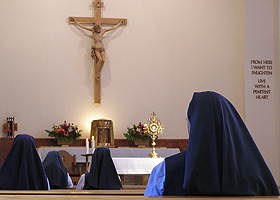
Adoration in our Pauline Chapel
Lifetime’s reality TV show The Sisterhood: Becoming Nuns continued last night with episodes 3 and 4 back-to-back. These new episodes highlighted all the conventions of a reality TV show that I don’t enjoy: competition, heightened (over-the-top!) drama, staged scenes, coaching from the show’s producers, oversimplification of relationships and personal journeys, and an overt editing that revealed an obvious manipulation of various events. For me, watching this show has become a study of reality television shows and how “not real” they are!
Yet, if we take these conventions into account, it’s still possible to gain insight, both into religious life and into the process of discernment, as some viewers live-tweeted with other sisters and me while watching the show. I think this is particularly true because of the good will of the sisters and discerners on the show, who tried to be real in their interviews and comments.
Insights that I think could be particularly helpful for those of us who want to live more deeply in a spirit of discernment are:
Insight 1. Do not be afraid, but trust in God! We can often see God’s hand in our lives much more clearly when we look back on an experience, rather than when we are living in it. The most positive moments in the show so far have been when the young women leave one convent for another. In looking back on their experiences there, they talk about being loved, about experiencing God, and about growing as persons.
Yet we have just witnessed that these visits were not easy to go through. So these episodes help us to see that even in the difficult, confusing, or challenging moments of our lives, we need to cling to hope: God will use every event to draw us closer to himself, if we let him. This insight bears repeating for all of us: Do not be afraid! Trust in God, no matter where you are because he is with you.
Insight 2. The power of Eucharistic adoration in discerning. As a Pauline sister, I have a special love for Eucharistic adoration. My favorite description of adoration is something that St. John Paul said when he encouraged young people to go before Jesus in the Blessed Sacrament and simply “let him love you.”
If you already pray before Jesus in the Eucharist regularly, you know how blessed we are to be able to take advantage of his presence, his love, his availability! When you take quality time with Jesus in the Eucharist—at Mass, receiving Communion, or making some time for adoration—Jesus will transform the rest of your life as well. You cannot, will not, walk away unchanged.
If you don’t already make an occasional or regular Eucharistic Hour of adoration, I encourage you to consider it, perhaps by starting with just 20 minutes. There is something about the tangible closeness and vulnerability of Jesus in the Eucharist that can pierce through our blindness and defenses, helping us understand how loved we are, and how faithful his love is.
For those for whom the silence of adoration is really hard, there can be for a number of reasons, but I hear two reasons repeatedly:
1) We simply don’t know what to do with the silence.
2) When we are silent for a time, all the negative stuff–thoughts, feelings, or experiences–that we carry within us come to the fore, and we’re not expecting that. It can make any time of silence difficult, including time of adoration. It can be really hard if we feel that we have to be “extra-holy” to come to adoration. But what better place to deal with the “tough stuff” of our lives than with our loving Lord? In the Eucharist, Jesus welcomes and loves us. Jesus knows us better than we know ourselves, and delights in us, no matter what we are struggling with. And when we draw close to him in the Eucharist, we are inviting him to work in us, to heal us, to help us to grow.
What can we do if we struggle with the silence? Here are a couple quick suggestions:
- Bring whatever is troubling us to Jesus in the Most Holy Eucharist. Keep the time of adoration to a length that feels manageable. Even five minutes of adoration can transform our day. And use favorite prayers and Scripture readings to make the time of adoration a real encounter with Jesus.
- Use a method to guide your time of adoration. Saint Alphonus Liguori’s method is beautiful and easy to use. The Pauline way of adoration is my favorite—you can find more about it below.
- Use a book like my newly published Soul of Christ to guide your time of adoration.
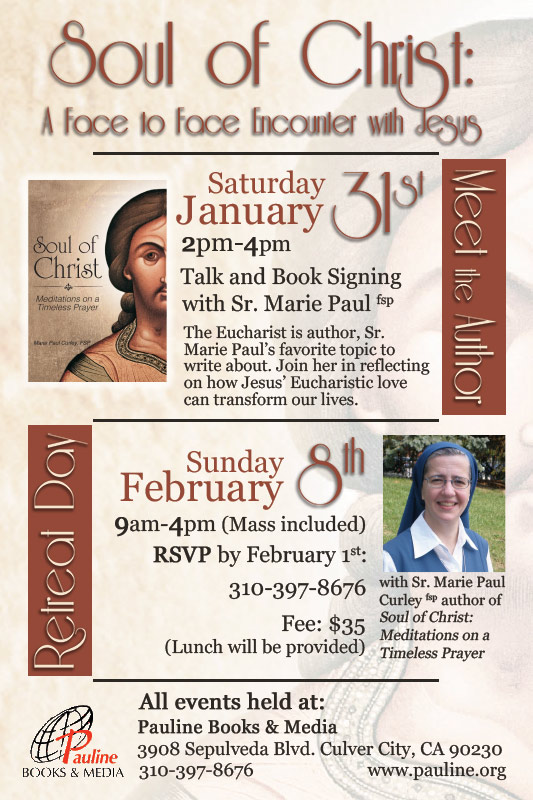
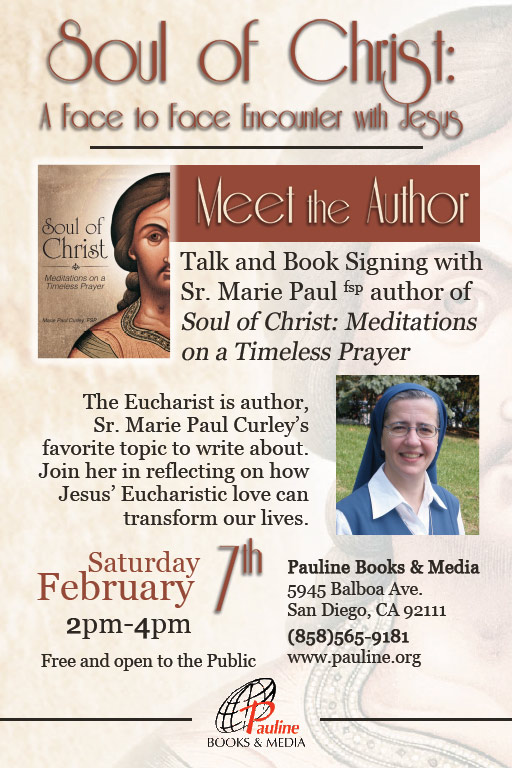
(For more on Eucharistic adoration, you may wish to check out my book, Soul of Christ: Meditations on a Timeless Prayer, or another book on Eucharistic prayer.)
Insight 3. Discernment is not about proving ourselves; it’s about love. None of us are “worthy” of being loved or being called to love. If we honestly know ourselves and ponder the heights of each vocation to love—whether it is the vocation to consecrated life, single life, or marriage—all of us find ourselves lacking.
Several times during the show, a young woman referred to “proving” herself to God, or “redeeming” herself in the eyes of others. This highlights for me again that the show can be misleading about competition and comparisons. Discernment is about discovering that we are loved by God deeply and wondrously, and then responding to God’s amazing love.
Discernment is about discovering our call to love.
4. God works with each of us individually. There are commonalities within discernment, but there is also the truth that God has a unique relationship with each one of us.
Every young woman experienced something remarkably different in the aftermath of several events, for example, praying the Rosary in the car after Darnell showed up to bring Eseni home (and thus short-circuit her discernment). From bringing back painful memories for Stacey and prompting her to feel lost, to offering light and clarity for Christie, this moment showed how unique each woman’s journey is. God’s individual guidance was also very clear during the young women’s different responses to the quiet time of Eucharistic adoration. Some of the young women were deeply touched and one had a breakthrough, while some found the adoration time very difficult—with one young woman needing to leave for some fresh air. (Note: It might have been helpful if the young women had some guidance in how to make an hour of adoration, especially for those who hadn’t done it before.) Because discernment is so individual, a group experience like this—while it has its strengths—also needs to take into account where each young person is. Obviously this wasn’t possible in a show like this.
* * *
Although the young women and sisters offered a lot of support to the young women discerning, both Episodes 3 & 4 had moments that really challenged me to continue watching, when certain behaviors contradicted Gospel values that are sought to be lived intensely in religious life. Especially the moments where participants of the show talk about others on camera, it’s hard for me to see the charity at work there amidst the comparisons, even knowing the comments are taken out of context. As one of our sisters, @SrSeanM so eloquently put in Twitter-verse nuggets last week:
“I figured out what’s bugging me about #TheSisterhood. They’re treating #discernment like religious life Boot Camp. And it’s so not!”
“#Discernment NOT a matter of seeing whether or not you measure up! It’s a matter of discovering what you are called to.”
“There are no short-cuts to creating a deep loving relationship. Love takes time and persistence. #Vocation is a call to love.”
Ultimately, discernment is a call to love: to discover how loved we are, and to respond to that immense, divine love! I close this post as I have in the past: by praying for the discerners on the show and watching the show. The prayer below is adapted from the prayer given to us by our Founder, Blessed James Alberione, to encourage prayer for priestly and religious vocations:
Jesus, Divine Master, who said, “The harvest indeed is great, but the laborers are few,” we lovingly accept your invitation: “Pray the heavenly Father to send forth laborers into his harvest.”
Inspire a devout crusade for vocations: “All the faithful for all vocations!” More priests! May they be the salt of the earth, the light of the world, the city placed on the mountaintop for the salvation of humanity redeemed by your blood. More religious–both men and women–to fill the earth with religious houses which welcome your chosen ones, and which will be centers of light and warmth, sources of prayer, gardens of saints, singing “glory to God and peace to men and women of good will.” More husbands and wives, fathers and mothers, who testify to your Gospel in the world, at work, in the family, and in the loving formation of their children.
Mary, “God’s chosen one,” Mother and guardian of holy vocations, pray with us, pray for us, and for all called by God to live our vocations in greater love and holiness. Amen.


 Co-Author Your Life with God
