The Story Behind This Blog

SrPaulSelfSmallGloomedFor nine years, I’d helped young women discern their vocation–whether they were called to religious life, married life, or the single life. I offered workshops and mini-courses on vocational discernment, discernment retreats, and individual vocational accompaniment. The intensity of others’ discernments helped me live the spiritual art of discernment much more mindfully. I was thrilled that I could focus on discernment so much, though I knew that I was just beginning to go deeper into living this profound spiritual art and practice. I was even asked to write a book about it—a book that I never got to.

Then I was transferred to another assignment–something very different from what I’d been doing. “No big deal,” I thought. I planned to continue discernment as an important part of my Pauline life. After all by this time, I’d been a religious sister living the vow of obedience for over twenty-five years.

But in a new and unfamiliar environment, the multitude of choices and decisions I faced daily made me feel paralyzed. When presented with several fantastic opportunities, I had no idea which one God was calling me to do. My prayer, dry at the time, didn’t shed any light. God made his presence felt, but not his desires, not his will. I felt as if I had no clue which opportunity or direction was truly his will. And just as I was realizing how inexpert I was in the art of discernment, I was once again asked if I would consider writing a book on discernment!

God often puts unexpected plot twists in the story of my life. This is not the first time that God has called me to grow in a certain area in my life by inviting me to write a book. So I’ve decided to give it a try. To create a true dialogue, to receive input from readers, and to make sure that I’m speaking to others’ real questions about discernment, I thought it would be great if I could blog the book first. And this blog, CoAuthorYourLifewithGod, was born.

Discernment has become a key part of my life because it leads me into greater alignment with God’s will, to live God’s story for me. Although I’ve spent a lot of time discerning and witnessing others’ discernments, I’m no expert. I still struggle with discerning how God is inviting me when I’m overwhelmed, afraid, or attached to having my way. The truth is that all of us can grow in this spiritual art of listening to the Lord’s invitations and striving to respond with a generous “yes!”

This blog gives us the opportunity to reflect on and grow in the spiritual art of discernment. Please ask questions, comment, and be active here on this blog—it’s for you! I’ll try to include opportunities to share, contests, and surveys that will make it fun to explore this important spiritual art, as we together seek to discover how we can listen more deeply and respond more generously to God’s loving call in our lives.

I’d really love to hear from you (in the comments box below or you can email me, too–just mention if you’d like me to keep your question anonymous):

  • Why have you stopped by and visited this blog?
  • What are you discerning?
  • What questions do you have about discernment or growing in your relationship with God?
  • What would you like to see here on this blog that would be helpful for you on your discernment journey?

God Dreams with Us – Part 2

01A choice 1In discerning God’s will, neither scruples nor a careless “whatever goes” attitude is helpful. God is close and wants to reveal himself to each of us. Discerning God’s story for us involves a lot of listening, but that’s because we are usually spiritually hard of hearing. God not only wants to communicate his love and his plan for us, he wants to work out that plan with our full participation, which includes our making choices. Our full participation doesn’t, however, mean that we can see the whole picture: seeing the full story is a surprise that awaits us in heaven. (Read Newman’s “I am created to do something or to be something for which no one else is created” for Blessed John Henry Newman’s take on this.) Instead, God’s story for us unfolds step by step, giving us what we need to know to do his will, to live his dream for us.

There are many times when I’ve been grateful for how God has led me through a particular circumstance, and afterwards I see how it was really important for me to go through. But I’m really glad I didn’t know all of what was involved ahead of time, because I know I would have worried so much about it that my fear would probably have made me resist God’s plan for me. I might not have truly believed that God’s grace would be there for me to help me.

God gives us the grace to live the present moment, not the future. For me, worrying ahead of time can lead to fear and resistance to God’s grace. And then the gifts and the growth that could come from that experience would be lost.

Most likely, we will not fully understand all of God’s plan for us while we’re here on earth. The best choice and the most important attitude we have is to seek God’s will. As we figure out what that means, and as our heart is purified to ignore other distractions and truly seek God’s will, God can work with our faltering steps.

* * *

Prayer Corner: Pray with Your Dreams

Have you ever prayed about your dreams? Take a few moments and journal:

  • What were your childhood dreams? What did you picture yourself doing when you were younger? How did you see yourself living your life?
  • What are your dreams now?

Bring this list of dreams to prayer and share them with God. Take a few moments to offer each dream individually to God. 

After your prayer, how do you feel about your dreams for your life?

God Dreams with Us, Not for Us

DSC03070One of the traps that we can fall into when we’re trying to discern something is to think that God has one precise and perfect way picked out for us, and woe to us if we take a wrong step. We mix up God’s knowledge of the future with God’s will, imagining that God already wrote the complete story of our lives, and that we really don’t have free will. That’s a pretty robotic view of human nature, and it’s far from the Church’s teaching about the human person. (See the Catechism of the Catholic Church, numbers: 1704, 1705, 1711, 1731, among many others.)

1. God doesn’t abandon us if we don’t pursue his dream for us—he always loves us and continues to invite us towards a closer relationship with him, up to the last moments of our lives.

2. God knows us better than we know ourselves, and God is all-wise, so whatever God wants is a perfect fit for us. His dream for us is exactly what we want at our deepest core, we just don’t always know it.

3. God’s dream for us isn’t created apart from us. It might be more accurate to say that God dreams with us, not for us. With the Holy Spirit, we are co-protagonists in the story of our lives.

4. God values our free will so much that he invites us (not forces us) into a loving relationship with him. Similarly, he invites us to enter into his dream for us. We choose how we respond to God’s invitations. God respects our freedom, and is more than willing to work with whatever steps we take, especially when we are sincerely seeking his will for us. Even when our steps seem to be going in the opposite direction, God is able to turn things around in the blink of an eye. The cliché “God writes straight with crooked lines” totally fits here—although it’s not complete. It’s even more than that! God seems to delight in working with our littleness, even with our limitations.

(We have a powerful reminder of this as we approach Christmas: God delights so much in working with human littleness that, when he took on human nature, he was born a little Baby.)

God Has a Dream for You

Not sure where the path is leading...

Not sure where the path is leading…

After I entered religious life, I was almost immediately assigned to proofreading as a way of taking part in the Pauline mission.* Already a bookworm, I loved it there because I got to read almost half of the new books that our sisters published that year. And I became a pretty good proofreader, too. It seemed the perfect fit.

About two years later, I was assigned to the newly developing Pauline Video studio. I was flabbergasted. Why would anyone in their right mind take me away from books and throw me into a department that required talent in visual arts and a combination of skills that I knew I didn’t have: creativity, technical skills, and an ability to design? As I struggled with the new assignment, one of the sisters told me, “God knows us better than we know ourselves. You wait and see: God will show you why you’ve been sent there.”

It took me a number of years to figure out what a marvelous gift God gave me in transferring me to the video studio. Working in a small studio where everyone has to help out in many areas—out of sheer necessity—stretched me to develop talents I’d had no idea I had. And it also gave me many opportunities to write. Although I’d never thought about writing a script before, it became my favorite form to write in. Sometimes God’s co-authorship gives our stories a plot turn that we do not expect!

Over the years, I have learned to trust that God always has a reason for leading us—God wants to lead us closer to himself, and closer to the fulfillment of God’s dream for us.

And God’s dream for us is better than we could ever possibly imagine!

*The Daughters of Saint Paul have the mission of communicating Christ through their lives and all forms of media.

The best discernment partner ever!

Due to our internet going down, I haven’t been able to post here or on Twitter since Thursday. Happily, we are up and running this morning!

Also, it’s my understanding that Lifetime will run the last two episodes of The Sisterhood: Becoming Nuns from 10 PM-Midnight EST tomorrow night. As before, the #RealPostulants and #MediaNuns will be tweeting about it, using the hashtag #TheSisterhood. I’ll also try to put my commentary up Wednesday morning. (Although I’m definitely going to be short on sleep!)

REQUEST FOR YOUR HELP: If you are watching The Sisterhood, feel free to tweet questions about discernment to me @SisterMPaul, and I will answer them on this blog! (Or you can simply email me anytime or put a question in the comments on any post.) God bless you!

* * *

Photo by Sr. M. Emmanuel Alves, fsp. © Daughters of St. Paul.

© Daughters of St. Paul. Photo: Sr. M. Emmanuel Alves, fsp

We do not discern alone.

Does it surprise you to discover that you have a partner ready to help you sort out your life? A partner who wants the best for you, who understands you better than you do yourself, who knows what will bring you the greatest happiness and fulfillment, who can bring to life your deepest dreams, who respects your freedom, who waits for you to ask for guidance?

This perfect partner is the God who created you out of love and for love, who died to save you and bring you greater freedom, and who now not only sustains your every breath but desires to walk with you and enliven your daily journey with joy, peace, and fulfillment.

The God who knows you better than you know yourself created you with a specific mission in mind. Yes, God has a dream for each of us, and shares with us our deepest dreams for ourselves—dreams of being our best selves, of living lives of purpose, meaning, and love.

God is with you on every step of your journey: previous, present, and future. When we remember that we have the perfect Partner to discern with, a Partner who shares our deepest dreams, we no longer need to fear the uncertainty of sorting through our lives on our own. Because we are not alone. God’s dreams—God’s story for you—are beyond all your cherished hopes and dreams.

* * *

Daily Discernment Tip

Today, pray this simple prayer of trust several times: Lord, I trust in Your dream for me.

Insights & Contradictions in The Sisterhood, Episodes 3 & 4

OLYMPUS DIGITAL CAMERA

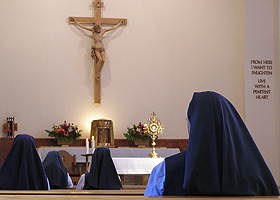
Adoration in our Pauline Chapel

Lifetime’s reality TV show The Sisterhood: Becoming Nuns continued last night with episodes 3 and 4 back-to-back. These new episodes highlighted all the conventions of a reality TV show that I don’t enjoy: competition, heightened (over-the-top!) drama, staged scenes, coaching from the show’s producers, oversimplification of relationships and personal journeys, and an overt editing that revealed an obvious manipulation of various events. For me, watching this show has become a study of reality television shows and how “not real” they are!

Yet, if we take these conventions into account, it’s still possible to gain insight, both into religious life and into the process of discernment, as some viewers live-tweeted with other sisters and me while watching the show. I think this is particularly true because of the good will of the sisters and discerners on the show, who tried to be real in their interviews and comments.

Insights that I think could be particularly helpful for those of us who want to live more deeply in a spirit of discernment are:

Insight 1. Do not be afraid, but trust in God! We can often see God’s hand in our lives much more clearly when we look back on an experience, rather than when we are living in it. The most positive moments in the show so far have been when the young women leave one convent for another. In looking back on their experiences there, they talk about being loved, about experiencing God, and about growing as persons.

Yet we have just witnessed that these visits were not easy to go through. So these episodes help us to see that even in the difficult, confusing, or challenging moments of our lives, we need to cling to hope: God will use every event to draw us closer to himself, if we let him. This insight bears repeating for all of us: Do not be afraid! Trust in God, no matter where you are because he is with you.

Insight 2. The power of Eucharistic adoration in discerning. As a Pauline sister, I have a special love for Eucharistic adoration. My favorite description of adoration is something that St. John Paul said when he encouraged young people to go before Jesus in the Blessed Sacrament and simply “let him love you.”

If you already pray before Jesus in the Eucharist regularly, you know how blessed we are to be able to take advantage of his presence, his love, his availability! When you take quality time with Jesus in the Eucharist—at Mass, receiving Communion, or making some time for adoration—Jesus will transform the rest of your life as well. You cannot, will not, walk away unchanged.

If you don’t already make an occasional or regular Eucharistic Hour of adoration, I encourage you to consider it, perhaps by starting with just 20 minutes. There is something about the tangible closeness and vulnerability of Jesus in the Eucharist that can pierce through our blindness and defenses, helping us understand how loved we are, and how faithful his love is.

For those for whom the silence of adoration is really hard, there can be for a number of reasons, but I hear two reasons repeatedly:

1) We simply don’t know what to do with the silence.

2) When we are silent for a time, all the negative stuff–thoughts, feelings, or experiences–that we carry within us come to the fore, and we’re not expecting that. It can make any time of silence difficult, including time of adoration. It can be really hard if we feel that we have to be “extra-holy” to come to adoration.  But what better place to deal with the “tough stuff” of our lives than with our loving Lord? In the Eucharist, Jesus welcomes and loves us. Jesus knows us better than we know ourselves, and delights in us, no matter what we are struggling with. And when we draw close to him in the Eucharist, we are inviting him to work in us, to heal us, to help us to grow.

What can we do if we struggle with the silence? Here are a couple quick suggestions:

  • Bring whatever is troubling us to Jesus in the Most Holy Eucharist. Keep the time of adoration to a length that feels manageable. Even five minutes of adoration can transform our day. And use favorite prayers and Scripture readings to make the time of adoration a real encounter with Jesus.
  • Use a method to guide your time of adoration. Saint Alphonus Liguori’s method is beautiful and easy to use. The Pauline way of adoration is my favorite—you can find more about it below.
  • Use a book like my newly published Soul of Christ to guide your time of adoration.

(For more on Eucharistic adoration, you may wish to check out my book, Soul of Christ: Meditations on a Timeless Prayer, or  another book on Eucharistic prayer.)

Insight 3. Discernment is not about proving ourselves; it’s about love. None of us are “worthy” of being loved or being called to love. If we honestly know ourselves and ponder the heights of each vocation to love—whether it is the vocation to consecrated life, single life, or marriage—all of us find ourselves lacking.

Several times during the show, a young woman referred to “proving” herself to God, or “redeeming” herself in the eyes of others. This highlights for me again that the show can be misleading about competition and comparisons. Discernment is about discovering that we are loved by God deeply and wondrously, and then responding to God’s amazing love.

Discernment is about discovering our call to love.

4. God works with each of us individually. There are commonalities within discernment, but there is also the truth that God has a unique relationship with each one of us.

Every young woman experienced something remarkably different in the aftermath of several events, for example, praying the Rosary in the car after Darnell showed up to bring Eseni home (and thus short-circuit her discernment). From bringing back painful memories for Stacey and prompting her to feel lost, to offering light and clarity for Christie, this moment showed how unique each woman’s journey is. God’s individual guidance was also very clear during the young women’s different responses to the quiet time of  Eucharistic adoration. Some of the young women were deeply touched and one had a breakthrough, while some found the adoration time very difficult—with one young woman needing to leave for some fresh air. (Note: It might have been helpful if the young women had some guidance in how to make an hour of adoration, especially for those who hadn’t done it before.) Because discernment is so individual, a group experience like this—while it has its strengths—also needs to take into account where each young person is. Obviously this wasn’t possible in a show like this.

* * *

Although the young women and sisters offered a lot of support to the young women discerning, both Episodes 3 & 4 had moments that really challenged me to continue watching, when certain behaviors contradicted Gospel values that are sought to be lived intensely in religious life. Especially the moments where participants of the show talk about others on camera, it’s hard for me to see the charity at work there amidst the comparisons, even knowing the comments are taken out of context. As one of our sisters, @SrSeanM so eloquently put in Twitter-verse nuggets last week:

I figured out what’s bugging me about #TheSisterhood. They’re treating #discernment like religious life Boot Camp. And it’s so not!”

#Discernment NOT a matter of seeing whether or not you measure up! It’s a matter of discovering what you are called to.”

“There are no short-cuts to creating a deep loving relationship. Love takes time and persistence. #Vocation is a call to love.”

Ultimately, discernment is a call to love: to discover how loved we are, and to respond to that immense, divine love! I close this post as I have in the past: by praying for the discerners on the show and watching the show. The prayer below is adapted from the prayer given to us by our Founder, Blessed James Alberione, to encourage prayer for priestly and religious vocations: 

            Jesus, Divine Master, who said, “The harvest indeed is great, but the laborers are few,” we lovingly accept your invitation: “Pray the heavenly Father to send forth laborers into his harvest.”

            Inspire a devout crusade for vocations: “All the faithful for all vocations!” More priests! May they be the salt of the earth, the light of the world, the city placed on the mountaintop for the salvation of humanity redeemed by your blood. More religious–both men and women–to fill the earth with religious houses which welcome your chosen ones, and which will be centers of light and warmth, sources of prayer, gardens of saints, singing “glory to God and peace to men and women of good will.” More husbands and wives, fathers and mothers, who testify to your Gospel in the world, at work, in the family, and in the loving formation of their children.

            Mary, “God’s chosen one,” Mother and guardian of holy vocations, pray with us, pray for us, and for all called by God to live our vocations in greater love and holiness. Amen.

What discernment is…

During my first year as a pre-postulant in the Daughters of Saint Paul

During my first year as a pre-postulant in the Daughters of Saint Paul–just after the most dramatic discernment of my life!

I made the most dramatic discernment of my life (up till now) when I was a teenager and discerned God’s call to enter religious life. At the time, I didn’t have the depth of understanding of discernment that I do now. But if you’d have asked me, I would have described discernment as, “seeking to do God’s will.” That classic definition still works for me, as well as all the descriptions given in my previous post.

(Yes, it was a trick question: all the answers are correct!)

But below are some of my favorite descriptions of discernment:

Discernment is…   

1. Seeking God’s will for my life

2. Coming to know Christ and recognize his presence in the story of my life

3. A spiritual art in which I come to better understand how God communicates himself to me, and how God is saving me…my personal salvation story. This definition is taken from one of my favorite authors on discernment, Jesuit priest Father Marko Ivan Rupnik, from his book: Discernment: Acquiring the Heart of God.  More about his wonderful book soon!

Perhaps you’d like to add a description of discernment in your own words. If you do, please share it!

4. ___________________________________________________________________

(You can email me if you’d like me to post it, or you can put it in the comments below.)

Keeping in mind both these descriptions and the ones from my previous post, we can now look more closely at why discernment is important:

If we believe in a God who truly loves us and wants what is best for us, then discerning what God wants is the best way to find happiness. God’s story for us may have its ups and downs, but it always leads to a happy ending!

What discernment is NOT…

What is discernment and why is it important?

discernindictionary2compressIn this blog, we’re talking about discernment in the Catholic spiritual tradition, which is a specific meaning different from the typical dictionary definition—“making a good judgment,” or “distinguishing between good and bad.” Discernment takes on its true importance when we understand what it is and what it is not. Discernment is not:

  • Making a decision
  • Magically becoming 100% sure of what God wants
  • Receiving visions or hearing voices from God
  • Rationally deciding what’s best to do
  • Knowing God’s entire plan for my life
  • Judging right from wrong*

*Note: God, who is all-good, can never desire evil; God can never desire that we do something that is wrong. If we are truly discerning, then we are deciding/choosing between two (or more) good things. If something is morally wrong, we may struggle with what to do, but we are making a moral judgment or choice, not a discernment.

So, what is discernment?

Choose the best definition of discernment.

Discernment is…

a) a search for the will of God

b) the art of communication between God and us, the art of reciprocal understanding

c) the art of living in the Holy Spirit

d) the art of entering into a free relationship with all that exists

Which definition did you choose?

In my next post, I will share my favorite definition of discernment!


Discernment Tip:

Turn your favorite definition of discernment into a prayer, and carry that prayer with you through the day (e.g., if your favorite definition is “Seeking the will of God,” then make this your prayer today: “Lord, help me to seek Your will”).

Learning from The Sisterhood: Discernment in Episode 2

discernit quote

Prayer To Discern Well from new Discern It! App

As I mentioned in my previous post, and have shared in many conversations, Lifetime’s show The Sisterhood: Becoming Nuns,  while suffering all the limitations of a reality TV show, can do a great deal of good by offering to viewers a fascinating portrayal of religious life, and a sense of the challenges and obstacles a young woman faces in discerning whether she is called to become a sister.

Episode 1 introduced us to each young woman and to the Carmelites of the Aged and Infirm, where the young women are doing the first two weeks of their live-in. Episode 2 brings us right into the “nuts and bolts” of the young women’s discernments.

For this episode, I’d like to look at some of the typical discernment moments that arose on the show, seeing what we can learn from them (and without making any judgments on the people  involved). Some key moments in discernment that I noted while I watched:

  • Eseni’s desire for growth and peace, and Sr. Maria Theresa’s response that it is important for her to seek healing. I really loved Sr. Maria Theresa’s comment that all of us are broken, and all of us need healing. (By the way, this is a wonderful insight for Advent: we are all in need of a Savior!)When we feel deep turmoil and restlessness, it’s a good time to reflect, but isn’t necessarily the best time to make a big change in our lives, because we might be making a change simply to find relief from our inner pain, rather than truly following God’s invitation. Saint Ignatius of Loyola has some great guidelines about this. If we are discerning about something major in our lives and we discover that we are deeply troubled about something else, we may want to slow down our discernment, or discern the cause of our turmoil and take steps towards healing and peace, rather than make a big decision about our original discernment. In general, when we are discerning something major in our life like our vocation, we want to discern from a place of peace.
  • Christie’s desire for greater intimacy with Christ, while instead she was feeling desolation. I love how honestly she puts it: “I showed up and he [Jesus] didn’t!” A wise spiritual director might encourage someone in a situation like Christie to not be afraid and to “stay the course” and not make any hasty decisions—either about going home or entering religious life. In the midst of the kind of anxiety or desolation that Christie seemed to be experiencing, we want to pay attention. The spiritual life is full of experiences of consolation and desolation, so when we are in the throes of desolation, it’s good to take it slow and reflect on what’s happening. A spiritual director who has experience in Ignatian discernment, especially “discernment of spirits,” can be really helpful, because St. Ignatius offers a lot of wisdom when he describes the different causes of spiritual consolation and desolation, and how we can discern even from within them.
  • The courage that several young women showed during times of anxiety or difficulty in participating in the sisters’ mission is inspiring and encouraging for all of us who seek to discern. Discernment takes great courage and freedom because we are letting go of our illusions of control and our ego, trusting in the Lord instead, and surrendering to his guiding love.
  • At several points Claire struggles with her relationship with the other discerners. Several comments that were made highlighted for me an important principle in matters of the spiritual life—including discernment. It’s not helpful to compare ourselves with others, especially if we’re trying to determine where we are on our journey or our next step. God works with each of us individually, and each of us has unique experiences and a unique relationship with God. While we can learn from each other, note similarities or differences in our journeys, we don’t want to fall into the trap of making comparisons or judgements.

And this is important, not just for the young women and sisters in the show, but for those of us watching as well. Even in a show with such good intentions as The Sisterhood, the temptation seems to be to compare these young women to each other, and to judge their responses to the challenges they face (and then to compare with ourselves). This is a very human tendency, but comparing these young women to each other and making judgments about their journeys is really unhealthy spiritually. (It brings to mind a homily Pope Francis gave last year about gossip.) Talking about others uncharitably is gossip. A TV show about discernment might especially tempt those of us who know more about this spiritual art to make judgments about the people involved. But in all honesty, as viewers we are not even receiving the full picture.

We all know that reality TV is not real:

  • it’s edited so that we never have the full context for any event or conversation
  • people naturally play to the camera or can even react differently if they are within range of a camera
  • reality TV fosters or emphasizes drama.

We also don’t know what only God knows: the deep desires and motivations of each person. Keeping all of that  in mind, even if we had the right to judge, we don’t have the full information needed to do so. (And we never do!)

* * *

In that spirit, I’d like to close with a prayer for all the discerners: those on the show itself, and those who are watching and seeking to discern God’s will for their lives.

Come, Holy Spirit, and shine your light, peace, and wisdom on Eseni, Stacey, Francesca, Claire, and Christie, and all those who seek to live more fully in accord with your will.

-Give them the peace to not be caught up in their feelings, but to sort through them in serenity to have greater clarity about their desires

-Purify their hearts so that their motivation to live in union with you grows always greater

-And grant them the courage and freedom to risk, to take on new challenges and try new things, as they seek to discover how you call them to live the Gospel of life and of love. Amen.

For those interested, you can find the new, free Discern It! App here from the Daughters of Saint Paul.

The Power of Stories

antique-booksI have loved stories ever since I can remember, becoming an avid, insatiable reader as a child.  Some years ago, I realized that if I wanted to make a talk or workshop memorable, I had to tell a powerful story. Better yet if I could illustrate and connect the important points of my workshop together through a series of stories. We are surrounded with stories: novels, TV shows, films, video games… Some would call our communications culture an entertainment culture; even our news has become “infotainment,” which means that for us to retain facts, they are best told to us in an entertaining way (usually narrative- or humor-driven). We may think that we are sophisticated technologically, but our nature as human beings hasn’t changed. We always have and still find a good, simple story hugely compelling.

While it’s lamentable that many of us seem to need to be entertained to stay well-informed, and that our attention span as a culture seems to be growing collectively shorter, it’s reassuring that the power of a good story hasn’t changed. Stories have always been compelling, and stories can go well beyond simple entertainment.

Stories are often an important way in which we find meaning in events that are troubling, complex, or outside of our usual experience. Looking at a seemingly random incident in the light of its causes or consequences can comfort us with a sense of meaning or purpose. A good story can:

* help us learn from another’s experience

* feel a sense of community or support

* discover our identity

* recognize a pattern in seemingly random events

* discover what we share with others who are different from us

* walk in another’s shoes

* be inspired to see how important even one small event or choice can be

Perhaps because a good story “works on us” on several levels (intellectual, emotional, imaginative, experiential, spiritual, etc.), stories remain one of the most important ways we have of making sense of our world and of our lives, and of communicating in a meaningful way with others.

In the Bible, God uses stories to communicate with us. From prophets in the Old Testament, to Jesus, to the adventures of Saint Paul, to the Fathers of the Church, to theologians today, the events of the Bible are seen as salvation history—that is, the story of how God redeems, heals, and saves his people.  Our individual lives can also be seen or interpreted as our personal stories of God’s healing, saving action in our lives, and our response to God: our personal salvation history.

In The Silmarillion, when Tolkien told the story of the creation of Middle Earth in a way beautifully reminiscent of Genesis, he wrote about creation as “great music.” As a Catholic and as a story writer, when I reflect on the world that God has created and my place in it, I see God as the Creator but also as the Storyteller, and Jesus not just as the Word of God but also the Story of God.

Seeing our individual lives as part of God’s salvation story for all humanity helps us to see the larger context of our lives, and to accept life’s ups and downs more easily, discovering meaning (or at least some meaning) behind the challenges, sufferings, joys, and routine of our lives.

* * *

Pen_Uncapped 

To Journal About

1. What are my favorite kinds of stories?

2. If I think about my life as a story, what kind of a story is it?

3. How do I see my life as my salvation history? What role does God have in the story of my life?

Discernment Tip:

Re-read my favorite story in the Bible. Why do I like this story? What might be God’s invitation to me through this story?