What are you discerning?

02 D (me)In light of God’s Storyview (see several previous posts),  let’s break down/explore the first key to an authentic discernment, which answers a key discernment question:

What can we discern?

When I first saw the great classic film, The Godfather, I was riveted by the core dramatic question: Was the younger son Michael Corleone going to become the next padrone? The film brilliantly explores moral choice; how one chooses what one will do with one’s life, including the complexity of intentions; the responsibility of those surrounded by an evil that has become systematized; the attractiveness of evil disguised as protecting one’s family; the insidious process of corruption from within. But as brilliant an exploration of good and evil this film is, The Godfather is never about discernment, because becoming part of the mafia is aligning one’s self with evil, and is thus a choice for evil, no matter what a person’s intentions are.

If a choice involves an option that is sinful, it’s not a situation where we need to discern God’s will. Instead, it’s a situation in which we need to pray for the wisdom to make a good moral decision and for the moral strength to resist temptation and respond to God’s grace.

Very often when Catholics hear the word “discern,” they associate it with vocational discernment, e.g., a person seeking to discover whether their vocation is to marriage, single life, consecrated life, or priesthood. (Or in some cases, a combination of two.)

Vocational state is a great example of what to discern because all the states in life are inherently good. Discernment is always between good things. God, who is Truth, Goodness, and Beauty, is always going to invite us to truth, goodness, and beauty. God cannot contradict himself; God’s will for us can never be something morally wrong.

One of my favorite movies about discernment is Amazing Grace, the story of two crises (and two discernments) in the life of William Wilberforce, an Englishman who dedicated his life to end slavery in Great Britain. If you have the opportunity, I encourage you to see the film using the “lens” of discernment. Several principles of discernment that we’ll look at here on this blog are well depicted in the movie, which I will highlight and reflect on in a later (soon to come!) “Discernment @ the Movies” guide.

Pen_UncappedTo Journal About:

  • What difficult moral choices am I facing in my life? What can I do to gain the wisdom and strength to make a good decision?
  • What in my life do I want or need to discern? What are the “goods” that I am discerning between?

Four Essential Principles for Discernment

02 CAs we’ve been reflecting in the past few posts, discernment begins—and makes sense—only in the light of God’s point of view: God’s unconditional love for us. From God’s storyview flow the “key principles of discernment” that we will explore in the next few blogposts. In classic or traditional terms, these are essential to authentic discernment:

Between two (or more) good choices. It’s not a good choice vs. a bad choice. God would never want us to choose to do something bad.

In the context of a vibrant relationship with God. Discernment is more than making a choice or a decision—it’s seeking God’s will. How will we come to know or want what God wants, unless we come to know and love God?

“3D” listening. As we discern, we need to pay attention to our whole being, our loved ones, our circumstances, and the world around us, because the Holy Spirit lives and works within us, around us, and through others. Our thoughts, feelings, situations, others’ needs and concerns, the needs of the world, the insights of others, the voice and needs of the community, the guidance of a mentor or guide–all of these help us to listen to God’s invitations.

Free. Making a free choice is the aspect of discernment that can take the most time, wisdom, reflection, and guidance.

Please Chime In!

Do these points make sense to you? In the next few posts, we’lll explore each of these key principles of discernment, but it’d be great to hear your questions! You can post them here in the comments, or email them directly to me.

Discernment Attitude: Trusting God Wants the Best for Us

BibleAs looked at in the last post, we know that the Bible reveals to us God’s basic story premise:

Our all-good God loves us and always wants what is good and best for us.

What does this mean for us? Unpacking God’s story premise gives us a couple more important foundations for our discernment:

1) God is good and always wants what is good. So whatever we are discerning must in itself be good; it must conform to God’s law. Our all-good God would never want us to do something morally wrong. God doesn’t contradict himself. When we are making a choice between good and evil, we are making a moral judgment or moral choice. This is different from discernment in the spiritual sense. God always want us to choose what is good.

2) God loves us as we are. Our Creator God wants what is good and best for us. Having created us in his own image, with intelligence and free will, God invites us to live our full potential, to “become our best selves” by loving fully and freely. While God will never violate our free will, evil in the world around us and our own tendency towards sin condition us to make choices that are not always truly free. This is why God sent his Son into the world. Jesus Christ is God’s “Yes!” to humanity, God’s “Yes” to the question of whether God loves us.

A big part of discernment—and why a good discernment often takes time—is our becoming interiorly free enough to receive God’s love. Receiving God’s love and letting it transform us means  letting go of fear, guilt, outside pressures, or anything else that can distract us from God’s invitation and dream for us.

3) God is always, actively, seeking what’s best for us. The Gospel of John reminds us that God is love. For God, love is not a noun but an active verb. Whether we know it or not, whether we see it or not, God takes an active part in our lives. Because God is pure Being, whatever God wants is also what God acts to bring about. God doesn’t just drop us into the world and walk away. Jesus reminded us of this concretely at the Last Supper, when he promised to send the Holy Spirit, and that he would be with us always.

The Holy Spirit is God at work in the world around us and in the people around us, including family, friends, enemies, mentors. This means that: Authentic discernment always takes place within the context of this vibrant relationship with God. The more we seek out a vital connection with God, the better our discernment will be. True discernment means listening for how the Holy Spirit is speaking to us, how the Spirit is inviting us, how the Holy Spirit is acting in our lives. One of the key places where the Holy Spirit speaks to us is in the depths of our own hearts.

God’s Storyview

rainbow809697_26431701-foto stoch-xchngOur loving Creator has revealed himself as Father. God has created a world that is exquisitely designed, beautiful, astonishing, powerful, and full of mysteries. This amazing and mysterious universe is where we live our lives, our stories. As we grow, we discover how our universe works—in its physical aspects (such as the rule of gravity), in our human nature, in the spiritual realm, etc. If we want to discover and live God’s story for us, if we truly want to co-author our lives with God, it’s helpful to understand God’s overall design. How can we tell what’s most important to God, and how God views his creation?

By listening to God.

God reveals himself in many ways, but most clearly in Sacred Revelation: the Bible and Sacred Tradition. This is where we can best find God’s view of the world he has created, his overall design for humanity, and the stories that he wants us to live. One simple way to describe God’s “storyview” is this basic premise that describes salvation history:

Our all-good God loves us and always wants what is good and best for us.

The spiritual art of discernment only makes sense in light of these foundational truths: that God is good, that God loves us, and that God always wants what is best for us. These fundamental truths give us important principles with which to shape our stories. In my next few posts, we’ll unpack them.

Pen_Uncapped

To Journal About:

It might be helpful to take a moment to take in this profound statement that is the foundation for any good discernment, allowing it to sink in.   

Our all-good God loves us and always wants what is good and best for us.

When I read this statement—to myself or aloud—what is my first reaction to it? What do I think? What do I feel? Do I believe it to be true?

God’s Story for Us

01A choice 2 (me)Oops! There’s a catch there in my last post when I said I love my plans. The catch is that I don’t just enjoy making plans and rejoicing when they work well. I actually become invested in my plans, to the point that I can make my security revolve around my plans–how well they are working, etc. If you are one of those people that rejoice in saying, “It’s all going according to plan,” then you might also be in danger of absolutizing your plan…or at the very least, making it more important than it was ever meant to be.

Because a plan is a very temporary thing, meant to serve the needs of the moment. It’s not meant to be something that takes over our lives, that becomes more important than its purpose, or the people it involves, even ourselves.

Yet plans can be incredibly helpful and important–in keeping a group on track, in juggling many things at one time, in achieving goals that, without a lot of careful planning, might otherwise be impossible.

Whether you are a pantser or a planner, whether you love plans or hate them, or whether you are somewhere in-between–loving the organization that plans bring, but longing for more spontaneity–you probably aren’t neutral to plans.

The problem with any plan is that it isn’t perfect. No matter how many contingencies we anticipate, it’s likely that something will come up that we couldn’t foresee. And then the plan must be adjusted or replaced with another.

The good news is that the most important plan for you is perfect: perfect for you wherever you are, and flexible when your situation changes, or when you want to shift directions. What plan is that, you wonder? God’s plan.

* * *

Vocational Insight: Religious Life*

For all of us, the future is unknowable. As a religious with the vow of obedience, I don’t have the stability of creating my own plan, of knowing where I’m going to live, or the work that I’m going to be doing. While others can take this stability and this sense of control for granted, they are not part of my life. Often, I have no clue of what’s coming next. I cannot count the times when I’ve needed to change plans for the mission that I’m carrying out midstream. And I honestly never know for sure where I will be or what I will be doing a year from now. Although this might sound difficult to live, the security I have in living the vow of obedience is worth it:

Living well the vow of obedience offers me the certainty that I am doing God’s will, however unexpected it may be.

My vow of obedience demands that I trust in a larger plan that is not my own: in God’s plan for me, as mediated through my superiors. Though at times I may struggle in the moment (or the first weeks or months) to accept God’s plan for me, the truth is that every time I’ve been able to step back and look at my life, it’s clear that God’s love guides the story of my life. God’s plan has proven  over and over again to be the best for me.

*For those who are  discerning their vocations, I’ll occasionally offer an insight from the various states in life. Naturally, since I’m a religious sister, my personal insights will most often be about religious life. But I’ll try to find others to offer spiritual insights into the vocation to marriage, priesthood, and the single life too.

Planner or Pantser: Which Are You?

02A (GS)They say that all writers come in two flavors only: planners and pantsers.

For those who aren’t familiar with the term, a “pantser” is a writer who writes from the “seat of his or her pants.” In other words, they go into a writing project or writing session without a plan, and they just see what comes out, what happens on the page. A planner, of course, is a writer who outlines what they write before they start writing. Some writers write detailed plans–a summary of every scene that may even include lines of dialogue; others write a simple outline of what needs to happen chapter by chapter. Others might simply have a general outline of the major plot twists of the story. On the other extreme, “discovery writers” have no idea where their story is going until they’ve written it.

Like many other writers, I fall somewhere in the middle, but I definitely start all my writing projects with some sort of direction. Planning out the stories I write makes them stronger and heightens their drama, and also results in less rewriting. But I also find it important to be present to whatever I’m writing in the moment, because only then do I imagine or “live” the details of what I write. These specifics of an emotion or concrete details of an event are what makes the story more compelling, more resonant with people.

With regard to much of the rest of my life, I’m a huge planner. Making a plan may be challenging, tiring, or exhilarating, but I always find it wonderfully freeing to have a plan. It frees me because it gives me something to hang my uncertainty on. At the same time, my plans give me control. When it’s my plan, I can deviate from it as much as I want. Sometimes I feel that planning gives me the ultimate control: I can stick rigidly to the plan if I can’t think of anything better, I can use it as a general guide, follow tiny pieces of it, or throw it away all together so that I can live in the moment. I love my plans, because plans make the story of my future real, hopeful, and positive.

But then, something unexpected will happen and all my plans will be disrupted and become completely useless. While this can be challenging, even upsetting, when this happens I often experience an unexpected but welcome sense of being connected with the present moment. Instead of being focused on future plans, I’m simply living the gift of the present.

How do you feel about plans?

* * *

Pen_Uncapped

To Journal About:

  • Are you a planner? Or are you more spontaneous in how you live your life? If you are a bit of both, in which areas of your life are you more spontaneous, and in which are you more comfortable making plans?
  • What are the strengths of allowing more spontaneity in life? What are the weaknesses of being spontaneous in one’s approach to life?
  • What are the strengths of making plans? What are the drawbacks of relying on one’s own plans?

True Story: What It’s Like To Be Married to Jesus

SrHelenaRSister Helena Raphael Burns, FSP, a sister in my community, recently published the story of her discernment titling it: What It’s Really Like To Be Married To Jesus. It’s a fun read, but also offers some very helpful insights for those who are discerning their vocations, especially to  religious life.

My favorite line from Sr. Helena’s story:

This is what you’re [everyone is] supposed to think when you see a nun: “Yup! God is the Spouse of every soul, the Spouse of my soul.

When we live our vocations with authenticity–marriage, priesthood, religious life, single life–they complement and strengthen each other. Enjoy her story!

A couple weeks ago, I put out a call for questions about discernment, thinking that maybe Friday’s post could be a Q & A. Although a number of readers emailed me, only a couple of questions came up about discernment, mostly about discerning religious life, or what it’s like entering a religious community. I’ll be answering those questions shortly, but I just want to remind you that I’m happy to answer questions–and provide a forum where we can explore discernment together. For now, the best way to send me questions is to “comment” on one of my posts or send me an email. Questions sent to me on Twitter will probably reach me if you use @SisterMPaul, but questions on Facebook won’t reach me for now. (I haven’t been able to set up Facebook’s notifications so that I’m not inundated by all kinds of information that takes too much time to sort through. Hopefully I’ll figure out the settings some day soon!)

I look forward to hearing from you and continuing on our discernment journeys together!

Put Out into the Deep! Lectio for Those Discerning

“Put Out into the Deep!”

Discerning with the Word: A Guided Lectio Divina for Those Discerning
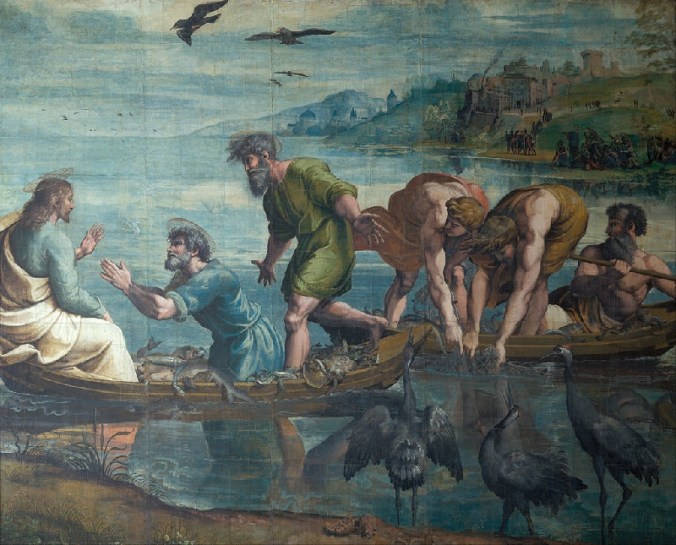
The Miraculous Draft of Fishes – Raphael – Public Domain


Introduction: At certain moments in our discernments, the lack of clarity about the path ahead and the letting go of past ways of doing things to make room for the “new” that God is working in our lives, can cause a sense of timidity, uncertainty, or fearfulness within us. Jesus reminds us, “Do not be afraid!” 

(As noted in the Lectio Divina Guide for Those Discerning, a wonderful way of listening to the Lord—and perhaps the first that we should practice—is praying with the Bible through lectio divina. This guided lectio is provided to help those who are just beginning with lectio divina. If  you choose to pray with this guide, I encourage you to go back later and pray with this passage from Luke on your own, using this simple guide.)

Lectio: Luke 5:1-11

Once while Jesus was standing beside the lake of Gennesaret, and the crowd was pressing in on him to hear the word of God, he saw two boats there at the shore of the lake; the fishermen had gone out of them and were washing their nets. He got into one of the boats, the one belonging to Simon, and asked him to put out a little way from the shore. Then he sat down and taught the crowds from the boat. When he had finished speaking, he said to Simon, “Put out into the deep water and let down your nets for a catch.” Simon answered, “Master, we have worked all night long but have caught nothing. Yet if you say so, I will let down the nets.” When they had done this, they caught so many fish that their nets were beginning to break. So they signaled their partners in the other boat to come and help them. And they came and filled both boats, so that they began to sink. But when Simon Peter saw it, he fell down at Jesus’ knees, saying, “Go away from me, Lord, for I am a sinful man!” For he and all who were with him were amazed at the catch of fish that they had taken; and so also were James and John, sons of Zebedee, who were partners with Simon. Then Jesus said to Simon, “Do not be afraid; from now on you will be catching people.” When they had brought their boats to shore, they left everything and followed him.

Read through this reading slowly and attentively at least twice. Take your time with it.

Meditatio

This reading has a wealth of meanings. For this lectio, let’s focus on three lines of the conversation between Jesus and Simon Peter:

  • Put out into the deep
  • Go away from me, Lord, for I am a sinful man!
  • Do not be afraid; from now on you will be catching people.

“Put out into the deep.” Up to this point in the Gospel of Luke, Simon Peter doesn’t know Jesus very well yet, except that Jesus healed his mother-in-law (Luke 4). It seems this is the first time that Jesus invites Simon to do something, and it is to step forward in faith in him. It’s an unusual request probably for a number of reasons; the impulsive fisherman mentions only two of them—the fish aren’t biting, and night time is better for catching fish. What is it about Jesus’ request or in his gaze that makes Simon Peter continue on, “…yet if you say so…” and follow Jesus’ invitation?

While Simon Peter was probably pretty familiar with the lake, I am not so familiar with “the deep.” It’s hard for me sometimes to follow Jesus’ invitation when I can’t clearly see the path ahead, when I don’t know “how deep,” or “how far” I’m being asked to go. But I have no need to be afraid because, like Simon Peter, I have Jesus in the boat with me. Jesus would never ask me to take a step forward in faith and then abandon me. He will be with me every moment of my discernment, every moment of my journey.

“Go away from me, Lord, for I am a sinful man!” I really identify with Peter’s words as he witnesses Jesus’ goodness and miraculous power. Peter is in touch with his humanity and his sinfulness. And it’s fitting that we acknowledge our need for forgiveness, for conversion, not just in the challenging moments of our journey, but also in the seemingly miraculous ones.

The truth is that none of us are “worthy” of Christ. Yet our relationship with Jesus is not about being worthy, or becoming worthy. Our relationship with Christ is about Christ loving us first. Jesus is not concerned with “how” unworthy I am, because it only means that I am more aware of how much I need his saving love. And Jesus delights in saving us.

“Do not be afraid; from now on you will be catching people.” Jesus repeats “Do not fear,” in the Gospels over and over again. It might be tiresome to others, but for me, it’s a message I need to hear especially when I’m invited to take a step of faith, when I’m invited to “put out into the deep.” The reason we do not have to be afraid? Because from now on, we are Christ’s. When we belong to Christ, we can trust in his faithful love for us.

Christ’s invitation to follow him is implied here. And Christ’s invitation isn’t just for Peter alone. In essence, Jesus is inviting them, “Help me with my mission of ‘catching people,’ of attracting people to salvation in me.” It was an irresistible invitation for Simon and the other fishermen who were called.

Our call and our mission are so deeply connected that usually we cannot discern one without the other. Often, it’s just when we feel least worthy that Jesus calls us to share in his mission! And his call to us to be close to him is genuine: there is no way to draw closer to Jesus than by sharing in his thirst for others’ salvation.

Contemplatio

“Put out into the deep water.” What is the “deep water” that Jesus invites me to? How do I need to change or grow to respond to Jesus’ invitation?

Oratio – Prayer To Live God’s Loving Plan

Lord, from all eternity,
You know me, choose me,
love me, and call me.

Every day You invite me
to a life full of joy, love, and meaning!
You call me to become more truly myself,
and more of You.

You who love me through and through, 
and know every stirring of my heart,
have gifted me with a unique calling
where the world’s deepest needs
meet my deepest joy.

Grant me the openness to hear Your invitation,
the faith to trust Your love,
the courage to choose You, Master, as You have chosen me,
and a generous heart 
that falls ever more deeply in love with You.

Mary, God’s Mother and mine,
you joyfully and fully responded to God’s call in your life.
Help me to respond to God’s plan for me with all my being,
as you did. Amen.

Actio

Choose a way in which to respond to Christ’s invitation to you today in your daily life.

Note: I apologize for not posting the past week: I came down with the flu, and am only now feeling better. Over the next three months, I am doing some traveling for promoting my book, Soul of Christ: Meditations on a Timeless Prayer, but hopefully I’ll still be able to post three times a week…  God bless you!

2015 Reminds Us: God Re-Creates Us Every Day!

2015 has begun. I love new beginnings (perhaps that’s why I love early mornings!). The freshness of a new year reminds us that God re-creates us every day! I begin this New Year, praying for all of you who are reading this blog, have emailed me, commented, or started to follow the blog: that you will receive the grace to hear and respond generously to God’s invitation. And I entrust all of us (including myself) to the intercession of Mary, our Blessed Mother and Queen, whose generous yes is the model for our yes: “Behold the handmaid of the Lord.” This is one of my favorite hymns to Mary, who always leads us to Christ:


The WordPress.com stats “helper monkeys” prepared a 2014 annual report for this blog. Considering that the blog is just over a month old, the stats are pretty amazing. A big thanks to all of you readers who have helped get this blog off the ground! I look forward to posting in the new year…

Here’s an excerpt from the report:

A New York City subway train holds 1,200 people. This blog was viewed about 7,800 times in 2014. If it were a NYC subway train, it would take about 7 trips to carry that many people.

Click here to see the complete report.

Discernment @ the Movies: Spider-Man 2

By Brian Gilmore (http://my-superhero.com/) [FAL], via Wikimedia Commons

By Brian Gilmore (http://my-superhero.com/) [FAL], via Wikimedia Commons

Do you enjoy superhero films? Do you have a favorite superhero?

Although I was no comic-book reader when I was growing up, I have come to enjoy the best of the superhero movies that have been produced in the past two decades. Superhero films can offer a lot to reflect on, but my favorites explore the themes of love and self-sacrifice in the life of the hero.

By far my favorite superhero is Superman. However, I’m still waiting for a truly great Superman movie. (Someday I’ll post reviews of all the onscreen live-action Superman movies!) In the meantime, Spider-Man 2 became one of my very favorite superhero movies. While there are many reasons for my choice, one reason is that Spider-Man 2 (2004, starring Tobey Maguire, Kirsten Dunst, directed by Sam Raimi) offers a great cinematic example of discernment. Practically the entire second act of the film is Peter Parker’s discernment: Shall I continue to be Spider-Man, or shall I give it up? It’s a question of identity, of mission, of deep desire, of the search for happiness and peace of mind and heart…all essential to making a good discernment.

Although a direct reference to God is lacking, Peter Parker takes many of the actions one needs to take to make a good discernment:

* Takes time to reflect on the circumstances of one’s own life

* Listens to the desires of one’s heart

* Listens to the needs of the world and one’s own specific circumstances

* Tests out a preliminary decision

* Reflects on what gives true peace of heart

* Seeks wise advice (mentor or spiritual director)

Watching Spider-Man 2 may be an unusual but helpful way to reflect on how to make a good discernment; especially if we’re in the midst of a discernment involving our vocation or a major life-decision, Peter Parker’s struggle to discern might really resonate with us.

You may find it helpful to download this short Discernment @ the Movies Guide: Spider-Man 2 and use it when you watch the film. Afterwards, take some time to reflect on the questions on the guide. You might even want to watch the film with a friend who is also exploring discernment, and discuss the questions together over coffee or tea afterwards.