Discernment in Images: Entrusting Self to God

Discernment quote 4This is one of my very favorite insights into discernment: we trust God because God–in Christ–first trusts us! Discernment: a relationship of love, trust, and freedom.


Blessed Easter! I have taken this week away from this blog to catch up on another project for our centenary year (yes, 2015 is the 100th anniversary of the foundation of the Daughters of Saint Paul!), but I’ll be back next week. Thanks for your patience.

In the meantime, Sr. Margaret Michael Gillis, vocation director for the Daughters of Saint Paul in the USA and Canada, offers a two-minute audio reflection about discerning religious life here.


Friday Q & A: Should I delay entering religious life when I feel called?

Here are a couple of great questions from another young woman discerning her vocation to religious life:

“It’s been a year since I discovered my call to religious life, and even though I’ve had a few ups and downs, It has mainly been all the time upwards, and I’ve been maturing the idea, thinking it through and everything seemed to work out well.

The things I have to discern about are mainly two. Firstly, I was thinking of entering a congregation next summer (2015) once I was 18. But my family has advised me and asked If I could delay it one or two years in order to be able to experience and live those first years of university outside of the congregation, in a “normal lifestyle”. I am really looking forward to entering and I’m not sure what I should do, experience life and “freedom” and then enter into a congregation or start straight away. It’s something I’m trying to discern. The next decision I have to make is which congregation apply to; the school I’m in is run by nuns, and I’ve always thought that I would like to be one of them…but lately I’ve been wondering if It’s the correct decision or I should look for another one. I like their mission and how they work, I also like the nuns; on the other hand sometimes I feel I don’t agree in certain aspects with them and It would be difficult for me to follow their instructions.

I would really appreciate if you could throw some light into those decisions and help me understand what God wants me to do. Any advice on how to listen to his call and his plans for me would be great.”

First of all, I just want to thank you for your courage in seeking to do God’s will in your life, and I encourage you to continue to be open to the Lord as he calls you!

With regard to your first question about whether to enter after you turn 18 or wait a year or two, there is wisdom in doing both, so it really depends on how God is inviting you in the concrete circumstances of your life. Obviously, if you have already gone through a significant discernment process, and both the community and you feel that God is inviting you to take the next step to enter the community, that is definitely the best choice.

But a significant discernment process requires a number of elements, just a few of which I’ll list here:

  • Taking the time to prayerfully discern God’s will in a way that you are not rushed or pressured. Above all, this means sufficient maturity, interior freedom from expectations, pressures, etc., and freedom from external pressures (such as financial, security, etc.)
  • Accompaniment by a spiritual director
  • A full understanding of what religious life entails
  • Dialogue (or discussion) with close family and friends
  • Discerning which community you are going to enter—which usually means visiting at least two other communities besides the one you plan to enter
  • Getting to know the community you are planning to enter well with (ideally) several live-in experiences of a weekend to a week—not just for you to get to know them, but for them to get to know you.
  • After making a decision, taking the time to evaluate it and continue to pray with it.

This can take six months…but it can also take two or three years. It requires an attentiveness not just to external events, but to the ways the Holy Spirit is working within the person discerning.

Since we are seeking God’s will in our discernment, if we truly discover it is God’s will that we enter sooner rather than waiting a year, then that is best.  But there are good reasons to wait for a year or even two:

  • To make sure our discernment isn’t rushed; to more fully understand and purify our own motivations so that our decision is fully free
  • To journey with our family and friends in our discernment when possible, so that they can be at peace and continue to support us on our journey
  • To be ready for the transition and challenges that we will face as we enter religious life
  • To discern well to which community we are called, and to get to know it well. (We are not called to “generic” religious life, but to a particular community. If we only visit one community, we may not realize whether the attraction is for religious life in general, or for that particular community.)
  • To grow in maturity to be ready to give a fuller gift of ourselves when we enter

Growing in maturity can include living certain life experiences. For example, if a young person has just turned 18 and has led a very sheltered life and never lived away from home nor had any experience in ministry, that might be a situation where gaining some life experience would enrich her discernment or clarify it (e.g. spend a year studying or working, being more involved in her parish or another form of ministry). This is not so that she experiences the “freedom” of doing her own thing, but so that her discernment is colored less by a decision to leave home for the first time and more about how God is calling her. But it depends on each young person’s circumstances. I entered the convent as a teenager with relatively little life experience and I have no regrets: I was eager to get started in my new life! But I know others whose time after entrance would have been easier if they had waited a year to enter. Every situation and every person is unique. And the requirements of each community are different as well. The important question is: How might God be inviting you through your circumstances?

We’re always seeking God’s will…and if we’re not sure of the course of action, it can be wiser not to rush in. But when we are discerning a big step such as entering religious life, we also want to make sure that we’re not using a good reason as an excuse to delay.

For your second question about which community to apply to, I think answering that question may influence the length of time you feel you need to discern. You could be called to the community which has taught you for years; but it’s also possible that you are simply drawn to their goodness and consecration, and you need to find the community to which God is calling you.

A lot of information is available online about different communities’ missions and spiritualities. (For those in the USA, www.vocationnetwork.org is a great resource for many communities! For those in Canada, www.vocations.ca is a great online resource.) You might want to spend some time browsing these sites and see where it leads you. Pick a few communities that attract you and research them. Email them with questions you have. Then, when you’ve narrowed your choices down, make arrangements to visit a couple of them—I’d recommend at least two; perhaps even three. Every religious community is made up of human beings—none of them are perfect!—so what you’re looking for is a community where you feel at home, living a lifestyle where you feel God is calling you to follow him more closely.

I hope this is helpful! You will be very much in my prayers as you continue your discernment!

Friday Discernment Q & A: What’s It Like To Enter a Convent?

For those of you who have sent in questions, thank you for your patience! For now, Friday will be a Q & A day. Feel free to email me your questions, or contact me through the blog’s contact page.

530am Beach and Sunrise 049A young woman who was recently accepted into a community and will enter the convent in nine months asked the following.

“I’m interested in any tips or stories you have for either of these two things: 1. the upcoming months of saying goodbye/getting rid of material things/getting increasingly excited and probably lots of other emotions  (I bet there are some good stories here!) and 2. what does discernment look like once you’re in the convent? I’m sure it’s different for each community and individual but it’s just been interesting taking this ‘big step’ but also knowing that God could just be calling me to the convent for a time (though I do think He is calling me forever). Is it normal to assume that I’ll be there forever, or do you think there’s prudence in speaking of it as ‘the next step’ on a long journey?  I’ve just been curious about that…how does one look at the vocation once they’ve been accepted or once they’re in the order?”

Congratulations on your acceptance! You will be in my prayers—and I suspect in the prayers of all those who read this post. Since you asked a few different questions, I’ll split my answer into two parts.

The months between acceptance and entrance into a religious congregation are just as you describe: a whirlwind of emotions. For me, I experienced the dizzying joy of God’s profound love for me in inviting me to take the next step toward an exclusive, spousal relationship with him; I was also looking forward to an adventure that would be filled with the support of a loving community. Overall, I had so enjoyed visiting the sisters that at the end of each visit when it came time to go home, I didn’t want to leave. A couple people told me that after I’d made the decision to enter, they could see me “glow,” I was so happy. (A funny footnote here: I was so thrilled to enter that I actually became excited when my mom and I bought the un-stylish black “nun” shoes I was supposed to wear as a postulant. Definitely not the kind of shoe I was used to wearing.)

Alternating with the incredible joy, I experienced great fear: fear of the unknown; fear of the sacrifices I knew I’d be making, fear of being asked to do something I didn’t enjoy or couldn’t do, fear that I might not “measure up” to being a religious and the expectations of the sisters.

In addition to my fears, I very much dreaded the separation from my family. Until I made the decision to enter, I shared my discernment journey with just a few close family members. Telling my family that I was entering the convent was not easy. Almost everyone was supportive, but a couple of times I was surprised by remonstrances or regrets from a close family member–someone I’d been sure would understand. While I didn’t expect everyone to be supportive, it was harder than I expected when someone close to me didn’t understand or agree with my decision.

In looking back in those months before I entered, two things gave me great joy and/or peace:

  • In discerning my vocation and in the aftermath of experiencing such a strong joy and peace by which God confirmed my decision to enter, God communicated such tremendous love for me that it was easier to trust that God would be with me every step of my journey. The whole experience of being called and so greatly loved really strengthened me through my fears. (And this joy has continued to be strengthen me throughout my journey as a sister.)
  • My greatest fear and source of suffering before I entered the convent was leaving my family. My vocation director encouraged me to remember two things: a) Leaving home was part of growing up, so eventually I would leave home even if I didn’t enter the convent now; and b) God would take care of my family better than I could, and our love would continue to grow. It helped that I knew that my congregation encourages us to stay in touch with our families, to call and write regularly. Now, with the internet that’s even easier. I truly believe that God blesses my sacrifice of leaving my family to dedicate my life to him by sending special blessings on my loved ones.

In many ways, my vocation to become a sister has shaped my relationships with my loved ones. Especially when I’m sent to carry out our mission in a place far away from my family, my less-frequent visits home become very focused and conversations can go deep—we talk about the important things because we may not have the luxury of another long conversation for a while. So, despite often living far from my family and missing the daily details, I’ve still been able to stay close.

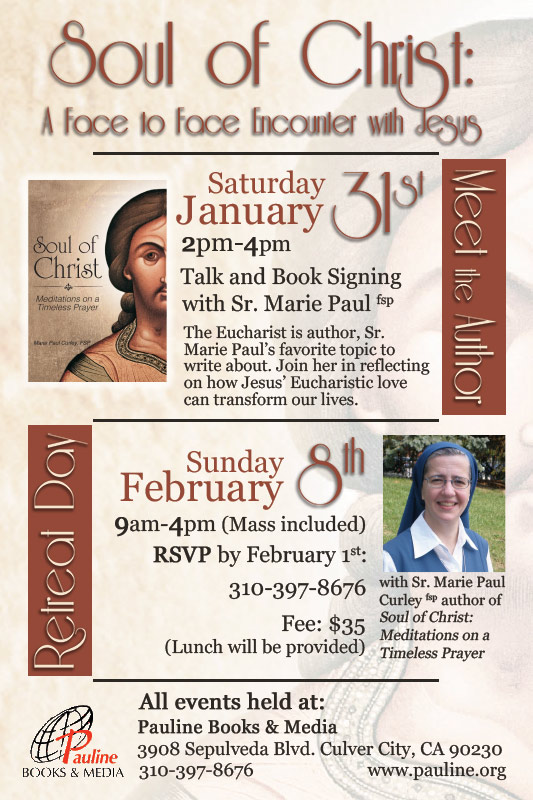
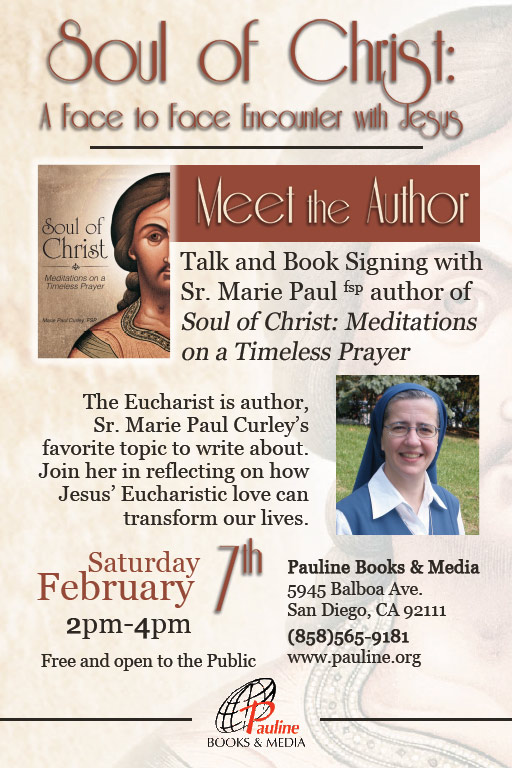
California Soul of Christ Talks & Book-signings

For those in California, I just wanted to let you know I’m visiting on a book promotion tour for the next two weeks. If you can, join me–I love meeting those discerning and readers of my books and blogs! I’m posting up the events below. As you know, Eucharistic adoration is one of the best ways to pray when you are making a discernment!

San Francisco Area:

SMPSoulOfChristReduced

Los Angeles Area (Culver City): 

SMP-Culver-City

San Diego:

SMP-San-Diego


God’s Story for Us

01A choice 2 (me)Oops! There’s a catch there in my last post when I said I love my plans. The catch is that I don’t just enjoy making plans and rejoicing when they work well. I actually become invested in my plans, to the point that I can make my security revolve around my plans–how well they are working, etc. If you are one of those people that rejoice in saying, “It’s all going according to plan,” then you might also be in danger of absolutizing your plan…or at the very least, making it more important than it was ever meant to be.

Because a plan is a very temporary thing, meant to serve the needs of the moment. It’s not meant to be something that takes over our lives, that becomes more important than its purpose, or the people it involves, even ourselves.

Yet plans can be incredibly helpful and important–in keeping a group on track, in juggling many things at one time, in achieving goals that, without a lot of careful planning, might otherwise be impossible.

Whether you are a pantser or a planner, whether you love plans or hate them, or whether you are somewhere in-between–loving the organization that plans bring, but longing for more spontaneity–you probably aren’t neutral to plans.

The problem with any plan is that it isn’t perfect. No matter how many contingencies we anticipate, it’s likely that something will come up that we couldn’t foresee. And then the plan must be adjusted or replaced with another.

The good news is that the most important plan for you is perfect: perfect for you wherever you are, and flexible when your situation changes, or when you want to shift directions. What plan is that, you wonder? God’s plan.

* * *

Vocational Insight: Religious Life*

For all of us, the future is unknowable. As a religious with the vow of obedience, I don’t have the stability of creating my own plan, of knowing where I’m going to live, or the work that I’m going to be doing. While others can take this stability and this sense of control for granted, they are not part of my life. Often, I have no clue of what’s coming next. I cannot count the times when I’ve needed to change plans for the mission that I’m carrying out midstream. And I honestly never know for sure where I will be or what I will be doing a year from now. Although this might sound difficult to live, the security I have in living the vow of obedience is worth it:

Living well the vow of obedience offers me the certainty that I am doing God’s will, however unexpected it may be.

My vow of obedience demands that I trust in a larger plan that is not my own: in God’s plan for me, as mediated through my superiors. Though at times I may struggle in the moment (or the first weeks or months) to accept God’s plan for me, the truth is that every time I’ve been able to step back and look at my life, it’s clear that God’s love guides the story of my life. God’s plan has proven  over and over again to be the best for me.

*For those who are  discerning their vocations, I’ll occasionally offer an insight from the various states in life. Naturally, since I’m a religious sister, my personal insights will most often be about religious life. But I’ll try to find others to offer spiritual insights into the vocation to marriage, priesthood, and the single life too.

The Story Behind This Blog

SrPaulSelfSmallGloomedFor nine years, I’d helped young women discern their vocation–whether they were called to religious life, married life, or the single life. I offered workshops and mini-courses on vocational discernment, discernment retreats, and individual vocational accompaniment. The intensity of others’ discernments helped me live the spiritual art of discernment much more mindfully. I was thrilled that I could focus on discernment so much, though I knew that I was just beginning to go deeper into living this profound spiritual art and practice. I was even asked to write a book about it—a book that I never got to.

Then I was transferred to another assignment–something very different from what I’d been doing. “No big deal,” I thought. I planned to continue discernment as an important part of my Pauline life. After all by this time, I’d been a religious sister living the vow of obedience for over twenty-five years.

But in a new and unfamiliar environment, the multitude of choices and decisions I faced daily made me feel paralyzed. When presented with several fantastic opportunities, I had no idea which one God was calling me to do. My prayer, dry at the time, didn’t shed any light. God made his presence felt, but not his desires, not his will. I felt as if I had no clue which opportunity or direction was truly his will. And just as I was realizing how inexpert I was in the art of discernment, I was once again asked if I would consider writing a book on discernment!

God often puts unexpected plot twists in the story of my life. This is not the first time that God has called me to grow in a certain area in my life by inviting me to write a book. So I’ve decided to give it a try. To create a true dialogue, to receive input from readers, and to make sure that I’m speaking to others’ real questions about discernment, I thought it would be great if I could blog the book first. And this blog, CoAuthorYourLifewithGod, was born.

Discernment has become a key part of my life because it leads me into greater alignment with God’s will, to live God’s story for me. Although I’ve spent a lot of time discerning and witnessing others’ discernments, I’m no expert. I still struggle with discerning how God is inviting me when I’m overwhelmed, afraid, or attached to having my way. The truth is that all of us can grow in this spiritual art of listening to the Lord’s invitations and striving to respond with a generous “yes!”

This blog gives us the opportunity to reflect on and grow in the spiritual art of discernment. Please ask questions, comment, and be active here on this blog—it’s for you! I’ll try to include opportunities to share, contests, and surveys that will make it fun to explore this important spiritual art, as we together seek to discover how we can listen more deeply and respond more generously to God’s loving call in our lives.

I’d really love to hear from you (in the comments box below or you can email me, too–just mention if you’d like me to keep your question anonymous):

  • Why have you stopped by and visited this blog?
  • What are you discerning?
  • What questions do you have about discernment or growing in your relationship with God?
  • What would you like to see here on this blog that would be helpful for you on your discernment journey?

God Has a Dream for You

Not sure where the path is leading...

Not sure where the path is leading…

After I entered religious life, I was almost immediately assigned to proofreading as a way of taking part in the Pauline mission.* Already a bookworm, I loved it there because I got to read almost half of the new books that our sisters published that year. And I became a pretty good proofreader, too. It seemed the perfect fit.

About two years later, I was assigned to the newly developing Pauline Video studio. I was flabbergasted. Why would anyone in their right mind take me away from books and throw me into a department that required talent in visual arts and a combination of skills that I knew I didn’t have: creativity, technical skills, and an ability to design? As I struggled with the new assignment, one of the sisters told me, “God knows us better than we know ourselves. You wait and see: God will show you why you’ve been sent there.”

It took me a number of years to figure out what a marvelous gift God gave me in transferring me to the video studio. Working in a small studio where everyone has to help out in many areas—out of sheer necessity—stretched me to develop talents I’d had no idea I had. And it also gave me many opportunities to write. Although I’d never thought about writing a script before, it became my favorite form to write in. Sometimes God’s co-authorship gives our stories a plot turn that we do not expect!

Over the years, I have learned to trust that God always has a reason for leading us—God wants to lead us closer to himself, and closer to the fulfillment of God’s dream for us.

And God’s dream for us is better than we could ever possibly imagine!

*The Daughters of Saint Paul have the mission of communicating Christ through their lives and all forms of media.

The Sisterhood Finale: Discernment Glimpsed

TheSisterhoodPhotoSeriesThe last two episodes of Lifetime’s reality TV show, The Sisterhood: Becoming Nuns, broadcast last night. Because of the nature of a reality TV show which needs an ending, the young women were asked to share their decisions at the end of the six weeks. This superficially imposed time frame was not necessarily helpful to the discernment process of these young women, but it gave the show some closure. I won’t give any spoilers here, but I’d like to offer some last reflections on topics that came up in the show.

I’ll begin by noting that once again, the insights offered into religious life were positive and marvelous. Mother Christina and the Sisters of St. Joseph the Worker were real, compassionate, and inviting.

But the process of discerning religious life is not so realistically portrayed.

Discernment Glimpsed, Not Portrayed

Having finished the show and guessing at some of what happened “behind the scenes” and interiorly in the young women, it seems to me that this show offers only glimpses of what it is like to discern religious life, and some of those glimpses are misleading.

Above all, the superficial timeline of six weeks—that is, trying to discern a vocation according to the constraints of a reality TV show rather than according to God’s timing—led to a lot of unnecessary stress and even distress for the young women discerning. While discernment can involve moments of turmoil, it’s really  important to be at peace during one’s discernment.

The decisions that were made by the young women were not final decisions, although that’s not really made clear on the show—especially for the young women who chose to continue their discernments with a particular community. First, they need to continue discerning, as one two-week visit is not enough time to discern. In addition, the sisters—especially the vocation directors and superiors—will now actively engage in discernment with the young women. Discernment doesn’t just involve the individual’s choice, but also the choice of God, which is revealed in the affirmation or confirmation of the Church—in this case, of the congregation. A young person doesn’t discern their vocation on their own, but within the Church.

Chastity for the Sake of the Kingdom

Not surprisingly for our sexuality-obsessed culture, the discerners talked about chastity and the question of “who is a virgin” in three separate conversations during episodes four and five. (Note that neither poverty nor obedience really came up as points for discussion.) I’d like to respond to a couple of points that came up in the conversations:

1) Our sexuality is integral to who we are as human beings, but actually having sex is not the only way  of expressing our sexuality. The love between a man and a woman is a sacred, beautiful thing, and most people are called to holiness as married people. For them, the act of making love is the fullest expression of their sexuality. Making love is meant for that one, intimate, permanent relationship.

2) God intends that the sacred act of making love be reserved for those who are married. The rest of us are called to live a celibate chastity. Having sex is not a “test” for a relationship. Nor is it necessary to have had sex in order to discern one’s vocation—to marriage, priesthood, or religious life. In discerning one’s vocation it’s helpful to have a certain level of maturity, but it’s not necessary to experience everything in order to make a good discernment.

One’s vocation to religious life does not depend on whether one is a virgin or not. However, the person discerning religious life needs to experience the capacity to live a celibate chastity—not just think about it. (For example, Claire deciding to live “sacred singleness.”) If we are beginning to discern our vocation, or even if we simply want to discern God’s will more deeply in our lives, we will want to look seriously at the call to live chastely according to our state in life.

3) Living the vow of chastity requires both faith and the continuous effort to grow as a person. As human beings, we are made for marriage! So it requires a special call, a special grace of God, to live a celibate chastity as a religious.  And sometimes that’s hard to understand for those who are not called in this way.

Having healthy relationships with people of both sexes is an important part of personal growth for someone committing (or thinking of committing) to the vow of chastity. On our part, actually living a celibate lifestyle requires faith, emotional and personal maturity, the desire to give all of one’s self to God in a radical way, and an openness to let God’s grace work in us.

Reconciliation

Just as we are all called to live chastely according to our state in life, we are also called to live in charity. Discernment has a communitarian aspect, and this was hinted at in the show by showing how five very different young women share such an intense journey—supporting each other, but also sometimes very tense with each other.

Several times during the show, one or more of the young women behaved in a way that didn’t reflect Gospel values. In response, one or more of the group of discerners tried to talk about it with the others. The motivation to talk about it always included charity—to help the person(s) whose behavior was problematic to the other discerners. The motivations also seemed to include a desire to grow in harmony and unity, or simply a desire to stay “on track” with a discerning spirit—which was another way of expressing the need for support for a faith-filled atmosphere during the days of discernment.

As we’ve all experienced, these kinds of discussions or confrontations can break down into blame, accusations, defensiveness or judgments. In episode 5, Mother Christina guides what could have become a divisive fight into an experience of reconciliation. Living in reconciliation—asking for forgiveness and extending forgiveness wholeheartedly—is not about being right, or even being fair. Nor is it simply “giving in.” Instead, reconciliation is about seeking to grow in love, letting go of judging others, and a letting go of what’s not essential for the sake of love. Learning to live in reconciliation is essential to community living (and to every vocation).

Sacred Silence

The discerners’ response to the nighttime “Grand Silence” in the convent? Writing notes to the camera!

I had to laugh at this. Silence can seem to be a scary thing, especially when we’re not used to it. As Daughters of Saint Paul, we too have many times of silence built into our lives, especially the night and early mornings, so that we can be more attuned to the voice of God. Our monthly one-day retreats and our eight-day annual retreats are special times of silence, which open us up to deeper intimacy with God.

If we are struggling to discover God’s will for us, then we might also be struggling to see or experience God’s presence in our lives. Building in some times of silence into our day—even just 15 minutes in the morning with no music, no news, no checking the internet—can make a huge difference in our ability to listen.

When we are surrounded by noise, we start to “tune out” because we can’t possibly hear everything going on around us. When we take time for quiet, we can start to hear the noise inside of us, and let it gradually quiet down. Once we are immersed in silence—both external and internal—we can “tune in” to what’s going on deep within us, and we can hear the Lord’s whispered invitations.

Silence and listening are keys to discerning well.

Family & Discernment

I was pleased to see that, in this show, each discerner shared her discernment with her loved ones, who were mostly supportive. When someone discerns a big life choice—a vocation, a job change, moving away, etc., this can be hard for family members to adjust to. Sometimes a family member will express misgivings. A family member who doesn’t share our faith may struggle to understand a young person’s vocation to priestly or religious life. The person discerning needs to follow God’s call no matter the cost, but taking the time to journey with one’s family, to seek their support, and to explain their reasons to those who don’t understand, are all important. If it’s available, we all need the support of our families to live our vocations well.

One of the sisters talked about how, when a young woman enters a convent, her family gains all the sisters of the convent as part of their extended family! This is true, because each sister’s family is now related to the community in a special way. While every congregation has its own customs of how they encourage their sisters to stay connected with their families (frequency of visits, phone calls, letters, etc.), it’s important that each community recognizes the importance of family in supporting one’s vocation, encouraging some kind of connection.

* * *

All in all, the show has been wonderful in its portrayal of religious life, the opportunities it’s offered for discussions about discernment, and the way that it’s allowed me to connect on Twitter and here on this blog with those who are interested/curious/discerning about religious life! I welcome further comments here or via email.

And I entrust the courageous and generous women on the show–Eseni, Francesca, Stacey, Christie, and Claire–and all the viewers, to the intercession of Mary, our Mother and Queen whose “yes” at the Annunciation is the model for our vocational “yes” and our daily “yes” to the Lord’s invitations:

Prayer To Our Lady of the Annunciation
by Blessed James Alberione

May all generations proclaim you blessed, Mary.
You believed the Archangel Gabriel,
and in you were fulfilled all the great things that he had announced to you.
My soul and my entire being praise you, Mary.
You believed totally in the Incarnation of the Son of Godin your virginal womb,
and you became the Mother of God.
Then the happiest day in the history of the world dawned.
Humanity received the Divine Master,
the sole eternal Priest,
the Victim who would make reparation,
the universal King.

Faith is a gift of God and the root of every good.
Mary, obtain for us, too, a lively, firm and active faith—
faith which saves and produces saints,
faith in the Church, in the Gospel, in eternal life.
May we meditate on the words of your blessed Son,
as you preserved them in your heart and devoutly meditated on them.
May the Gospel be preached to everyone.
May it be docilely accepted.
May all men and women become, in Jesus Christ, children of God. Amen.

Insights & Contradictions in The Sisterhood, Episodes 3 & 4

OLYMPUS DIGITAL CAMERA

Adoration in our Pauline Chapel

Lifetime’s reality TV show The Sisterhood: Becoming Nuns continued last night with episodes 3 and 4 back-to-back. These new episodes highlighted all the conventions of a reality TV show that I don’t enjoy: competition, heightened (over-the-top!) drama, staged scenes, coaching from the show’s producers, oversimplification of relationships and personal journeys, and an overt editing that revealed an obvious manipulation of various events. For me, watching this show has become a study of reality television shows and how “not real” they are!

Yet, if we take these conventions into account, it’s still possible to gain insight, both into religious life and into the process of discernment, as some viewers live-tweeted with other sisters and me while watching the show. I think this is particularly true because of the good will of the sisters and discerners on the show, who tried to be real in their interviews and comments.

Insights that I think could be particularly helpful for those of us who want to live more deeply in a spirit of discernment are:

Insight 1. Do not be afraid, but trust in God! We can often see God’s hand in our lives much more clearly when we look back on an experience, rather than when we are living in it. The most positive moments in the show so far have been when the young women leave one convent for another. In looking back on their experiences there, they talk about being loved, about experiencing God, and about growing as persons.

Yet we have just witnessed that these visits were not easy to go through. So these episodes help us to see that even in the difficult, confusing, or challenging moments of our lives, we need to cling to hope: God will use every event to draw us closer to himself, if we let him. This insight bears repeating for all of us: Do not be afraid! Trust in God, no matter where you are because he is with you.

Insight 2. The power of Eucharistic adoration in discerning. As a Pauline sister, I have a special love for Eucharistic adoration. My favorite description of adoration is something that St. John Paul said when he encouraged young people to go before Jesus in the Blessed Sacrament and simply “let him love you.”

If you already pray before Jesus in the Eucharist regularly, you know how blessed we are to be able to take advantage of his presence, his love, his availability! When you take quality time with Jesus in the Eucharist—at Mass, receiving Communion, or making some time for adoration—Jesus will transform the rest of your life as well. You cannot, will not, walk away unchanged.

If you don’t already make an occasional or regular Eucharistic Hour of adoration, I encourage you to consider it, perhaps by starting with just 20 minutes. There is something about the tangible closeness and vulnerability of Jesus in the Eucharist that can pierce through our blindness and defenses, helping us understand how loved we are, and how faithful his love is.

For those for whom the silence of adoration is really hard, there can be for a number of reasons, but I hear two reasons repeatedly:

1) We simply don’t know what to do with the silence.

2) When we are silent for a time, all the negative stuff–thoughts, feelings, or experiences–that we carry within us come to the fore, and we’re not expecting that. It can make any time of silence difficult, including time of adoration. It can be really hard if we feel that we have to be “extra-holy” to come to adoration.  But what better place to deal with the “tough stuff” of our lives than with our loving Lord? In the Eucharist, Jesus welcomes and loves us. Jesus knows us better than we know ourselves, and delights in us, no matter what we are struggling with. And when we draw close to him in the Eucharist, we are inviting him to work in us, to heal us, to help us to grow.

What can we do if we struggle with the silence? Here are a couple quick suggestions:

  • Bring whatever is troubling us to Jesus in the Most Holy Eucharist. Keep the time of adoration to a length that feels manageable. Even five minutes of adoration can transform our day. And use favorite prayers and Scripture readings to make the time of adoration a real encounter with Jesus.
  • Use a method to guide your time of adoration. Saint Alphonus Liguori’s method is beautiful and easy to use. The Pauline way of adoration is my favorite—you can find more about it below.
  • Use a book like my newly published Soul of Christ to guide your time of adoration.

(For more on Eucharistic adoration, you may wish to check out my book, Soul of Christ: Meditations on a Timeless Prayer, or  another book on Eucharistic prayer.)

Insight 3. Discernment is not about proving ourselves; it’s about love. None of us are “worthy” of being loved or being called to love. If we honestly know ourselves and ponder the heights of each vocation to love—whether it is the vocation to consecrated life, single life, or marriage—all of us find ourselves lacking.

Several times during the show, a young woman referred to “proving” herself to God, or “redeeming” herself in the eyes of others. This highlights for me again that the show can be misleading about competition and comparisons. Discernment is about discovering that we are loved by God deeply and wondrously, and then responding to God’s amazing love.

Discernment is about discovering our call to love.

4. God works with each of us individually. There are commonalities within discernment, but there is also the truth that God has a unique relationship with each one of us.

Every young woman experienced something remarkably different in the aftermath of several events, for example, praying the Rosary in the car after Darnell showed up to bring Eseni home (and thus short-circuit her discernment). From bringing back painful memories for Stacey and prompting her to feel lost, to offering light and clarity for Christie, this moment showed how unique each woman’s journey is. God’s individual guidance was also very clear during the young women’s different responses to the quiet time of  Eucharistic adoration. Some of the young women were deeply touched and one had a breakthrough, while some found the adoration time very difficult—with one young woman needing to leave for some fresh air. (Note: It might have been helpful if the young women had some guidance in how to make an hour of adoration, especially for those who hadn’t done it before.) Because discernment is so individual, a group experience like this—while it has its strengths—also needs to take into account where each young person is. Obviously this wasn’t possible in a show like this.

* * *

Although the young women and sisters offered a lot of support to the young women discerning, both Episodes 3 & 4 had moments that really challenged me to continue watching, when certain behaviors contradicted Gospel values that are sought to be lived intensely in religious life. Especially the moments where participants of the show talk about others on camera, it’s hard for me to see the charity at work there amidst the comparisons, even knowing the comments are taken out of context. As one of our sisters, @SrSeanM so eloquently put in Twitter-verse nuggets last week:

I figured out what’s bugging me about #TheSisterhood. They’re treating #discernment like religious life Boot Camp. And it’s so not!”

#Discernment NOT a matter of seeing whether or not you measure up! It’s a matter of discovering what you are called to.”

“There are no short-cuts to creating a deep loving relationship. Love takes time and persistence. #Vocation is a call to love.”

Ultimately, discernment is a call to love: to discover how loved we are, and to respond to that immense, divine love! I close this post as I have in the past: by praying for the discerners on the show and watching the show. The prayer below is adapted from the prayer given to us by our Founder, Blessed James Alberione, to encourage prayer for priestly and religious vocations: 

            Jesus, Divine Master, who said, “The harvest indeed is great, but the laborers are few,” we lovingly accept your invitation: “Pray the heavenly Father to send forth laborers into his harvest.”

            Inspire a devout crusade for vocations: “All the faithful for all vocations!” More priests! May they be the salt of the earth, the light of the world, the city placed on the mountaintop for the salvation of humanity redeemed by your blood. More religious–both men and women–to fill the earth with religious houses which welcome your chosen ones, and which will be centers of light and warmth, sources of prayer, gardens of saints, singing “glory to God and peace to men and women of good will.” More husbands and wives, fathers and mothers, who testify to your Gospel in the world, at work, in the family, and in the loving formation of their children.

            Mary, “God’s chosen one,” Mother and guardian of holy vocations, pray with us, pray for us, and for all called by God to live our vocations in greater love and holiness. Amen.

Free & Wonderful App for Those Discerning Their Vocation


For any readers discerning their vocation, check this out: Discern It App Header w words2Deepen your vocational discernment with  Discern It!,  a new, free app from the Daughters of Saint Paul to help those discerning their vocations.

This wonderful little app is a novena that provides the perfect atmosphere for deepening your vocational discernment, to understand how God is calling you to love. With  Discern It!  you will have the opportunity to:

◊ Do something daily to help you discover God’s plan for your life.

◊ Learn how to be more open to the gifts God wants to give you.

◊ Find out ways to move past the hurdles in discernment.

◊ Grow in your intimacy with God.

You can find out more about the app here, which also includes the links to download it for both iPhone and Android. The App is available free for the Year of Consecrated Life.