How To Promote Vocations to Consecrated Life in the Family

woman-591575_1280When I was growing up, my parents always encouraged me to think of the future with freedom and hope. Although my parents had high expectations regarding my behavior and my schooling, they gave my siblings and I great freedom in deciding what we would do with our lives. I knew they wanted me to be happy and holy, but I also knew that I could aspire to be a nurse, a veterinarian, a musician, or anything else, and they would support me in following my dreams.

So, when I asked permission to enter the convent while still a teenager, I was thrilled but not super-surprised that they said “yes.” (I expected support but wasn’t sure if my parents would ask me to wait.) Only later did I realize how unusual their decision was, how hard it must have been for them, and how much flak they received from family and friends in allowing me to follow my dreams.

Helping a child discern his or her vocation in life is one of the most important responsibilities of being a parent. Why? Because we find our most complete fulfillment and happiness possible here on earth when we are living our vocation. In creating us, God has gifted us with a mission that, when we carry it out, fulfills our deepest desires and allows us to develop our gifts. Helping a child to discover and follow their unique, God-invited path is one of the greatest gifts a parent can give to a child; such a gift becomes foundational to that child’s happiness for the rest of his or her life!

The most important way to help a child follow his or her vocation is, of course, to nurture their life of faith and their call to holiness. But how can parents specifically foster in their children an openness to every vocation?

Openly talk about the various vocations with your children.
If your child is old enough to be seriously thinking about his or her future, invite him or her to consider the various options. Talk about the advantages and gifts of each state in life. If they make a preemptive choice for a particular vocation or career, talk it over with them reasonably. Even if their choice seems ridiculous, find out why they are drawn to it, and help them to see the practical consequences. By encouraging them to think through their choices, you free them from the pressure of choosing something simply to please you or someone else.

WhatDoesaPriestDoOne resource to begin a conversation—even at a young age— is this flip book published by Paulist Press entitled What Does a Priest Do? / What Does a Nun Do? by Susan Heyboer O’Keefe. (The back cover is the front of the second book, What Does a Nun Do?)

HeSpeaksToYouFor young women (teens and young adults)  He Speaks to You by Sr. Helena Burns, FSP is a daily meditation book directed specifically to teens with super-short meditations, prayers, and activities that encourage a young woman to root her life in Christ and discern how she can follow Jesus in her daily life and in the future.

Help to make deacons, priests and sisters familiar to your children whenever possible.
Find ways to be active at your parish, and encourage your children to participate as well, as a singer in the children’s choir, as an altar server, as a member of the Junior Legion of Mary, etc. In addition to helping them engage in parish life, they will also see the priest(s) at the parish more often.

If you have a friend who is a sister, deacon, or priest, invite them over for a family dinner.

Encourage your child to become a pen pal of a religious priest or sister. (Sr. Christina Marie Neumann, OSF, has offered to match up a few pen pals with sisters in her community, the Franciscan Community of Dillingen-Hankinson, North Dakota Province. (Website home at www.ourfranciscanfiat.wordpress.com)

Sister-Softysmall-683x1024Another resource for young children is from ABCatholic, who has created a unique series of dolls, among them “Sister Softy” who can help to make religious life more familiar for young girls. Unfortunately, many young people never have the opportunity to meet religious sisters, especially sisters in habits. Sadly, the habit, which is meant to be a sign of consecration to God but also a sign of God’s loving care, can even make some people feel a bit intimidated to approach a sister. This doll—and others in the series, such as the Carmelite Sister or the Dominican Sister—can help make religious sisters accessible.

Share the lives of the saints with your children.
Share with your children of all ages stories of your favorite saints, planting the seeds for their vocation even at a young age. Use a Catholic calendar to note and celebrate feast days of your favorite saints. Perhaps you can pick a patron saint for your family every year, or choose a patron to celebrate every month.

encounterthesaintsseries

Our sisters at Pauline Books & Media produce fantastic saints’ books for children. My favorite is the Encounter the Saints series (pictured above), which is awesome for middle grade children and young teens. (Sometimes older teens and adults will pick up an Encounter saint book because they want a quick and engaging introduction to a saint’s life.)

SaintsoftheAmericasFor younger children, Saints of the Americas Coloring Book was recently distributed at the World Meeting of Families in Philadelphia as a way to encourage vocations in families.

Our sisters also have a Catholic book club for Catholic schools called JClub (“J” is for Jesus), which provides not just books and resources, but can sometimes include a visit from a sister to the school, if one of our convents is local: www.jclubcatholic.org/

Watching movies on the saints can become a monthly family night. These dramatic portrayals of the lives of the saints not only inspire growth in the faith and knowledge of Church history, but also provide an “inside view” of how different individuals have lived their unique vocations. For recommendations of great saint movies, check out this post on my media blog. 

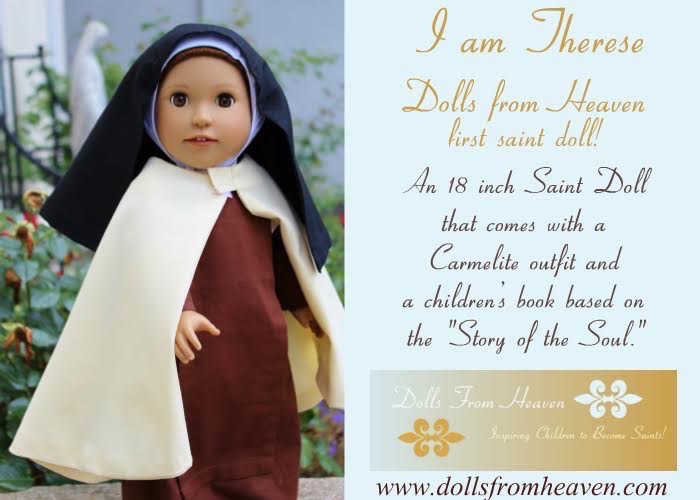
Perhaps the cutest option for encouraging younger children to encounter the saints for themselves is from the Kiczek family at www.DollsfromHeaven.com:
DollsfromHeavenT

The Kiczek family have created a lovely doll of St. Therese of Lisieux, which comes with accessories: several costumes and a children’s book about her life. The Kiczek family are hoping to create a whole series of saint dolls at www.dollsfromheaven.com. Dolls are a warm way to encourage a child’s relationship with individual saints, as well as introduce the universal vocation to holiness, and the various vocations.

Creatively Use Holy Days and Holidays To Engage Your Children’s Imaginations
Dressing up is a favorite childhood pastime. Halloween gives children and families the opportunity to dress up imaginatively for a night. If your parish, Catholic homeschool group or Catholic school has a themed party for Halloween or All Saints Day, this is a perfect opportunity for your child to dress up as a monk, nun, priest or deacon. An “All Saints Day” party offers the chance to research a saint and dress up as well. A “Dress Up As Your Favorite Saint Contest” at home could also be an opportunity to explore what it means to live a particular vocation to holiness.

Celebrating the feast day of a favorite family saint can include reading the life of the saint aloud together, dressing up, and preparing a meal or dessert that reflects that saint’s nationality. (For more creative ideas about celebrating the saints in your family, check out Catholic Family Fun by Sarah Reinhard.) 

Encourage Retreats and Visits to Shrines, Convents, and Monasteries
There is nothing like seeing religious life in action, to better understand it firsthand. Make a family pilgrimage to a convent, monastery, or seminary during an “open house” or special celebration. If an opportunity arises for an older child to make a retreat, go on a “nun run” (a visit to a series of convents for young women), or something similar, encourage him or her to go.

Encourage Active Participation in Mission Outreach
Encourage your teens to actively participate in mission outreach sponsored and supervised by the parish, diocese, or religious communities. Being sent on mission is a great way for a young person to experience the mission of the Church—a mission they are called to participate in, no matter what their vocation is. Mission experiences can help a young person understand that God has a mission for them to fulfill, and how important it is to correspond to God’s call.

Here are some additional ideas for ways to promote vocations in your family:

How To Promote Vocations in Your Family A comprehensive list of ideas downloadable as a PDF from the Diocese of LaCrosse.

7 Ways Families Can Foster Vocations is a brochure that can be purchased and shared—but also simply read online here.

Catholicmom.com has the most comprehensive resource online that I found for encouraging vocations in the family. I highly recommend checking it out—both for encouraging vocations, but also for great resources on nurturing holiness in our families.

How To Overcome Obstacles in Discerning Consecrated Life & National Vocation Awareness Week

woman-571715_1920This week—from Sunday, November 1 until Saturday, November 7, 2015—is National Vocation Awareness Week. The United States Conference of Catholic Bishops invites us all to dedicate this week to promote vocations specifically to the priesthood, diaconate, and consecrated life through prayer and education, and to renew our prayers and support for those who are considering one of these particular vocations.

With the recent Synod on the Family, the importance for young people to discern and be formed in their vocation to marriage is recognized, but there is one big difference. In our culture, marriage as we understand it as Catholics may be under pressure, but it is still considered a “usual” or “normal” path in life. Whereas ordained and consecrated life are the “hidden” or “forgotten” options for many young people. There could be any number of reasons for this, but in working with young people, I’ve found there’s usually just a few:

  • Out of sight, out of mind. A young person has never truly connected with a young priest, deacon, or religious, and so the thought that he or she could have a similar vocation never comes to mind.
  • Celibate chastity is so counter-cultural in our “do whatever feels right” culture obsessed with pleasure and sex, it’s immediately dismissed as “not possible.”
  • Similarly, the vow of poverty is absurd to someone immersed in the materialistic culture
  • The mistaken belief that true freedom means to be absolutely unencumbered by any form of restraint whatsoever, makes the priestly or religious vows unthinkable: like an unbearable lifetime of captivity.
  • Fear of commitment
  • Fear of unworthiness to be consecrated to God

National Vocation Awareness Week (NVAW) is especially helpful for highlighting consecrated life as a valid vocation to discern; NVAW can also help to address the misunderstandings that people often have about a life consecrated to God’s service. Great joy, beauty, love, and goodness flow from authentically living a priestly, diaconal, or religious vocation.

Of course, the greatest joy and love flow from living one’s own authentic call, so the point of National Vocation Awareness Week is not to put pressure on anyone, but to ensure that the full range of beautiful vocations in the Church are understood,  considered, and discerned.

Through the week, I hope to:

  • Answer the most recent questions about religious life that  have come in. Feel free to email, comment, or tweet me with your questions. (Note: I’m only on Twitter once or twice a day, so to reach me through Twitter, I believe you have to add a period in front of my name: put .@SisterMPaul at the beginning of your tweet, otherwise I might miss your question.)
  • Tweet resources that I discover through the week (and I’ll try to list them on the blog)
  • Highlight resources for nurturing vocations to religious life, priesthood and diaconate in the family, which is ideally the place where one can find the greatest support for discerning and taking the first steps to follow one’s vocation.

In addition, as I mentioned earlier, you can support NVAW in prayer by: downloading reflections for each day, a holy hour that you can pray for vocations this week, and a digital prayer card (PDF) that you can pray with and share, as well as other resources here on the USCCB’s website.

Back from Hiatus

hand-226358_1280for being so patient with me these past few weeks!

I’m back from my blogging/mostly offline hiatus. It is a real joy to be back online and blogging again! Posting three times a week has really pushed me to  come quite far writing the book on discernment, but it’s also proven to be quite challenging to keep up with. By the end of summer, I know I was barely hanging in there. I think I finally went into “overload” mode these past couple of weeks—in part because I’d fallen behind posting, but also because of other responsibilities that have arisen.

One benefit to all of this is that out of sheer necessity, I’ve been trying to live in the spirit of discernment even more than usual during these past couple weeks. So I have some more personal experiences and stories to share with regard to discerning day-to-day. Another (probably the best) benefit to you is that when I miss a blogpost, I pray extra for you, that you will receive the insights and graces that you need for your next step in your discernments! You have been in my prayers more than usual.

But I’m really excited to be back here writing. I’m trying to plan things out so that if it once again becomes impossible to blog regularly, I can at least post once or twice a week until I’m able to make time again.

From November 1-7, 2015, we celebrate National Vocation Awareness Week here in the USA. The United States Conference of Catholic Bishops (the USCCB) designated this week to encourage a culture of vocations specifically for priesthood, diaconate, and religious life. (In general, a vocational culture also includes discerning a possible vocation to marriage or single life.) Here are some recommended resources for parishes, families, and religious education–click on the link for National Vocational Awareness Week, English or Spanish. During that week, I hope to highlight a few other resources for encouraging openness to the call to consecrated or ordained life in the family that I’ve recently come across.

And just a reminder, please feel free to share your insights about discernment and your discernment journey with other readers through the comments. I love hearing from you, and also receiving your questions! The best way to reach me is here on the blog or via email. (Although you can find me on Twitter and Facebook, I am not able to maintain a consistent enough presence to be sure that I will receive your messages in a timely manner.)

Discerning Our Call To Serve

06L my crazy ideaA hugely important part of any good discernment is to listen to God’s invitations as expressed in the needs of the world—the needs of those around us: Where is God sending us to serve?

We live in a busy world, with so many needs. Any person of good will alive today can easily become overwhelmed by the number of requests for help, whether from family, friends, neighbors, parish, or work. Sometimes it may seem to be a call from God; at other times, we may become casually involved in helping out our family, our community, or a ministry simply as a favor, and the favor turns into a bigger commitment that we didn’t pray about or plan for. Especially when the invitation is casual, or we never envisioned ourselves serving in this particular way, we may not recognize God’s call.

When we feel pulled in many directions, or find ourselves juggling too much, this is the perfect time to enter into a spirit of discernment, to sort through the different demands on our time and discern which requests or needs are invitations from God. Sometimes, we can easily sort through them. At other times, it may take time to gradually clarify how God is inviting us. But as we go forward in our lives, we will develop more of a sense of our personal mission, of how God is calling us to be and to love in the world.

For example when I visit a hospital, I am drawn to help the people I encounter there—not just the person I am visiting, but also the people I meet casually. While I’m at the hospital, I seek to respond as best I can to the requests that I receive. I believe that God wants to work through me to touch the lives of the people that I encounter on that particular visit. (And often I am deeply touched by the people who are so courageously undergoing such suffering.)

06L RGB Stock

However in my vocation as a Daughter of Saint Paul, I am also aware that I am not called to be a nurse. Instead, my vocation as a Pauline communicator is to focus on the spiritual poverty and suffering of the people whom I encounter, whether they are wealthy or poor. This can be a less obvious call, because physical poverty and suffering are often more noticeable.

What criteria can we use to sort through the many demands that we experience? For me, the wonderfully profound Presbyterian minister and writer Frederick Buechner sums it up best when he wrote, “The place God calls you to is the place where your deep gladness and the world’s deep hunger meet” (Frederick Buechner, from his book Wishful Thinking: A Theological ABC). Looking for that resonance between the outward call we receive/perceive, and the inner movements of our heart may take time, prayer, and discernment, but the God who lovingly calls us will clarify his will for us in his time.   

Three ways the Church helps us discern

06H Sr Margaret JosephBelonging to the Church and being active in the Church is one of the best ways to live and grow in our faith, and can be invaluable in helping us discern God’s call. Our faith community can be as small as a prayer group, as large as a parish, or a midsize group that centers around a form of ministry or nurturing our faith and spirituality in every day life. Virtual faith communities can also support us spiritually and help us to grow, although in more limited ways. We may belong to more than one faith community.

Faith communities that really nurture us can be difficult to find, and they take many shapes. If you do not have a faith community—for example, you go to Sunday Mass but are not more involved in living and sharing your faith in your parish or in other ways—I encourage you to actively seek one. Your own parish is a good place to start. (If you don’t feel that your parish is nurturing your faith deeply enough, there are many other ways to connect with the Church.)

Why is belonging to a faith community so important to our discernment?

1. Because we need to be actively involved in building the Church in order to fully live our faith. Jesus doesn’t call us as isolated individuals, but calls us into community, to serve one another and to live in communion with each other. How can we do that if we aren’t actively involved? An essential part of our baptismal call is to evangelize, to witness, and share our faith with others. And the first place that we can do that is within the Church.

We cannot nurture and grow in our faith alone; we need others to help us, to inspire us, to motivate us, to call us to greater self-giving. Finding a dynamic faith community where we are nurtured spiritually can be challenging, but it’s worth the search. If we cannot find a vibrant parish nearby, we can start looking for other kinds of Catholic faith communities. Retreats, lay movements, or connecting with religious communities of priests, brothers, or sisters, are three ways we can find people who are committed to growing in holiness in ways that we can identify with and share. In a dynamic faith community where we truly share the height and depths of our Faith, we can more easily hear and respond to God’s invitations to us—whether they are to a particular ministry or initiative, or a deeper relationship with Christ. Especially if we are discerning our vocation or ministry, Jesus will call us and affirm our call in and through the Church.

2. We often receive Christ’s call in and through his Church: through receiving the Word of God, through our sacramental life, through the Eucharist, in the homilies, in the calls of our pastors, in the service that we give, in the holy examples of the saints and perhaps in the inspiring lives of someone we know. For those discerning their vocations, the Church has the best understanding of how to receive, respond to, and live the call to marriage, single, priestly and religious life.

3. Usually it is in the Church that we can best learn how to serve with the mind and heart of Christ. Despite the reality that the Church is Christ’s Body, we will find many people in the Church whose humanity and sinfulness irritate, disturb, and perhaps even appall us. But we know that Christ died to redeem us and sanctify us, and that the Church’s holiness comes from Christ. If we look attentively, we will also find people in the Church who are truly holy: who are receptive to the Word of God in the Scripture and in the Eucharist, and who humbly serve—often without being acknowledged. We are called to build up the Church—sometimes the irritating or wounded part of the Church that would normally turn us away—with our faith and service. In turn, certain members of our faith community will invite and/or challenge us to serve. And they will also affirm us in our service.

As Catholic Christians, we are called to listen to the invitations the Church makes–because Christ speaks through his Church. Our last few popes have wisely and unapologetically called the Church to take specific actions. Coming from pastors who most clearly represent Christ on earth, these are calls from God. Today, Pope Francis sometimes startles us with the vividness of his invitations of how we are to called to love the world as Christ did. His wise and pastoral invitations to holiness and service are not just for the bishops and clergy, but for all of us Catholic Christians to bring to prayer and discernment.

Our Gifts and Weaknesses Help Us Discern Our Way of Being in the World

06D RGBstock 2 choiceDiscernment can be approached in many ways. Personally, I’ve found it easier when I begin with my own heart, my identity, and experience (as at the center of a circle) and then gradually expand outwards to my situation, my family, community and workplace, the calls of the Church, and the needs of the world.

If we imagine discernment as a series of concentric circles, the innermost circle would be my interior life, including: my God-given identity, my feelings, thoughts, deep desires, my gifts and limitations. We discover these in prayer and also by praying with our history, the needs of the world, and our current situation.

In particular, reflecting on and praying with our gifts and limitations—the ways that God has given us to be and to act in the world—is extremely helpful in discerning a course of action or our vocation. One of the most popular sayings of St. Thomas Aquinas is: “Grace does not destroy nature but perfects it.” This is helpful in understanding that we are called be holy in a way that respects our humanity, although grace also enables us to transcend the merely human and to selflessly sacrifice for the sake of love.

A superficial examination of the lives of several saints quickly reveals how unique each saint’s path to holiness was. (I give a quick example between St. Pio and St. Frances Cabrini in this earlier post.) Sanctity certainly has many common elements: faith, hope, and love; the works of mercy; the Beatitudes. But how each individual is specifically called to live holiness is unique, partly according to that person’s gifts and limitations.

Taking into account our gifts and limitations, therefore, is an important part of understanding God’s call for us. There are certain roles that require certain aptitudes or skills. If we are discerning our call to a role that has such requirements, we need to reflect on whether we have the aptitudes or the ability to acquire the needed skills. We don’t discount the reality that grace can help us to do something that would ordinarily be beyond us, but we also don’t seek to work against the foundational inclinations of our personality, unless we have a compelling reason to do so.

* * *

As a college student, Sarah is currently discerning her future career. At heart, Sarah is an artist and idealist who feels called to serve others. For some reason—perhaps because of her family background—she believes that being a doctor is the best way to serve others. Yet, she finds herself dismayed when she starts to fill out an application for medical school because she feels no personal inclination towards a medical profession: she isn’t good at science, and she becomes faint not just at the sight of blood, but at the thought of blood. If Sarah’s interest in becoming a doctor is based solely on her theory that being a doctor is the best way to help others, then she is basing her discernment on a faulty assumption, and her resistance to filling out that application is a real indication of that. The clue here is not that being a medical doctor is hard, or a lot of work, but that it actually goes against Sarah’s personal inclinations and gifts. Sarah may indeed be called to serve others, but in another way.

* * *

When we discern, we want to take our personalities, gifts, limitations, and inclinations into account. Part of the work of vocation directors for priesthood and religious communities is to see if the candidate is a “good fit.” For example, as Daughters of Saint Paul we share life closely—not just daily life, but also in the ways we carry out our daily mission together. It can be quite demanding to live and work so closely together, even for those of us who are called to it. (One of the greatest “daily miracles” in religious life is the reality that five women, who all take turns cooking the meals, can share the same small kitchen and still be friends at the end of the day!)

Since a young woman needs to have a certain amount of flexibility and sociability to be happy as a Daughter of Saint Paul, this becomes part of her discernment with our community. If she doesn’t have those particular qualities, it doesn’t mean she isn’t a wonderful person called by God to a special mission, but it’s an indication that she might be called somewhere else—perhaps to another congregation of sisters who don’t live community life together so closely, or perhaps to single life, or married life.

On the other hand, someone who hastily dismisses an invitation to be involved in something good–such as their parish’s outreach program–only because it’s “too hard,” is not really discerning. The amount of sacrifice involved is not the question; as followers of Christ, we will always have something to offer because we seek to love selflessly as Christ does. Instead, the question is how God is calling us to use our particular gifts and our limitations to serve others’ needs in the way that only we can.

Lectio Divina for Discerners: What do you seek?

06C wikipedia (3)

Discerning with the Word: A Guided Lectio Divina for Those in Discernment
“What do you seek?”

Introduction: We may not notice, but many times when Jesus encounters someone, he asks them a question about what they want. In this reading, Andrew and John, who would become two of Jesus’ chosen apostles, meet Jesus for the first time. As you pray with this reading, imagine Jesus directing this question to you. How would you answer?

Lectio: John 1:35-42

The next day John again was standing with two of his disciples, and as he watched Jesus walk by, he exclaimed, ‘Look, here is the Lamb of God!’ The two disciples heard him say this, and they followed Jesus. When Jesus turned and saw them following, he said to them, ‘What are you looking for?’ They said to him, ‘Rabbi’ (which translated means Teacher), ‘where are you staying?’ He said to them, ‘Come and see.’ They came and saw where he was staying, and they remained with him that day. It was about four o’clock in the afternoon. One of the two who heard John speak and followed him was Andrew, Simon Peter’s brother. He first found his brother Simon and said to him, ‘We have found the Messiah’ (which is translated Anointed). He brought Simon to Jesus, who looked at him and said, ‘You are Simon son of John. You are to be called Cephas’ (which is translated Peter).

Read through this reading slowly and attentively at least twice. Can you imagine yourself as one of the people in this story, and how you might feel? Take your time praying with it.

Meditatio

Jesus begins his relationship with Andrew and John by asking them what they want. Andrew and John answer Jesus in a way that seems ordinary but that actually expresses their desire to get to know Jesus better, to “stay” with him. Jesus responds to their desires–both spoken and unspoken. This initial encounter was so transformative for Andrew that he immediately went off and convinced his brother Simon to meet Jesus. The meeting between Jesus and Simon is even more dramatic, as Jesus doesn’t just call Simon by name, but gives him a new name, “Peter.”

As we begin to discern, Jesus asks us this same question, “What are you looking for?”

What are your dreams? What are you looking for? Share one of your deep desires or dreams with Jesus now.

Contemplatio

You have shared with God a dream or desire important to you. Now, take some quiet time to listen. How might God communicate to you his dreams for you?

God may respond in word, in a feeling, in making things work out…or God may respond in silence. But God always responds to us.

Oratio

God’s Dream for Me based on the writings of Bl. James Alberione

Your dream, O Master, is to lay hold of me with your divine life.
Your dream is to purify me, to recreate me,
to make me a new person in your image.
Your dream is to fill me with your love, to make me love the Father and all my brothers and sisters just as you do.
Your dream is to draw me to you with the closest of bonds, to unite my heart with yours, to make me strong,
to impart to me your divine power
so that I can overcome evil and be constant in doing good.
Your dream is to inflame me with an untiring zeal to spread your kingdom.
Your dream is to possess me in this life and in the life to come.
O Master, may your dream come true!
May I be able to give all you ask of me. Amen.*

* From Live Christ! Give Christ! Prayers for the New Evangelization 

Actio

Try to be aware of your hopes for the day each morning.
Next, start to bring your “hopes” to prayer.
Imagine Jesus looking at you and asking you, “What do you want me to do for you today?”

I’m temporarily offline but praying for you

I’d hoped I’d be able to keep up posting during this week and next, but am not able to. I apologize for the lack of posts, and hope to be back by the end of next week. Know that you have been in my prayers in a special way.

For the young women discerning religious life, I am posting below a couple of retreat opportunities that our sisters are offering this summer. If you are interested (or you know someone who might be), please contact Sr. Michael at the phone number or email provided.

3That Christ May Live in Me_Daughters of St. Paul_Discernemnt Poster_YCL_Consecrated Life_Discernment


SaintPaulSummerProgram2015_Flyer_Square_Daughters-of-St-Paul_Discernment_Consecrated-Life


Guided Lectio Divina for Discerners: He Loved Me and Gave Himself for Me

“He Loved Me and Gave Himself for Me!”

453px-Caravaggio-The_Conversion_on_the_Way_to_DamascusIntroduction: St. Paul, who was known as “Saul” before his encounter with Christ, was a good man and a devout Jew who was quite conscientious about keeping the Law of God. He desired to serve God, but was too focused on what he wanted to do for God, rather than on what God was doing. Saul’s zeal was so misguided that he sought to persecute the Christians, whom he felt were destroying the Jewish religion. On his way to Damascus, instead of accomplishing this task, he encountered Jesus the Savior, who revealed to Paul the depth of God’s mercy and love. Paul’s foundational experience of Christ’s saving and merciful love for him and for the people to whom he would send Paul shaped Paul’s entire life and mission. It was an experience of love, light, and beauty to which Paul returned to over and over again.

For this lectio divina, we’ll pray with one of the Scriptural accounts of Paul’s encounter with Christ from Acts, followed by a short description of the experience from a letter of Paul.

Lectio: Acts 9:1-19 and 1 Tim. 1:12-17

Acts 9:1-19 (Read from your Bible or click here for this first reading.)

1 Tim. 1:12-17

I am grateful to Christ Jesus our Lord, who has strengthened me, because he judged me faithful and appointed me to his service, even though I was formerly a blasphemer, a persecutor, and a man of violence. But I received mercy because I had acted ignorantly in unbelief, and the grace of our Lord overflowed for me with the faith and love that are in Christ Jesus. The saying is sure and worthy of full acceptance, that Christ Jesus came into the world to save sinners—of whom I am the foremost. But for that very reason I received mercy, so that in me, as the foremost, Jesus Christ might display the utmost patience, making me an example to those who would come to believe in him for eternal life. To the King of the ages, immortal, invisible, the only God, be honor and glory forever and ever. Amen.

Meditatio

The Acts of the Apostles gives three different accounts of the conversion of Saint Paul because of its importance in the early Church (see Acts 9:1-19, Acts 22:3-16, and 26:2-18). In his letters, Paul often refers to his encounter with Christ, although often indirectly (see 1 Cor. 15:8, Gal. 1:11-16, 2 Cor. 4:6).

Initially, Paul had found fulfillment in living the Law to the point of perfection. But his encounter with Jesus changes all that. The brilliance of Jesus’ love and truth blinds Paul initially. He thought he had been able to see, but his temporary blindness enables him to see himself and his relationship with God and others in a whole new way. Paul must have felt great distress for being so wrong, for recognizing that he was persecuting the followers of Jesus, whom he now recognizes as the Messiah, the Son of God, his Light.

In his encounter with Jesus, Paul truly listens. He discovers that God’s merciful love in Christ gives the deepest meaning to his life, and he doesn’t have to do anything to win or earn that love. He just has to believe in it and receive it. Paul’s response is the beautiful and moving response of a discerning disciple, even though his world has just been turned upside down: “Lord, who are you? What do you want me to do?”

Praying with Paul’s dramatic encounter with Jesus, we can see that God may communicate to us in many ways: through an interior whisper or an insight, through others such as Ananias, or through an unexpected event that shakes us up. Jesus’ gaze of mercy on Paul transformed his life forever. But this profound transformation in Paul is not easy, nor is it over in three days. Paul’s growth in Christ and carrying out the call of Christ was lifelong.

In our times of discernment, we may experience similar moments to Paul in his encounter with Christ:

  • disturbance/shake-up (Paul fell to the ground)
  • great light
  • listening/attentive (light and voice)
  • dialogue
  • fasting (from both food and human sight)
  • absorbed in prayer and in one’s relationship with Christ
  • obedient to Christ’s call
  • receiving grace through the community and the celebration of the sacraments
  • guidance of an “elder” of the community
  • community confirms God’s call
  • obedience to the community
  • commitment to the entrusted mission of proclaiming/witnessing to Christ

How do we experience Christ’s invitations in our lives? When we are confronted with interruptions, unexpected changes, or times of transition, it can be difficult to see God’s light or invitation. But suppose we “refocused” our gaze from the distress of the unexpected experience to seeing it as an invitation from God, as Paul did? What insights would we receive if we did this? Discovering that we need to convert, change, or grow is an inherent part of receiving God’s call. How do I want to respond to God’s invitation?

Contemplatio

I am grateful to Christ Jesus our Lord, who has strengthened me, because…I received mercy. (See 1 Tim. 1:12-13)

From the second reading (from 1 Timothy) it’s clear how Paul’s encounter with Christ on the way to Damascus shaped his whole life. Paul’s descriptions of his relationship with Christ are marked by thanksgiving for Christ’s merciful love. It’s a deeply warm and personal relationship. This invites us to reflect:

  • What are our earliest memories of our relationship with God?
  • How have our encounters with Christ “marked” our lives, transformed us? How have I experienced Christ’s mercy, and how have I responded?
  • How would we characterize our relationship with Christ? How do we feel Jesus is inviting us to grow in our relationship with him?

Oratio

My favorite prayer posture is to sit or kneel on the floor near the tabernacle. As I was praying, I suddenly realized that this receptive and adoring posture–sitting at the feet of the Master–characterizes my relationship with Christ. At the feet of the Master, I am receptive to his call and his sending me; I listen, adore, love, receive his love, learn his way of gentleness, plead with him, receive forgiveness. I am blessed to be at his feet.

Sometimes when I’m coming to the end of my prayer time, I will joyfully remind Jesus, “I’m not going anywhere” — meaning that I will stay at his feet always. It’s a little renewal of my fidelity to the All-Faithful One.

Renew your relationship with Jesus in your own words. 

Actio

Be mindful of Jesus’ merciful love for you throughout your day today, choosing at least three times throughout the day where you will stop and thank Jesus for the gift of his love for you.

Sharing the Treasure of Pauline Spirituality in NYC This Week

Just a reminder for any New Yorkers that I’ll be visiting this week for two special events:

1. Manhattan’s very own #Soul of Christ talk and book-signing at our Pauline Book & Media Center at 64 West 38th St. on Thursday evening (June 4) at 6:00 PM

NewYorkPromoFinal


2. Daughters of Saint Paul Centenary Day of Recollection and Centenary Mass on Saturday, June 6th, from 10 AM to 6:30 PM, at Holy Family Church, where I will be giving one of two talks and will lead the Eucharistic Hour of Adoration:

Flyer for Holy Family event