A few years ago, a wonderful wife and mother named Catherine came to see me.

Catherine is a loving and generous woman who has inspired the many people at her parish who know her. She constantly seeks God’s will amidst the usual and sometimes unusual challenges of married life, and puts herself at the service of the needs of her parish. But recently, she underwent a particular experience of change, accompanied by darkness: her children were growing up and leaving home and didn’t seem to need her as much; her relationship with her husband felt routine; her daily life gave her little satisfaction. At one point, Catherine confided to a friend, “I was attracted to religious life when I was younger, and being a sister is so much more peaceful and holy. Maybe I missed my vocation. What if God really called me to religious life?”
This thought that she might have “missed” her vocation was a scary one for Catherine (and for anyone serious about seeking God’s will–more on that later). However, because she still had commitments to her husband and children, it was clear that God’s will for Catherine was to continue in her vocation as a loving mother and wife. If Catherine had indeed chosen a path other than what God originally willed for her, God’s will for her at his point in her life was clear: to continue in her vocational commitments. Her doubts were almost certainly not a call to switch vocations in midlife. But at her age, repeatedly experiencing these doubts could be an important part of Catherine’s midlife journey: she may have needed to re-evaluate certain decisions and how she was living her vocation. Rather than something to discourage or scare her, Catherine could use these troubling questions as an invitation to reflect on her life, bringing them to prayer and spiritual direction.
When we talked together, I encouraged Catherine to consider these possibilities:
A) It was possible her doubts were a temptation, especially because the doubts seemed to be making Catherine lose some of her interior peace. Perhaps the devil wanted to distract this loving, goodhearted woman from her true vocation—that of being a loving mother and wife. By putting the “holier” life of a religious sister on a pedestal and entertaining doubts about her own vocational discernment, Catherine could have been letting the devil gain a foothold in her thoughts, blurring her perception of the unique beauty of her call and gradually weakening her commitment to her vocation.
Instead of allowing these doubts to distract her, Catherine could use them as an opportunity to recommit more deeply to her life of self-giving love as a mother and wife, perhaps discerning new ways in which she can express her love in her changing situation.
B) Catherine might have been going through a time of desolation where, through her doubts and longing for “more,” God was inviting her to purify her motivations and deepen how she lives her true vocation. Catherine could take time to examine how she was living her vocation and how she could grow in her call to love as a wife and mother.
C) Perhaps God was inviting Catherine to dig deeper into what attracted her about religious life. Catherine’s feelings of dissatisfaction could have been reflecting a desire placed in her by God for greater union and intimacy with him—something that she previously thought was reserved only for sisters. God could have been using her feelings of desolation to call her to a deeper spiritual life of union with him. Perhaps deep within her restless longing, God was calling Catherine to offer herself to him in a special way: for example, in a particular ministry or consecrated lay institute.
Every person’s individual experience and discernment has specific details that God uses to lead them. Catherine never shared the fruits of her prayer after we talked, but she chose to continue in her vocation of love. She is now a happily devoted grandmother.
!["The Scream by Edvard Munch, 1893 - Nasjonalgalleriet" by Edvard Munch - [1]. Licensed under Public Domain via Commons - https://commons.wikimedia.org/wiki/File:The_Scream_by_Edvard_Munch,_1893_-_Nasjonalgalleriet.png#/media/File:The_Scream_by_Edvard_Munch,_1893_-_Nasjonalgalleriet.png](https://coauthoryourlifewithgod.com/wp-content/uploads/2015/11/the_scream-e1448054509584.jpg?w=625&h=797)
 Every good story has key turning points in which the rest of the protagonist’s life is affected. Turning points in our lives are usually, but not always, recognizable. In BBC’s Sherlock, a recent retelling of Arthur Conan Doyle’s detective stories, Dr. Watson’s decision to become roommate to the enigmatic Sherlock Holmes is the definitive turning point upon which Dr. Watson’s entire future is based, although Watson certainly did not know that at the time. (It changes Sherlock’s life profoundly, too, although he is slower to admit it—see season 3.) In storytelling, turning points are characterized by their importance in affecting characters’ lives, whether they know it or not.
 What are some of the key moments in our life when we might want to pay special attention to discernment? Any time we are going though a big change. Some of these big changes include: the death of a loved one, moving, financial crisis, job loss or change, physical illness, changes in the lives of our closest loved ones (e.g. children leave home, a spouse retires, etc.), changes in our roles or responsibilities, etc.
 Living in a spirit of discernment is a wonderful spiritual attitude to cultivate and grow in daily. One of the benefits of living with a discerning heart is that, when the time comes to make a big decision in our lives, we have the tools of discernment at hand to help us discover God’s will for us.
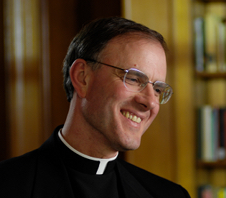 Father Timothy Gallagher, OMV,
 Discerning the Will of God: An Ignatian Guide to Decision Making
 The Discernment of Spirits: An Ignatian Guide to Everyday Living
 Called to Life by Father Jacques Philippe
 He Speaks to You
 ![Ferguson Slide by Eeekster (own work) [CC by 3.0]](https://commons.wikimedia.org/wiki/File%3AFerguson-slide.jpg)


![Anton Robert Leinweber [Public domain], via Wikimedia Commons](https://coauthoryourlifewithgod.com/wp-content/uploads/2015/11/1024px-robert_leinweber_001-e1447104654156.jpg)

 Co-Author Your Life with God
