Will My Family Disapprove If I Discern Consecrated Life?

Ferguson Slide by Eeekster (own work) [CC by 3.0]

One response that came up high in the results of the poll, What’s the Biggest Obstacle to Considering Consecrated Life, was a written-in answer that had a common thread:

  • Fear of what others (especially family) will think of me
  • Fear of disappointing family or parents
  • Fear of disapproval or lack of understanding

All of these answers are about what others think and expect of us, especially family and loved ones. This fear is very understandable. But, being overly concerned or fearful about others’ opinions impinges on our freedom to discern. Yet in our discernments we are to consult with those who know us well. How are we supposed to take into account our family’s and friends’ advice when we are discerning something that they don’t expect, such as an unusual vocational choice? Should we even consult them?

Several Factors To Consider
1) Discerning our vocation is sacred, and if we truly feel that we might be called to religious life or priesthood, it’s important to discern it without letting our families’ or friends’ opinions prevent us from doing so. Our vocation is a sacred calling that is too important to let the resistance or disapproval of family and friends stand in the way of even exploring it. This doesn’t make it easy. But it is very freeing to seek our true calling, and if God is calling us to religious life or priesthood, he will give us the grace to work through our fears and all other obstacles.

2) When we are discerning, the people we seek advice from should above all be living a spiritual life, otherwise they may not understand or be able to support us in seeking God’s will. (Other qualities, such as wisdom and knowing us well, are helpful. But above all, they must also desire that we follow God’s will.)

3) Seeking advice or counsel is not the same as seeking approval. In consulting others, we are looking for greater knowledge and insight about ourselves, our situation, and how God is inviting us, but we are not seeking to please the person we are consulting with.

4) To know our fears when we discern is really helpful because fear can help us to reflect and to bring our discernment to prayer. However, fear in itself is not a sufficient motivation to decide whether or not to discern something, especially when it’s something as important as a vocation. Instead, we can make our fear part of our discernment by exploring why we are afraid, and then, offering our fears to the Lord and moving forward.

If we feel the need to discern something which we know someone important in our life (such as a parent or friend) is probably going to disapprove, then we need to seek greater interior freedom. Becoming free is the hardest part of discerning! In these cases, it is really important to detach ourselves from others’ opinions about our discernment, so that we don’t allow fear to control us and so that we can more freely listen to God’s invitation. This detachment is often a gradual journey that happens as we discern and God’s call becomes clearer to us.

Sorting Through Others’ Opinions
Sorting through others’ opinions—whether favorable or unfavorable to our discernment—can sometimes be helpful in detaching ourselves from them. We may want to ask ourselves a few questions:

A) Why do we think they would oppose a particular decision? Are we just unsure, or are we pretty certain that they will be disappointed? Will the lack of support be permanent, or is it just that what we are discerning is new, and they will need time to get used to the idea?

B) If we are pretty sure that this person(s) will not understand or be disappointed in our decision, do we know why? For example, some parents are hesitant about their daughter becoming a sister because they think they will never see her again, and they love their daughter and want to stay close to her. (Different congregations have different practices about their sisters visiting their families, so this particular concern may not even be real.) At other times, a parent might resist a child trying to follow a certain career (such as becoming an actor or an artist) because they know how hard it is to earn a living in the arts, and they want their child to have security.

These kinds of questions can help us to see past our own fears into the real concerns of our loved ones—concerns that we need to think about and perhaps address with them, if and when we tell them about our discernment.

Discerning Our Vocation Is Sacred
Ideally, we’d want to share our vocational discernment at least in part with our family, because we want our family’s understanding and support throughout our life. But sometimes a parent or family member will be so resistant to a particular vocation that we simply need to wait to tell them about it until after we have completed our discernment.

Our vocation is a sacred calling that is too important to let the resistance or disapproval of family and friends stand in the way. Countless priests, brothers, and sisters had to go against their parents’ wishes to follow their vocation. (The family of Saint Thomas Aquinas’s family kidnapped and imprisoned him to prevent him from following his vocation in the Dominican Order.) This is not an easy path to walk, but if we possess sufficient maturity and have discerned well, it is more important to follow God’s call than to give in to our family’s opinions. Jesus himself called his disciples to leave their parents and families behind to follow him.

St. John Paul II had this to say about following one’s vocation:

“Do not be afraid of the radicalness of Christ’s demands, because Jesus, who loved us first, is prepared to give himself to you, as well as asking of you. If he asks much of you, it is because he knows you can give much.”                                                                                                                – Sept. 8, 1992

Photo credit: Ferguson Slide by Eeekster (own work) used under Creative Commons Attribution 3.0 license

What if I don’t think I’m “good enough” to become a sister?

Anton Robert Leinweber [Public domain], via Wikimedia Commons

“Peter’s Denial” by Anton Robert Leinweber [Public domain], via Wikimedia Commons

After seeing the results of the recent poll that I posted (“What’s the biggest obstacle to considering consecrated life?”) one reader asked a series of really great questions about feeling that we are not good enough to be a religious:

Hello Sister, thank you for your posts! I love your blog.
I can see from the poll results a lot of us feel like we are not good enough to be religious.

What would you say to young women with a history of sinful behavior or who think they aren’t devout or prayerful enough?
Are devotion and prayerfulness things that can be nurtured?
If we are called to religious life will sins from our past be an issue?

Thank you! 🙂

Thanks for the great questions! I think we can start by making a couple of clarifications that can help with some false assumptions that many of us share.

Being Worthy

1) God’s love is gratuitous and unconditional. None of us are “worthy” of the kind of relationship with God that God seeks to have with us. God’s love is gratuitous; he simply wants to be with us, no matter where we are. But that doesn’t mean that God leaves us where we are, especially if we are trapped in a cycle of sin or deeply unhappy.

God’s love is multi-faceted: first, God simply loves us for who we are, no conditions. But God’s love is not idle. God works actively to bring about our greatest good, whether within us by inviting us to grow in a the way we need most, or externally through circumstances and people who help us to grow in the area we need the most (or both)! No matter where we are in our lives or spiritual journeys, God is inviting us to grow, to become more Christlike, to grow into our best selves.

Think of Jesus’ Apostles. They were far from perfect, but Jesus loved them and called them as they were, even with their dramatic failures. (Think of Peter’s denial.) But Jesus also formed them, taught them, called them to live in him, to share in his life, to receive the power of the Holy Spirit so that they could witness to him.

2) Priestly, diaconal, and religious life, because of their visibility, lifestyle, and dedication to prayer and ministry, can certainly seem “holier” or “better” in a theoretical sense. (For example, religious life is described as the call to perfection; priestly ministry is talked about as in persona Christi: “in the person of Christ.” But keep in mind also that all vocations are described by the Church in spousal terms that relate to the God-instituted gift of marriage.) So the true question to ask in discerning one’s vocation is not, “Which vocation is better?” because all vocations, all states in life, are good; each has its own strengths, appeals, and charism; all of them are calls to great holiness. Instead, the true question is: “Which vocation is God calling me to? Which vocation is the best for me? Which vocation is the path where I will most grow in holiness?” Wherever God is calling me, that vocation is the “holier” one, the “best.”

Just as none of us are worthy of God’s love, none of us are “worthy” of the call to holiness (relationship with God) in the various states in life. Each vocation is mind-blowingly beautiful and exalted when understood in all its God-given glory.

When we remember that the “best” vocation is the vocation God intends for me, we are ready to truly discern.

Past Sins and Being Called

With regard to sinfulness in general, it’s important to know that everyone struggles with sin, including priests and religious. I remember when I entered religious life, I naïvely thought that my temper would disappear without much effort…or even all by itself! Unfortunately for the sisters I live with, that was not true. However, my personality—while at times challenging for the sisters with whom I live in community—is generally drawn towards community: I’m truly, deeply happy in sharing my life closely with the other sisters in the convent. So even though I still have to examine myself frequently on my temper (especially when I’m tempted to speak sharply to someone), it doesn’t make community life unbearable for me nor prevent me from being called to religious life.

When discerning, it’s really good to review our personal history and what our choices tell us about our deepest desires. The most obvious example here (and a frequently asked question) is about celibate chastity. If we have not lived chastely as a single lay person, can we still be called to priesthood or religious life? The answer is a definite “Yes, it’s possible.” But it’s important to look at our struggles and history closely and prayerfully. If someone has not lived chastely for a lengthy period of time, then they may not be called to live vowed celibate chastity for the rest of their lives as a priest, brother, or sister. Their attraction to marital intimacy—even when acted upon outside of marriage—could be an indication that the person is called to marriage. On the other hand, Saint Augustine, who struggled with living a chaste life for decades, became a priest and then a bishop. Why? Augustine’s radical conversion, focused Christian discipleship and chaste lifestyle for a number of years, convinced his bishop that Augustine was indeed called to be a priest and later, a bishop.

Praying over our history—the graces, the joys, the sorrows, and our sinfulness—helps  us to discern what our deep desires are, which in turn often give us important clues about how God might be calling us.

“I Don’t Pray Enough”

The final question, that someone may not feel worthy to be a priest, deacon, or religious because they don’t have enough devotion or don’t pray enough, is answered by the questioner. Yes, devotion and prayer can be nurtured—and all of us, not just priests, deacons, and sisters, need to continually nurture our prayer life!

In addition to Mass, lectio divina is the form of prayer that I’ve encouraged most on this blog because praying with the Word of God is so powerful and is really a primary way of praying for all Catholics. Other forms of prayer that I recommend include: Eucharistic adoration, devotion and prayers to the Blessed Mother, meditation, morning and evening prayer, the Liturgy of the Hours. Most people have several ways that they pray regularly. At certain times in their lives, they’ll probably feel called to shift or try another form of prayer. If someone feels their prayer life is lacking, then it’s easy to make a little plan to grow in prayer: in scope (the time we spend) or in depth (the quality of our prayer), or both! Advent and Lent are great times to do this each year—they are the “retreat seasons” that the Church offers to all of us to focus on growing closer to Christ.

In this blog, I’ve tried to include a little of how to grow in various forms of prayer. As Catholics, we have lots of great resources that can help us to grow in our prayer life, whether we are just learning how to pray for the first time, or whether we want to expand and try something new or more contemplative. I’m curious if you as a reader would find it helpful for me to include a list of great books to begin, nurture, and develop your prayer life. Or perhaps you wonder about your prayer life and would find it helpful for me to include a short “primer on prayer” in the book/blog. Please let me know—in the comments or via email.

When we get to the section about specific kinds of discernment, I’ll respond to some of the other obstacles to discerning religious life, diaconate, or priesthood that came up in the poll–they were some great answers there! (If you have a specific burning question or obstacle, let me know and I’ll try to answer it sooner.) And if you haven’t taken the poll yet, you can still do so here.

Tips for the Discerner

PraySeveral people have sent in questions or comments, which I will be delighted to address tomorrow or Friday. But in the meantime, I have run across a number of wonderful reflections and tips for those who are discerning, and I couldn’t wait to share them with you. Check these out!

From Sr.  Margaret Michael’s video, Discernment Tip #2: He who is the Way will show us the way for our life. Pray! (Check out her video on facebook here on our Daughters of St. Paul Facebook Page–and keep checking back all week!) Actually, if you are discerning religious life, I would recommend you visit the discernment section on our Daughters of Saint Paul website, too. No matter what community you are called to, you will most likely find the discernment tips offered there very helpful. (Yes, I wrote some of the material that you will find there.)  

Sr. Christina Neumann, OSF, who has a lovely blog that offers an “inside view” of religious life from the Franciscan perspective, offers her reflection for how we can all live #NationalVocationAwarenessWeek

The Heart of Mary’s Women’s Fellowship occasionally offers “self-studies” or “mini-retreats.” They recently posted a beautiful nine-day series of Scriptural reflections on call, vocation, and discernment, which you can find here. This series of reflections make a beautiful Scriptural novena with lectio divina for anyone who is seeking to discern how to follow God more closely in their life. 

The Coffee Spoons Blog posted a lovely reflection, “Everything is grace,” about St. Thérèse’s Garden: that living our true vocation is not necessarily living whom we think we’re supposed to be, but whom God calls us to be! St. Therese’s words are a joyful reminder of God’s loving call to us to be ourselves–our best selves.

How To Promote Vocations to Consecrated Life in the Family

woman-591575_1280When I was growing up, my parents always encouraged me to think of the future with freedom and hope. Although my parents had high expectations regarding my behavior and my schooling, they gave my siblings and I great freedom in deciding what we would do with our lives. I knew they wanted me to be happy and holy, but I also knew that I could aspire to be a nurse, a veterinarian, a musician, or anything else, and they would support me in following my dreams.

So, when I asked permission to enter the convent while still a teenager, I was thrilled but not super-surprised that they said “yes.” (I expected support but wasn’t sure if my parents would ask me to wait.) Only later did I realize how unusual their decision was, how hard it must have been for them, and how much flak they received from family and friends in allowing me to follow my dreams.

Helping a child discern his or her vocation in life is one of the most important responsibilities of being a parent. Why? Because we find our most complete fulfillment and happiness possible here on earth when we are living our vocation. In creating us, God has gifted us with a mission that, when we carry it out, fulfills our deepest desires and allows us to develop our gifts. Helping a child to discover and follow their unique, God-invited path is one of the greatest gifts a parent can give to a child; such a gift becomes foundational to that child’s happiness for the rest of his or her life!

The most important way to help a child follow his or her vocation is, of course, to nurture their life of faith and their call to holiness. But how can parents specifically foster in their children an openness to every vocation?

Openly talk about the various vocations with your children.
If your child is old enough to be seriously thinking about his or her future, invite him or her to consider the various options. Talk about the advantages and gifts of each state in life. If they make a preemptive choice for a particular vocation or career, talk it over with them reasonably. Even if their choice seems ridiculous, find out why they are drawn to it, and help them to see the practical consequences. By encouraging them to think through their choices, you free them from the pressure of choosing something simply to please you or someone else.

WhatDoesaPriestDoOne resource to begin a conversation—even at a young age— is this flip book published by Paulist Press entitled What Does a Priest Do? / What Does a Nun Do? by Susan Heyboer O’Keefe. (The back cover is the front of the second book, What Does a Nun Do?)

HeSpeaksToYouFor young women (teens and young adults)  He Speaks to You by Sr. Helena Burns, FSP is a daily meditation book directed specifically to teens with super-short meditations, prayers, and activities that encourage a young woman to root her life in Christ and discern how she can follow Jesus in her daily life and in the future.

Help to make deacons, priests and sisters familiar to your children whenever possible.
Find ways to be active at your parish, and encourage your children to participate as well, as a singer in the children’s choir, as an altar server, as a member of the Junior Legion of Mary, etc. In addition to helping them engage in parish life, they will also see the priest(s) at the parish more often.

If you have a friend who is a sister, deacon, or priest, invite them over for a family dinner.

Encourage your child to become a pen pal of a religious priest or sister. (Sr. Christina Marie Neumann, OSF, has offered to match up a few pen pals with sisters in her community, the Franciscan Community of Dillingen-Hankinson, North Dakota Province. (Website home at www.ourfranciscanfiat.wordpress.com)

Sister-Softysmall-683x1024Another resource for young children is from ABCatholic, who has created a unique series of dolls, among them “Sister Softy” who can help to make religious life more familiar for young girls. Unfortunately, many young people never have the opportunity to meet religious sisters, especially sisters in habits. Sadly, the habit, which is meant to be a sign of consecration to God but also a sign of God’s loving care, can even make some people feel a bit intimidated to approach a sister. This doll—and others in the series, such as the Carmelite Sister or the Dominican Sister—can help make religious sisters accessible.

Share the lives of the saints with your children.
Share with your children of all ages stories of your favorite saints, planting the seeds for their vocation even at a young age. Use a Catholic calendar to note and celebrate feast days of your favorite saints. Perhaps you can pick a patron saint for your family every year, or choose a patron to celebrate every month.

encounterthesaintsseries

Our sisters at Pauline Books & Media produce fantastic saints’ books for children. My favorite is the Encounter the Saints series (pictured above), which is awesome for middle grade children and young teens. (Sometimes older teens and adults will pick up an Encounter saint book because they want a quick and engaging introduction to a saint’s life.)

SaintsoftheAmericasFor younger children, Saints of the Americas Coloring Book was recently distributed at the World Meeting of Families in Philadelphia as a way to encourage vocations in families.

Our sisters also have a Catholic book club for Catholic schools called JClub (“J” is for Jesus), which provides not just books and resources, but can sometimes include a visit from a sister to the school, if one of our convents is local: www.jclubcatholic.org/

Watching movies on the saints can become a monthly family night. These dramatic portrayals of the lives of the saints not only inspire growth in the faith and knowledge of Church history, but also provide an “inside view” of how different individuals have lived their unique vocations. For recommendations of great saint movies, check out this post on my media blog. 

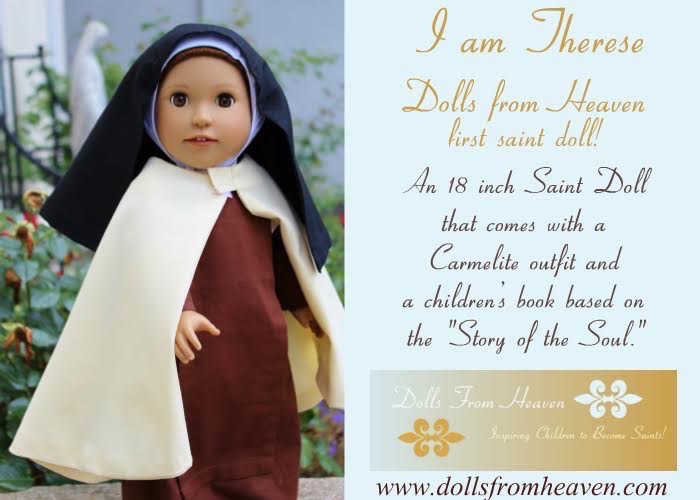
Perhaps the cutest option for encouraging younger children to encounter the saints for themselves is from the Kiczek family at www.DollsfromHeaven.com:

DollsfromHeavenT

The Kiczek family have created a lovely doll of St. Therese of Lisieux, which comes with accessories: several costumes and a children’s book about her life. The Kiczek family are hoping to create a whole series of saint dolls at www.dollsfromheaven.com. Dolls are a warm way to encourage a child’s relationship with individual saints, as well as introduce the universal vocation to holiness, and the various vocations.

Creatively Use Holy Days and Holidays To Engage Your Children’s Imaginations
Dressing up is a favorite childhood pastime. Halloween gives children and families the opportunity to dress up imaginatively for a night. If your parish, Catholic homeschool group or Catholic school has a themed party for Halloween or All Saints Day, this is a perfect opportunity for your child to dress up as a monk, nun, priest or deacon. An “All Saints Day” party offers the chance to research a saint and dress up as well. A “Dress Up As Your Favorite Saint Contest” at home could also be an opportunity to explore what it means to live a particular vocation to holiness.

Celebrating the feast day of a favorite family saint can include reading the life of the saint aloud together, dressing up, and preparing a meal or dessert that reflects that saint’s nationality. (For more creative ideas about celebrating the saints in your family, check out Catholic Family Fun by Sarah Reinhard.) 

Encourage Retreats and Visits to Shrines, Convents, and Monasteries
There is nothing like seeing religious life in action, to better understand it firsthand. Make a family pilgrimage to a convent, monastery, or seminary during an “open house” or special celebration. If an opportunity arises for an older child to make a retreat, go on a “nun run” (a visit to a series of convents for young women), or something similar, encourage him or her to go.

Encourage Active Participation in Mission Outreach
Encourage your teens to actively participate in mission outreach sponsored and supervised by the parish, diocese, or religious communities. Being sent on mission is a great way for a young person to experience the mission of the Church—a mission they are called to participate in, no matter what their vocation is. Mission experiences can help a young person understand that God has a mission for them to fulfill, and how important it is to correspond to God’s call.

Here are some additional ideas for ways to promote vocations in your family:

How To Promote Vocations in Your Family A comprehensive list of ideas downloadable as a PDF from the Diocese of LaCrosse.

7 Ways Families Can Foster Vocations is a brochure that can be purchased and shared—but also simply read online here.

Catholicmom.com has the most comprehensive resource online that I found for encouraging vocations in the family. I highly recommend checking it out—both for encouraging vocations, but also for great resources on nurturing holiness in our families.

How To Overcome Obstacles in Discerning Consecrated Life & National Vocation Awareness Week

woman-571715_1920This week—from Sunday, November 1 until Saturday, November 7, 2015—is National Vocation Awareness Week. The United States Conference of Catholic Bishops invites us all to dedicate this week to promote vocations specifically to the priesthood, diaconate, and consecrated life through prayer and education, and to renew our prayers and support for those who are considering one of these particular vocations.

With the recent Synod on the Family, the importance for young people to discern and be formed in their vocation to marriage is recognized, but there is one big difference. In our culture, marriage as we understand it as Catholics may be under pressure, but it is still considered a “usual” or “normal” path in life. Whereas ordained and consecrated life are the “hidden” or “forgotten” options for many young people. There could be any number of reasons for this, but in working with young people, I’ve found there’s usually just a few:

  • Out of sight, out of mind. A young person has never truly connected with a young priest, deacon, or religious, and so the thought that he or she could have a similar vocation never comes to mind.
  • Celibate chastity is so counter-cultural in our “do whatever feels right” culture obsessed with pleasure and sex, it’s immediately dismissed as “not possible.”
  • Similarly, the vow of poverty is absurd to someone immersed in the materialistic culture
  • The mistaken belief that true freedom means to be absolutely unencumbered by any form of restraint whatsoever, makes the priestly or religious vows unthinkable: like an unbearable lifetime of captivity.
  • Fear of commitment
  • Fear of unworthiness to be consecrated to God

National Vocation Awareness Week (NVAW) is especially helpful for highlighting consecrated life as a valid vocation to discern; NVAW can also help to address the misunderstandings that people often have about a life consecrated to God’s service. Great joy, beauty, love, and goodness flow from authentically living a priestly, diaconal, or religious vocation.

Of course, the greatest joy and love flow from living one’s own authentic call, so the point of National Vocation Awareness Week is not to put pressure on anyone, but to ensure that the full range of beautiful vocations in the Church are understood,  considered, and discerned.

Through the week, I hope to:

  • Answer the most recent questions about religious life that  have come in. Feel free to email, comment, or tweet me with your questions. (Note: I’m only on Twitter once or twice a day, so to reach me through Twitter, I believe you have to add a period in front of my name: put .@SisterMPaul at the beginning of your tweet, otherwise I might miss your question.)
  • Tweet resources that I discover through the week (and I’ll try to list them on the blog)
  • Highlight resources for nurturing vocations to religious life, priesthood and diaconate in the family, which is ideally the place where one can find the greatest support for discerning and taking the first steps to follow one’s vocation.

In addition, as I mentioned earlier, you can support NVAW in prayer by: downloading reflections for each day, a holy hour that you can pray for vocations this week, and a digital prayer card (PDF) that you can pray with and share, as well as other resources here on the USCCB’s website.

Back from Hiatus

hand-226358_1280for being so patient with me these past few weeks!

I’m back from my blogging/mostly offline hiatus. It is a real joy to be back online and blogging again! Posting three times a week has really pushed me to  come quite far writing the book on discernment, but it’s also proven to be quite challenging to keep up with. By the end of summer, I know I was barely hanging in there. I think I finally went into “overload” mode these past couple of weeks—in part because I’d fallen behind posting, but also because of other responsibilities that have arisen.

One benefit to all of this is that out of sheer necessity, I’ve been trying to live in the spirit of discernment even more than usual during these past couple weeks. So I have some more personal experiences and stories to share with regard to discerning day-to-day. Another (probably the best) benefit to you is that when I miss a blogpost, I pray extra for you, that you will receive the insights and graces that you need for your next step in your discernments! You have been in my prayers more than usual.

But I’m really excited to be back here writing. I’m trying to plan things out so that if it once again becomes impossible to blog regularly, I can at least post once or twice a week until I’m able to make time again.

From November 1-7, 2015, we celebrate National Vocation Awareness Week here in the USA. The United States Conference of Catholic Bishops (the USCCB) designated this week to encourage a culture of vocations specifically for priesthood, diaconate, and religious life. (In general, a vocational culture also includes discerning a possible vocation to marriage or single life.) Here are some recommended resources for parishes, families, and religious education–click on the link for National Vocational Awareness Week, English or Spanish. During that week, I hope to highlight a few other resources for encouraging openness to the call to consecrated or ordained life in the family that I’ve recently come across.

And just a reminder, please feel free to share your insights about discernment and your discernment journey with other readers through the comments. I love hearing from you, and also receiving your questions! The best way to reach me is here on the blog or via email. (Although you can find me on Twitter and Facebook, I am not able to maintain a consistent enough presence to be sure that I will receive your messages in a timely manner.)

I’m temporarily offline but praying for you

I’d hoped I’d be able to keep up posting during this week and next, but am not able to. I apologize for the lack of posts, and hope to be back by the end of next week. Know that you have been in my prayers in a special way.

For the young women discerning religious life, I am posting below a couple of retreat opportunities that our sisters are offering this summer. If you are interested (or you know someone who might be), please contact Sr. Michael at the phone number or email provided.

3That Christ May Live in Me_Daughters of St. Paul_Discernemnt Poster_YCL_Consecrated Life_Discernment


SaintPaulSummerProgram2015_Flyer_Square_Daughters-of-St-Paul_Discernment_Consecrated-Life


Sharing the Treasure of Pauline Spirituality in NYC This Week

Just a reminder for any New Yorkers that I’ll be visiting this week for two special events:

1. Manhattan’s very own #Soul of Christ talk and book-signing at our Pauline Book & Media Center at 64 West 38th St. on Thursday evening (June 4) at 6:00 PM

NewYorkPromoFinal


2. Daughters of Saint Paul Centenary Day of Recollection and Centenary Mass on Saturday, June 6th, from 10 AM to 6:30 PM, at Holy Family Church, where I will be giving one of two talks and will lead the Eucharistic Hour of Adoration:

Flyer for Holy Family event

The Novena Continues…and 5 Things I’ve Learned About Holiness


Regina apostoli edit col bal - Version 2Day 5 of the Novena to Mary, Queen of Apostles

Prayer to Mary for a Listening Heart

Mary, when the Angel gabriel surprised you one day, you listened to his words with an attentive heart. You said “yes” to God’s invitation…

Intercede for us, that we, too, may have listening hearts: hearts that seek to hear the voice of God in every detail of our lives, hearts ready to respond to the needs of those around us…. Pray that we, like you, may treasure God’s word in our hearts and act on it. Amen. – excerpt from Live Christ! Give Christ! Prayers for the New Evangelization edited by Sr. Margaret Kerry, FSP.


FacebooknovenapicIn addition to the online Novena to Mary Queen of Apostles that I’m running here, our sisters are also running one on our Daughters of St. Paul Facebook Page here.  Now you can choose between two online novenas to our loving Mother and Queen!

I don’t know how I missed this lovely article by Daughter of Saint Paul Sr. Theresa Aletheia Noble on her Pursued by Truth Patheos Blog, but here it is for you: Five Things I’ve Learned About Holiness in the Convent.

More on Alberione: “Vibrant Media Apostle”

It’s a delight to be able to share with you so many resources on the Pauline spirit and our lives as consecrated Daughters of St. Paul. Just after I posted yesterday’s update from our interview on CatholicTV, I found out about Sr. Sean Marie David’s interview on New York’s Net TV about our new film on Blessed James Alberione, Media Apostle: The Father James Alberione Story. She does a fantastic job explaining about our charism and our Founder: