Discerning in My Weakness: a personal story

OLYMPUS DIGITAL CAMERARecently, I made a discernment that specifically takes into account my personal gifts and weaknesses. Honestly, I hesitated to write something so specific and personal on this blog, but then I thought it might be helpful for others if I shared the process that I went through. Like the stories I try to write, there’s an unexpected twist at the end!

Gift from God
As a published author, I am often asked to give talks and conferences, or lead retreats. But I’ve always been terrified of public speaking. Over the years, I’ve worked hard to overcome my fears and to become a speaker who really engages with people; I try to make the talks appealing and enjoyable. A number of people have affirmed that they have been touched by the talks and conferences.

Limitations Surrounding the Gift
Despite my best efforts, speaking publicly is still quite difficult and draining for me. While I’m able to present well, I am often quite anxious several days ahead of time. Afterwards, I’m drained and have difficulty for several more days settling into writing and my other demanding responsibilities. I was hoping that over time, the anxiety and energy drains would lessen, but this year’s book tour has shown me that this is not true. Instead, the traveling and stress from the book tour resulted in my being unable to fulfill some of my other apostolic responsibilities well.

Motivation to Discern
This is the reason I started to discern whether I should continue to speak publicly. With God’s grace, I can manages the challenges and sacrifices that speaking publicly requires. But these challenges make me less available to enter deeply into my prayer life and to carry out my other responsibilities.

After the book tour ended in June, I’ve continued to receive requests for public speaking, and my next book will release in eighteen months. How is God calling me with regard to public speaking as an evangelizer for the Gospel? After praying about it and not receiving any clarity, I did a simple “pros and cons” analysis. These were the most important points that arose  when I prayed with the question: Is God calling me to continue public speaking?

 Pros:

  • I am asked repeatedly to speak publicly
  • God seems to bless my talks by touching people’s hearts and lives
  • Public speaking is part of being an author today because it’s an important way to spread the message of the books that I’ve written

Cons:

  • Because I become unduly stressed, anxious, and drained almost every time I accept an engagement, my prayer, writing, and other apostolic duties (given to me in obedience) are often affected negatively, despite my best efforts

When I discern taking on apostolic projects, an important criteria is seeking the greatest good for the greatest number of people. But I puzzled over what that meant in this case. Is it reaching more people through public speaking? How about the people that I reach through my writing, whom I can’t count? What about the quality of my prayer, of how I carry out my other responsibilities, and of my relationships with the sisters with whom I live? And, if I become burned out, how will I be able to effectively communicate Christ’s love?

The Unexpected Twist
After several months of discerning, I suddenly realized that maybe I’d been asking God the wrong question all along. Perhaps I was trying too hard to plan out the future, when instead what I really needed to do was discern the opportunities that were right in front of me. I changed the question from being general to being specific: Am I being called to speak in this particular time and place? Immediately I started receiving clear answers.

And my larger question was answered, too, though not in the way I expected. For right now, it is clear that God is inviting me to discern each opportunity for public speaking individually, on a case-by-case basis, and to accept those specific engagements which I truly feel called to and which my other responsibilities allow.

Finally, I also received an interesting insight in my prayer–that God seems to be guiding me to do his will specifically through this weakness of mine. If I didn’t find public speaking so challenging and need to set limits around it, maybe I would accept so many invitations to speak that I wouldn’t have any time to write another book. Perhaps this balance between public speaking and writing is exactly how God is calling me.

At some point in the future when my situation changes—for example, if I were freed up from other duties—I may find God inviting me to do more public speaking. Or I might be given a duty which precludes public speaking altogether. But for now, in the situation I’m in with my current responsibilities, gifts, and limitations, God’s will is clear. I cannot always say “yes” to people’s requests, but I can be open to the guidance and invitations of the Holy Spirit in each opportunity that arises, in my gifts and limitations, and in my current circumstances.

Our Gifts and Weaknesses Help Us Discern Our Way of Being in the World

06D RGBstock 2 choiceDiscernment can be approached in many ways. Personally, I’ve found it easier when I begin with my own heart, my identity, and experience (as at the center of a circle) and then gradually expand outwards to my situation, my family, community and workplace, the calls of the Church, and the needs of the world.

If we imagine discernment as a series of concentric circles, the innermost circle would be my interior life, including: my God-given identity, my feelings, thoughts, deep desires, my gifts and limitations. We discover these in prayer and also by praying with our history, the needs of the world, and our current situation.

In particular, reflecting on and praying with our gifts and limitations—the ways that God has given us to be and to act in the world—is extremely helpful in discerning a course of action or our vocation. One of the most popular sayings of St. Thomas Aquinas is: “Grace does not destroy nature but perfects it.” This is helpful in understanding that we are called be holy in a way that respects our humanity, although grace also enables us to transcend the merely human and to selflessly sacrifice for the sake of love.

A superficial examination of the lives of several saints quickly reveals how unique each saint’s path to holiness was. (I give a quick example between St. Pio and St. Frances Cabrini in this earlier post.) Sanctity certainly has many common elements: faith, hope, and love; the works of mercy; the Beatitudes. But how each individual is specifically called to live holiness is unique, partly according to that person’s gifts and limitations.

Taking into account our gifts and limitations, therefore, is an important part of understanding God’s call for us. There are certain roles that require certain aptitudes or skills. If we are discerning our call to a role that has such requirements, we need to reflect on whether we have the aptitudes or the ability to acquire the needed skills. We don’t discount the reality that grace can help us to do something that would ordinarily be beyond us, but we also don’t seek to work against the foundational inclinations of our personality, unless we have a compelling reason to do so.

* * *

As a college student, Sarah is currently discerning her future career. At heart, Sarah is an artist and idealist who feels called to serve others. For some reason—perhaps because of her family background—she believes that being a doctor is the best way to serve others. Yet, she finds herself dismayed when she starts to fill out an application for medical school because she feels no personal inclination towards a medical profession: she isn’t good at science, and she becomes faint not just at the sight of blood, but at the thought of blood. If Sarah’s interest in becoming a doctor is based solely on her theory that being a doctor is the best way to help others, then she is basing her discernment on a faulty assumption, and her resistance to filling out that application is a real indication of that. The clue here is not that being a medical doctor is hard, or a lot of work, but that it actually goes against Sarah’s personal inclinations and gifts. Sarah may indeed be called to serve others, but in another way.

* * *

When we discern, we want to take our personalities, gifts, limitations, and inclinations into account. Part of the work of vocation directors for priesthood and religious communities is to see if the candidate is a “good fit.” For example, as Daughters of Saint Paul we share life closely—not just daily life, but also in the ways we carry out our daily mission together. It can be quite demanding to live and work so closely together, even for those of us who are called to it. (One of the greatest “daily miracles” in religious life is the reality that five women, who all take turns cooking the meals, can share the same small kitchen and still be friends at the end of the day!)

Since a young woman needs to have a certain amount of flexibility and sociability to be happy as a Daughter of Saint Paul, this becomes part of her discernment with our community. If she doesn’t have those particular qualities, it doesn’t mean she isn’t a wonderful person called by God to a special mission, but it’s an indication that she might be called somewhere else—perhaps to another congregation of sisters who don’t live community life together so closely, or perhaps to single life, or married life.

On the other hand, someone who hastily dismisses an invitation to be involved in something good–such as their parish’s outreach program–only because it’s “too hard,” is not really discerning. The amount of sacrifice involved is not the question; as followers of Christ, we will always have something to offer because we seek to love selflessly as Christ does. Instead, the question is how God is calling us to use our particular gifts and our limitations to serve others’ needs in the way that only we can.

Lectio Divina for Discerners: What do you seek?

06C wikipedia (3)

Discerning with the Word: A Guided Lectio Divina for Those in Discernment
“What do you seek?”

Introduction: We may not notice, but many times when Jesus encounters someone, he asks them a question about what they want. In this reading, Andrew and John, who would become two of Jesus’ chosen apostles, meet Jesus for the first time. As you pray with this reading, imagine Jesus directing this question to you. How would you answer?

Lectio: John 1:35-42

The next day John again was standing with two of his disciples, and as he watched Jesus walk by, he exclaimed, ‘Look, here is the Lamb of God!’ The two disciples heard him say this, and they followed Jesus. When Jesus turned and saw them following, he said to them, ‘What are you looking for?’ They said to him, ‘Rabbi’ (which translated means Teacher), ‘where are you staying?’ He said to them, ‘Come and see.’ They came and saw where he was staying, and they remained with him that day. It was about four o’clock in the afternoon. One of the two who heard John speak and followed him was Andrew, Simon Peter’s brother. He first found his brother Simon and said to him, ‘We have found the Messiah’ (which is translated Anointed). He brought Simon to Jesus, who looked at him and said, ‘You are Simon son of John. You are to be called Cephas’ (which is translated Peter).

Read through this reading slowly and attentively at least twice. Can you imagine yourself as one of the people in this story, and how you might feel? Take your time praying with it.

Meditatio

Jesus begins his relationship with Andrew and John by asking them what they want. Andrew and John answer Jesus in a way that seems ordinary but that actually expresses their desire to get to know Jesus better, to “stay” with him. Jesus responds to their desires–both spoken and unspoken. This initial encounter was so transformative for Andrew that he immediately went off and convinced his brother Simon to meet Jesus. The meeting between Jesus and Simon is even more dramatic, as Jesus doesn’t just call Simon by name, but gives him a new name, “Peter.”

As we begin to discern, Jesus asks us this same question, “What are you looking for?”

What are your dreams? What are you looking for? Share one of your deep desires or dreams with Jesus now.

Contemplatio

You have shared with God a dream or desire important to you. Now, take some quiet time to listen. How might God communicate to you his dreams for you?

God may respond in word, in a feeling, in making things work out…or God may respond in silence. But God always responds to us.

Oratio

God’s Dream for Me based on the writings of Bl. James Alberione

Your dream, O Master, is to lay hold of me with your divine life.
Your dream is to purify me, to recreate me,
to make me a new person in your image.
Your dream is to fill me with your love, to make me love the Father and all my brothers and sisters just as you do.
Your dream is to draw me to you with the closest of bonds, to unite my heart with yours, to make me strong,
to impart to me your divine power
so that I can overcome evil and be constant in doing good.
Your dream is to inflame me with an untiring zeal to spread your kingdom.
Your dream is to possess me in this life and in the life to come.
O Master, may your dream come true!
May I be able to give all you ask of me. Amen.*

* From Live Christ! Give Christ! Prayers for the New Evangelization 

Actio

Try to be aware of your hopes for the day each morning.
Next, start to bring your “hopes” to prayer.
Imagine Jesus looking at you and asking you, “What do you want me to do for you today?”

Discerning: What’s In Our Heart?

06B foto stochDiscerning what is in our heart is the touchstone of our discernment, and it’s what we need to keep coming back to throughout our discernment. Previously, we spoke about desire and deep desire (see What’s the Connection Between Desire and Discernment, and Discerning with Deep Desires blog posts), but let’s re-visit this briefly, as many people struggle with interior “listening” the most.

Our deepest desires—such as the longing to love and be loved—are placed in us by God. These deep desires are often buried beneath more superficial desires that spring from our ego or the stress or distractions of daily life. That’s why it’s so important to pray with our feelings and desires, and to continually “go deeper” and evaluate what we most truly want. If you haven’t had the opportunity to do this, I encourage you to take some time now to pray with your desires. You can use the journaling and prayer exercises in the earlier posts listed above, if that’s helpful.

As we reflect on the other important aspects of our lives to discern, we want to constantly return to what our hearts are telling us. How do we feel about the needs of the world, about the needs of the people around us, about the circumstances in which we find ourselves? It’s not that what our heart says is more important than whatever else we bring to discernment, but rather it is our minds and hearts that find the balance and assign the right importance to each of these different elements. Everything must be sorted through our minds and hearts because, in the end, it is with our will and heart that we will say “yes” to God.

Pen_Uncapped

To Journal With

When we begin a discernment, it can be helpful to start with how we feel, because our feelings can often help us determine what troubles us, what we are resisting, and what feels like an invitation. Because all of us want to be happy, we can receive important clues for our discernment when we ask ourselves a few questions about happiness. These might be helpful questions to pray with over the next few days:

  • What does happiness look like for me?
  • Am I happy now? Why or why not?
  • What might I need to become truly, deeply happy (or happier)?

Throughout our discernment, we will want to continue to touch base with our thoughts, feelings, and desires, and bring them often—daily—to God in our prayer.

Follow-up Resource

For a prayerful reflection on how our gifts and our dreams can intersect to reveal God’s will to us, read Meditation 48 in my book, See Yourself Through God’s Eyes, Pauline Books & Media. In the printed book, Meditation 48 can be found on pp. 139-142.

Discernment: Praying Our Future

2012-10-11 16.38.21The art of discernment encompasses praying our past, our present, and our future. But we are called to live in the present moment. Does the art of discernment force us into an unhealthy attitude of trying to live in the past, or in a future that is not here yet? Not if we are discerning well.

Discernment is very much a call to live the present moment. In order to attentively listen to and seek God’s will for the next step in our lives, we need to be fully present to ourself, to God, and to our own lives, in the here and now. Discernment is the art of listening to God in the present so that we are open to carrying out God’s plan. The greater our ability to listen, the more we discover—perhaps to our surprise—that God invites us in specific ways to draw closer to him and to do his will in the world. We are not seeking to foretell the future, nor to make our own plans, but to seek God’s plan, so that what God wills can fully become our will. Whether it’s seeking how to approach an important conversation with a loved one, discerning our vocation, or recognizing God’s invitation in the moment, discernment is being present to God right here, right now, and making ourselves available to God’s plan for us. As Father Ivan Rupnik says in his book, Discernment: Acquiring the Heart of God: “Discernment is not a technique for resolving the problems of our spiritual life, but a reality found in the relationship between the human person and God.”

God’s Dream for Us
Up to this point, we have focused more on how to grow in the attitudes that will help us discern God’s will for us. As we go forward, we enter into the concrete practice of discernment, of how to give priority to God’s will in our lives, and how to overcome the obstacles that get in the way of a discerning heart so that we can fully live God’s will.

God’s will=God’s plan=God’s desires=God’s dream for us.

We know from the Bible that God’s dream for us is what is truly best for us. God dreams of our happiness, our freedom, of being in a close relationship with us, of our knowing and trusting that we are loved, of our complete fulfillment. As mentioned earlier, God doesn’t just dream for us, but with us. We can see discernment as our way of dreaming with God, of discovering how we can reach that fullness of happiness and freedom that God desires for us—even more than we want it for ourselves. Since God shares his dreams with us most often in the ordinary “stuff” of our lives, these ordinary things are what we will be praying and discerning with: our prayer, our interior dispositions, our situations, our world, our desires, our abilities, limitations, and gifts.

How To Pray the Examen Prayer

imag0079Here is an example of how you can pray the examen during an Hour of Adoration or a longer time of prayer—perhaps in the evening.

1. Place Yourself in God’s Presence

This is a moment like that of the Transfiguration on Mount Tabor: Jesus is here before you, wishing to bathe you in the radiance of his love, wanting to speak to you. This is a moment of very personal encounter between you and Jesus. Take this moment to rest in the light of his gaze of unconditional love for you. Allow his love to fill you—perhaps with awareness of his presence, or peace, or joy—whatever grace he wishes to give you at this moment.

2. In Gratitude

In the light of his love, look over your day or the past week, with gratitude. What are the gifts you have received this day/week? Give thanks to God for the blessings that immediately spring to mind. Now look deeper. Have you received a special grace this day or week for which you want to thank God? A hidden gift that you took for granted until now? Or a little joy that reminded you of how loved you are? Remember also to thank God for the special gifts that he has given you, in your person—whether it’s a talent to serve or to cook, or to listen, or your patience, or a gift to encourage others… Thank God for these gifts.

3. Petition

Confident in God’s desire to draw you closer to himself, now ask the Holy Spirit to come into your heart and to help you gently look over the day or week in the light of his grace and your response to his grace.

4. Gently Review Your Day/Week

Look through your life in these days/week. A particular event might spring to mind right away—that might be God’s invitation to spend some time with him reflecting on it. If nothing comes to mind, look through the events of your day, especially noticing what’s going on inside of you—your motivations and feelings.

Good questions to ask yourself:

  • When did you feel loved today? How were you able to show love to someone else?
  • What drew you closer to God today?
  • What drew you away from God today?
  • What kind of moods were present in you today? Why?
  • What regrets do you carry for today?
  • Where were God’s invitations to you today? How did you respond?
  • Do any events seem to be unfinished, requiring some reflection or making you feel uncomfortable, angry, or fearful? How might God be inviting you in this situation?

5. Renewal of love and resolve

Express whatever is in your heart to Jesus—how you feel about the events of this day or week, how you have grown closer to him, asking forgiveness for your sinfulness and failures. In a particular way, ask him to be with you in the coming day or week.

Close with a prayer for the grace to live in his love, such as the Our Father.

3D Listening to God: with the Examen Prayer

bible study and notesOne of the reasons we seek to pray through the day is so that we can hear God’s daily invitations to us. How can we cultivate this attitude of listening to God in our daily life? The examen prayer is one of the best tools to help us listen to God’s invitations to us in our daily life. It is recommended by the saints—St. Francis de Sales, St. John Chrysostom, St. Basil, and most notably St. Ignatius of Loyola, who developed this prayer in the way we discuss it below.

Foundationally, the examen is a way to recognize God’s presence in our life today. As a tool to help us to listen to God in my daily life, it’s best used as a daily practice. St. Ignatius recommends making the examen “formally” twice a day: around noon and in the evening; in his Examen App, Fr. Michael Denk provides an easy option to schedule it into your day. As I mentioned in an earlier post, I totally recommend Father Denk’s Examen App, which will guide you through the whole process—either through words on the screen, or through his videos.

The Jesuits have developed many wonderful resources to help someone learn and use this powerful practice of prayer, and many are available online. You can find videos, audio files, articles, and printed materials here.

For those who are hesitant about making the exam, not interested in the app, or already pray the examen and would like to explore it further, let’s take a deeper look.

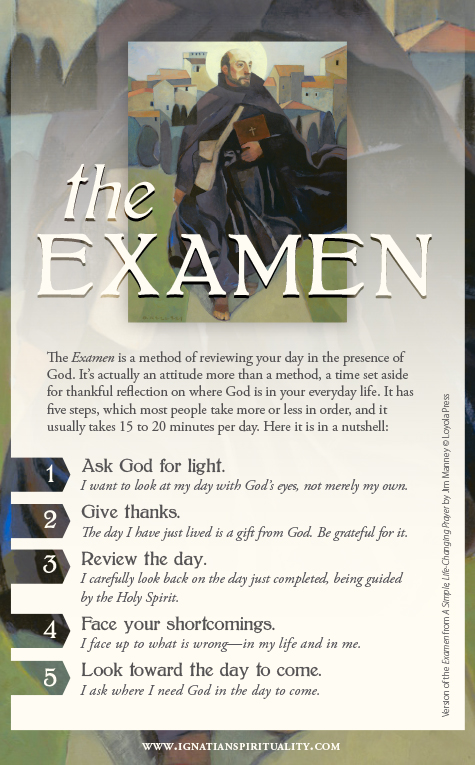
To get started, you may wish to look over the five steps for the examen I posted earlier, or read through this attractive printable PDF card provided by www.ignatianspirituality.com:


examenprayerignatianspirituality

The five steps may be described differently, but the basic “movements” of the examen are:

  • Remember that we are in the presence of God
  • Note and thank God for God’s gifts to us
  • Ask for divine light to discern God’s presence in our day and in our life, and to gain insight into our own choices and hearts
  • Review the events of our day, paying attention to how we responded to God’s gifts and invitations, and especially noting our thoughts and the stirrings of our heart. We ask forgiveness for the times that we have turned away from God’s gifts and invitations.
  • Renew my love for God, my trust that God is with me, and my resolve to act in accord with God’s invitations as I look forward to tomorrow (or the rest of my day)

Blessed James Alberione (Founder of the Daughters of Saint Paul) told us that praying the examen is crucial  for growing in the spiritual life. He advocated praying it preventively in the morning during meditation, making the examen during our daily Hour of Adoration, again at noon, and again at evening prayer. For him, the practice of the examen is one of the best ways to grow in self-knowledge and in humility.

To make the examen well, Blessed James Alberione recommends writing down the main points: the gifts that God has given us, the events of our day and how we have responded, and our renewal of our resolve. The Examen App actually gives you a place to journal on your phone or tablet, but non-digital folks can use a small notebook.

Above all, Blessed James saw the examen as a path towards what he called “the habitual examen.” In other words, praying the examen through the day is meant to bring us to living mindfully, aware of our thoughts and desires, our words and choices, as we are living them. For Alberione, the goal of the examen is to bring us to a place where “my heart is with Jesus,” where the desires of Jesus become our desires. In other words, to live continuously in a spirit of discernment.

“The important thing is that the strings of my heart are tuned for the melody we want to play, that is the hymn: ‘Glory to God and peace to humanity.’ The essential purpose of the exam is to see whether or not these strings play this melody well. The strings of my heart are my interior dispositions. Therefore, they need to be played in order to know what they sound like. Do they sing of the glory of God? Or do they sing my self-love?” – Bl. James Alberione

As a follow-up to this post, try to make the examen prayer today or this week. Please feel free to contact me in the comments or via email with any questions you have about this beautiful and helpful form of praying that can draw us deeper into a spirit of discernment. In my next post, I’ll share a personal example of how I pray with the examen prayer during my Hour of Adoration.

3D Listening: Connecting with God Every Day

Various spiritualities offer support in living in greater awareness of God’s presence in our day to day life. You can get really creative with this, depending on your schedule and what helps you! I hope that you share in the comments below what you are already doing, or what you might try to increase your awareness of God’s love for you daily. Here are a few practices that I have found useful.

* Begin the day with meditation on a Scripture passage that concludes with a preview of how I want to live what I meditated on through this day. As I look forward to my day and the responsibilities I will face, I resolve how to  respond with love in the various situations that might arise

* Use everyday events to remind myself to pray a one-line pray (or aspiration) frequently. For example, I  set my watch to beep on the hour. When my watch is silenced, I try to remember to pray every time I stand up from my desk. I’ve also used other reminders, such as beginning or switching to a new project/file, as a reminder to pray

* Use part (or all) of my lunch break for prayer: go to Mass, pray the Angelus, make a spiritual communion or visit Jesus in the Eucharist in a nearby church, or take a prayer-walk (during which you can simply rejoice in God’s love for you, or pray the Rosary, etc.). I know people whose work is flexible enough that they can stop at 3 PM to pray the Divine Mercy chaplet

* Use times when I have to make a decision or am not sure what to do to pray for guidance from the Holy Spirit

* Close my day by putting on my “Sherlock Holmes” hat to look for one way that God revealed himself to me today. It might not be obvious or expected. For example, God often “speaks” to me through nature, such as a chickadee that chirps a greeting. A friend’s support at just the right moment, a film or song that deeply moves us, or a sudden insight—any of these can reveal God’s love.

Often, at the end of these mini prayer breaks, I will ask Jesus to guide me to respond to his call through the next hour/minute/project.

A favorite prayer practice that I use daily is the examen, and I hope to blog more in detail about that next.

A month of thanksgiving

The month of June was full of travels, and I thought I’d be able to keep up with the blog, but it proved impossible. (I will get back to posting as usual next week, on Monday.) Between beautiful centenary celebrations for our 100th anniversary of foundation (Boston and New York), and a visit with family, June for me has been a month of renewal and above all, gratitude to God. Over and over again, I have thanked God for the great gift of his faithful love as manifested to me in my congregation, the Daughters of Saint Paul. (Visit here for a glimpse of the most joyous occasion of Sr. Emi Magnificat’s perpetual profession last week!)

Finally, a last call for those young women who are interested in discernment: Our sisters are offering a very special week-end discernment retreat at our retreat house in Billerica, MA in just two weeks. We’re extending the registration deadline, so please share this with any young woman whom you know is discerning. Depending on how many participants we have, I might be called upon to help out at the retreat.

Have a blessed weekend.

3That Christ May Live in Me_Daughters of St. Paul_Discernemnt Poster_YCL_Consecrated Life_Discernment

I’m temporarily offline but praying for you

I’d hoped I’d be able to keep up posting during this week and next, but am not able to. I apologize for the lack of posts, and hope to be back by the end of next week. Know that you have been in my prayers in a special way.

For the young women discerning religious life, I am posting below a couple of retreat opportunities that our sisters are offering this summer. If you are interested (or you know someone who might be), please contact Sr. Michael at the phone number or email provided.

3That Christ May Live in Me_Daughters of St. Paul_Discernemnt Poster_YCL_Consecrated Life_Discernment


SaintPaulSummerProgram2015_Flyer_Square_Daughters-of-St-Paul_Discernment_Consecrated-Life