What’s the connection between deep desire and discernment?

Anna_Brassey_438-victorian-woman-writing-jornalThe driving force of any story is the protagonist’s deepest needs and desires, because they determine what the protagonist chooses and does. Think of Will Smith’s character in the film The Pursuit of Happyness. Or Elizabeth Bennet in Jane Austen’s Pride and Prejudice. 

Whenever we are discerning, we want to become more mindful of our deepest needs and desires. (Deep desires go much deeper than a passing urge, such as our appetite for chocolate or ice cream. “Deep desire” means desires that well from deep within our soul, such as the longing for happiness, etc.)  Just like in a movie, our needs and desires drive our choices—often without our knowing it. So the more aware we can become of what we want and need, the more honest and free our discernment becomes.

When writing a story, the writer has to write two stories that are deeply connected: the outer story with events, plot, obstacles, and other characters; and the inner story of the protagonist’s growth with the protagonist’s desires, needs, and choices. In a good story, these two stories are so deeply connected that it’s the resolution of both the inner and outer challenges that make a powerful ending.

Just as a good story has both an inner and outer story, so does a good discernment. In our world today, it’s easy to spend time focusing on the outer story: What are the needs of the world today? What do my family and friends tell me about myself? What does this spiritual book tell me? What is Pope Francis saying about the needs of the Church and how to live our Christian vocation?

All of these are important and critical when we discern. Yet the most critical place to listen to the voice of God is interior: within us. The basis for any discernment is our relationship with God. If we do not pray, we cannot hear the voice of God—often the whisper of God—within us.

When we discern, we also need to go within, to listen to God speaking and working within us. Our deepest desires often express our God-given identity! It’s just as important to pay attention to the voice of God within as it is to pay attention to how God speaks to us through events, circumstances, and people in our lives. Discernment involves weighing the different “voices” that I hear—from within, from outside—and discovering which is God’s call.

Our interior journey—our understanding of who we are, and our needs and desires—will profoundly influence and shape our response to God’s call in our choices and actions.

Pen_Uncapped

To Journal About

  • Make a list of the ten things in life that are most important to you.
  • When you’re finished, bring that list with you before the Lord in prayer, and ask him to reveal his priorities for you.

Living Our Vocation “to the Full”

"The Good Shepherd" by Joseph Ritter von Führich, c. 1840

“The Good Shepherd” by Joseph Ritter von Führich, c. 1840

Yesterday, “Good Shepherd” Sunday, was the World Day of Prayer for Vocations. If you are discerning your vocation, I hope that you could feel the support of the Church’s prayers for you, lifting you up from all over the world!

Pope Francis offered a really beautiful reflection for the day in his Message for the 52nd World Day of Prayer for Vocations.  One of the coolest things about it is that he describes “vocation” in such a dynamic way, comparing the living of our vocation with the exodus experience. Thus, Pope Francis’ message for the World Day of Prayer for Vocations isn’t just for those discerning their vocations, but an invitation for all of us to live the gift of our vocations fully. I’d like to share three points that particularly struck me and that I’ve been praying with:


Following One’s Vocation (whether for the first time, or as a renewal of our commitment): 

Belief means transcending ourselves, leaving behind our comfort and the inflexibility of our ego in order to centre our life in Jesus Christ. It means leaving, like Abraham, our native place and going forward with trust, knowing that God will show us the way to a new land.

Living One’s Vocation “To the Full”:

The exodus experience is paradigmatic of the Christian life, particularly in the case of those who have embraced a vocation of special dedication to the Gospel. This calls for a constantly renewed attitude of conversion and transformation, an incessant moving forward, a passage from death to life like that celebrated in every liturgy, an experience of passover…. Vocation is always a work of God. He leads us beyond our initial situation, frees us from every enslavement, breaks down our habits and our indifference, and brings us to the joy of communion with him and with our brothers and sisters. Responding to God’s call, then, means allowing him to help us leave ourselves and our false security behind, and to strike out on the path which leads to Jesus Christ, the origin and destiny of our life and our happiness.

The Model for Every Vocation:

The Virgin Mary, model of every vocation, did not fear to utter her “fiat” in response to the Lord’s call. She is at our side and she guides us. With the generous courage born of faith, Mary sang of the joy of leaving herself behind and entrusting to God the plans she had for her life. Let us turn to her, so that we may be completely open to what God has planned for each one of us, so that we can grow in the desire to go out with tender concern towards others (cf. Lk1:39).  

If you can, go and read the entire message here. It’s not just beautiful, but challenging and encouraging, reminding us that the Christian vocation is to love, and that living the fullness of the Gospel message does not limit us but leads us to the fullest possible freedom. I also was struck by his comparing each Christian’s vocation to the Exodus experience, because in doing so, Pope Francis is indirectly validating the “storytelling” lens that I’m using on this blog to talk about discernment!

How Our Weaknesses Shape Our Discernment: the Importance of Knowing One’s Self

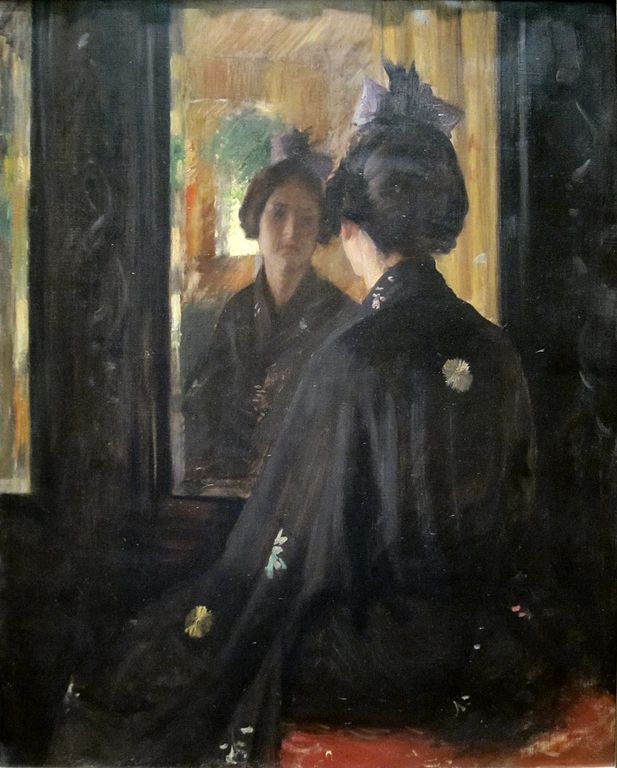
“The Mirror” by William Merritt Chase, c. 1900

What makes a novel or movie fascinating for me is when the protagonist is flawed and must overcome inner obstacles to achieve his goal, or to choose (and find) her happiness. If all the characters—especially the main ones—are practically perfect, then we have trouble being interested in the story or the characters, because they’re not real. (Even the practically perfect Mary Poppins has a fault—or at least a weakness—in how she deals with her affection for the children and for Bert.) Perfect characters don’t just make the story less interesting. We are unable to relate to these flat characters, or to their lives, because they aren’t struggling with anything. They’re not like us.

We all struggle with ourselves—our faults, a flaw, or even a simple tendency that, in our situation, causes pain or distress. If we truly come to know ourselves, we acknowledge that we struggle with much more than the occasional fault. We all have a tendency to sin, and the more honest we are with ourselves, the better we know our sinfulness and flaws. (One of the benefits of spiritual direction is gradually coming to a clearer self-knowledge.) St. Augustine encourages us to pray for self-knowledge, and it’s something we can do daily before we make our examen.

People have different levels of awareness of their faults and sinfulness, but almost all of us have “blind spots” when it comes to how we see ourselves. A strength or talent we take pride in may actually be an irritant or flaw to others. For some of us, pride blinds us to our flaws and we have trouble acknowledging our sinfulness, except in things that we don’t consider that important. For others among us, all we can see is our faults and sinfulness. And many of us swing back and forth between the two perspectives—we have days we feel we can conquer the world, and other days where to love that irritating person for the love of Christ feels way more heroic than we can manage.

Neither perspective is really helpful. If you are someone who, like me, shifts back and forth, then you have one advantage: you know that you have still not come to the truth of who you are. For me, the key word in my understanding of who I am is one word: and.

Who are we? We are flawed and saved. We are called to eternal glory through the gift of our Baptism, and we are limited and sinful human beings. We are sinners and redeemed. We are cherished and we are called to conversion.

When we are discerning an important decision, it is crucial that we remember who we really are: precious and weak, sinful and called to holiness. At some point, God will probably call us to go beyond ourselves, beyond our own strength, sustaining us with the gift of his grace. But God also perfects our human nature, the gifts of our specific personality inherent in us. Our weaknesses shape our call just as much as our gifts, so it’s important in our discernments that we know who we are, in all the greatness of our call and all the weakness that we suffer.

For some helpful real-life examples, we can read more about the saints. In comparing two saints, we will often discover that the questions that they wrestled with were very different. A sensitive monk who grapples with scrupulosity and becomes a great confessor (like the great saint, Padre Pio) will have very different discernments during his life than a practical peasant woman who grows up on a farm and founds a religious congregation dedicated to bringing the love of God to others through the corporal works of mercy (like the great St. Frances Xavier Cabrini). Both are great saints known for their love for God and selfless service of others, but their love was expressed in completely different ways.

Pen_Uncapped

To Journal About

  • How do I see myself? Do I use “and” or “but” when I describe myself?
  • At this point in my life, what is my greatest fault?
  • At this point in my life, what is my greatest gift?

You may wish to conclude your journaling time with a prayer to the Holy Spirit for the grace to see yourself through God’s eyes.

God Wants a Relationship with Us

To understand God’s call for us, we need to also understand how God sees us; we have to understand our “backstory” (to put it in storytelling terms) or where we come from.

How does God see us? Most simply put, we have been loved into being:

There is one truth for believers that, no matter how much our wounded nature might try, cannot be twisted. This truth is that God chose to create each of us. There is something so unique and wonderful about us that God wants to share his life with us. God wants us in the world.  See Yourself Through God’s Eyes

Not only is this true, but it has an amazing corollary: in creating us, God is expressing a desire to have a relationship with us. Because of Jesus, we know that this relationship with the God is adoption as God’s child, and our relationship with Jesus is friend.

Image 7How precious is the worth and dignity of every person on earth! The core of our identity is that we are created in the image of God, invited to become a child of God through Baptism so that we can share in Jesus’ divine Sonship. Created in God’s image, we have the ability to know and to love. Unfortunately, the freedom that gives us the ability to love also gives us the ability to choose to turn away from love.

When we choose not to love, we aren’t living according to the greatness of our identity. Although we are beloved, we are also flawed and sinful. Yet, even God’s response to our sinfulness proves his love for us! God sends his Son Jesus to save us from ourselves, from the power of sin, from the power of evil. Every time that we repent of our sins and ask forgiveness, we are invited to return to the depth and beauty of greater communion with God.

Our “backstory” helps us as begin or deepen our attitude of discernment, because God’s call to us is congruous with this reality that we are precious in God’s eyes. Since our very identity is founded on our relationship with God, it makes sense then that God is the Co-Protagonist in our life. God wants to partner with us, to draw us always closer to himself (in deeper communion with him) throughout our lives.

To Pray With

Psalm 139 is wonderful to pray with and ponder our identity in God’s eyes—God’s beloved ones. Pray with it over the next few days, and allow the awe and gratitude of this psalm to fill you.

Discernment in Images: Entrusting Self to God

Discernment quote 4This is one of my very favorite insights into discernment: we trust God because God–in Christ–first trusts us! Discernment: a relationship of love, trust, and freedom.


Blessed Easter! I have taken this week away from this blog to catch up on another project for our centenary year (yes, 2015 is the 100th anniversary of the foundation of the Daughters of Saint Paul!), but I’ll be back next week. Thanks for your patience.

In the meantime, Sr. Margaret Michael Gillis, vocation director for the Daughters of Saint Paul in the USA and Canada, offers a two-minute audio reflection about discerning religious life here.


Wonderful App for the Examen

GoodFriBlessings for Holy Week! You will all be in my prayers even though I’m taking a bit of a break from posting the book this week.

In the meantime I wanted to share with you an app that teaches and reminds us how to do the examen, a wonderful discernment tool and spiritual practice. The examen is a wonderful way to listen to God’s invitations in our life, helping us to look over our day and to be aware of how God is acting in our life, and how we’ve responded. The examen comes to us from the famous expert on discernment, St. Ignatius of Loyola, the founder of the Jesuits, who has influenced the Church greatly with his spirituality that focuses on discerning the will of God. One of the tools for discernment are his Spiritual Exercises–an in-depth retreat where the retreatant seeks to discover God’s will. A practical tool that everyone can use in everyday life is the examen of consciousness. 

The examen is a bit like the examination of conscience–examining our thoughts, words, actions, and omissions at the end of every day, or before we go to confession. But the examen is a bit different. Rather than  focusing on what we’ve done or haven’t done, the examen helps us to look over the day and focus on how God has invited us and worked in our lives during the day.

At http://www.theprodigalfather.org/ Father Michael Denk hosts the Examen App for iPhones, android phones, and tablets that can guide you through the examen–with written steps on the screen and videos. The app is free and contains a full explanation of how to pray the examen. It even has reminders that you can set so that you remember to take the time to pray the examen! If you have a moment, just visit his site now and download the app!

For those of you who don’t have a device with which to use the app, I’ll briefly share the steps of the examen below. Later, I’ll do a whole blog post on this powerful prayer and tool for discernment.

Steps for the Examen: 

1. Gratitude
Note the gifts of love God has given this day; give thanks

2. Petition
Ask God for insight and an open heart; ask God to show you what God wants of you this day

3. Review
With God, look over your day; pay attention to the stirrings of your heart; review your choices and responses

4. Forgiveness
Accept the love and forgiveness God gives you

5. Renewal
With God plan concretely how to live in accord with God’s desire for you

Journaling with the steps of the examen is very helpful, and Father Michael’s Examen app encourages you to do just that. For more explanations of the examen prayer, visit: http://www.ignatianspirituality.com/ignatian-prayer/the-examen/


Begin Where We Are

Happy little girlAt any point in our journey—especially when we begin or deepen our discernment, it’s important to begin where we are, because God is always “here” with us (wherever “here” is). This is true for two reasons:

1) First, God is faithful and would never abandon us, and

2) Because wherever we find ourselves, God wills or allows us to be here and is at work in our life at this precise time and place. The present moment is where we can find God and do God’s will. “Now is the day of salvation!” Saint Paul reminds us (2 Cor. 6:2)

Beginning where we are can be hard for us if we’re not happy or struggling. It’s easy to recognize God’s presence in the good things in our lives, when we’re happy. It’s harder for some of us to discover God’s presence when we’re struggling, because we think the struggle is an obstacle to God. We may want our “new beginning” to be an escape from the struggles in our life, but it’s more likely that beginning anew will help us to see our challenges in a new way, so that the struggle can become the very thing that helps us draw closer to God. Our worst struggle can actuallyl become a steppingstone to God.

Several years ago, a friend of mine started suffering from a respiratory illness. She repeatedly caught the flu, which lasted for two months and agitated her usually dormant asthma. Used to walking twelve miles a week, she now struggled to walk up one flight of stairs. Some days, breathing took so much effort that she stayed in bed.

For two years, she suffered this illness off and on. At first, the restrictions of her activity agitated and frustrated her. Although she was forced to slow down physically, she continually focused on all of the things she couldn’t do, or had to give up doing. And she’d push herself to get up sooner, to be more active, and then end up sicker than before.

But during the second year, she finally accepted her condition. And when she did, she started seeing possibilities. Being forced to slow down gave her an opportunity to pray, read, and reflect more. She became more present to her family because she wasn’t always rushing off. She started to realize that, whether she was well or ill, she didn’t want to rush around as much as she had been doing. Accomplishing more was not what was most important to her. She had the time to think about what was most important in her life, and to set those as her priorities for both when she was sick and when she got well.

Accepting her illness didn’t just enable my friend to take care of herself and recover, but it also became a gift, an opportunity for her to reset her priorities in life. Her illness became a steppingstone towards discerning a more serene lifestyle.

Pen_Uncapped

To journal with:

What do I have trouble accepting in my life right now?
How might God be inviting me or challenging me to grow through this struggle?

Spiritual Direction

Another way to help us to listen to God in our prayer and in our lives is to seek out spiritual direction. Speaking regularly to a spiritual director is a time-honored practice, especially when someone is discerning their vocation, making a major life-choice, or a week-long retreat.

How can a spiritual director help us? Ideally, a spiritual director accompanies us on our journey, helping us to recognize God’s action and invitation in our lives. As we share our prayer and experiences with a spiritual director, the director helps us to understand more clearly how God is speaking to us in our prayer and our lives. The more honest we are, the more insight the spiritual director can offer to us. An essential part of spiritual direction is our openness about our lives and what is happening interiorly. At first, it can be difficult or feel awkward to speak about our spiritual lives, our deeper thoughts and feelings, and what happens in our prayer life, but it is important to be open with a spiritual director.

Finding a good spiritual director can take time but is worthwhile. Here are some characteristics to look for in a spiritual director:

—Approachable—someone you can honestly speak to

–Available–a spiritual director only has time to meet with so many directees, and in many places, spiritual directors are in short supply. If a spiritual director tells you that they are not available right now, or it becomes too difficult to arrange a meeting, it is probable that they are already directing too many people to fit in another person. You can ask them for a recommendation for another director.

—A good listener—a good spiritual director offers guidance and direction, but most often listens to our experiences and then points us towards what is significant about that experience

—Spiritual experience and maturity—someone who is faithful in living their faith, is proficient at prayer, and growing in their own spiritual life. Ideally, a spiritual director has significant experience in the spiritual life and also training in spiritual direction.

—Accompanies rather than leads.

How can we find a good spiritual director?

  • Look for a priest whose homilies or personal conversations you find helpful. (Parish pastors can often be too busy to offer spiritual direction, but sometimes an associate pastor may be available.)
  • Ask for a recommendation from your pastor or another priest you trust.
  • Call a Catholic retreat house and ask for recommended spiritual directors in your area.
  • Make a retreat and follow up with the retreat director, or with someone the retreat director recommends.
  • Connect with a religious community that offers spiritual direction: Jesuits, Benedictines, Oblates, etc.

Having a good spiritual director accompany us on our spiritual journey helps us to learn the principles of the spiritual life, recognize God’s unexpected action in our lives, avoid obstacles and self-deception, and go beyond being stuck in a rut or discouragement. However, while finding a good spiritual director to be very helpful, our true Spiritual Director is Jesus Christ, who guides us in hidden ways through the action of the Holy Spirit. And Jesus is always with us, guiding us.

Coincidence or God?

If God speaks to us in all these ways, how do we know when it’s God speaking to us, and when it’s just coincidence?

  • For a person of faith, there are no coincidences, only Providence. Providence can be defined as God acting in our world, in our lives. It doesn’t mean that every circumstance of our life is a direct call from God, but the overall circumstances of our lives are an important context in which we are called to listen and to act.When someone is a good writer, there are no coincidences in the stories they write. If it’s included in the story, it serves a purpose for the overall story. Likewise in God’s story for us, there are no coincidences. But sometimes we may need to pray with what an event means before we understand it; sometimes we may not understand God’s purpose until years later; sometimes we may need to simply trust in God’s loving purpose for us.
Cassatt_Mary_Nurse_Reading_to_a_Little_Girl_1895

Nurse Reading to a Little GIrl by Mary Cassatt (Public Domain)

We cannot limit how God speaks to us; rather, we want to use all the resources we have at our disposal to listen. God gave us intelligence, a heart with the potential to be compassionate, the community in which we live and work, mentors or wise people in our lives, our gifts and limitations, and our circumstances, in addition to faith and the gift of prayer… Just as God will use all of these to communicate his love, to draw us to himself, and to invite us to live our mission, God wants  us to use our heads as well as our hearts, the advice of mentors as well as self-knowledge, to listen to him.

  • Many of us share the same circumstances, but the call or invitation from God can be different for each person. For example on a city street, dozens of people pass a homeless person. One person may be called to pray for that person; another to offer a kind greeting or a smile, or to initiate a conversation; another to offer a sandwich or a hot coffee; another person may be called to start volunteering at a soup kitchen; another person may be called to donate more generously; another person may be called to be grateful for the gift of a home. The truth is that probably every person who passes someone who is homeless on the street is called to do something, but it requires discernment to discover what.
  • Just as a writer “listens” to everything in his or her life to inform the story that he or she is writing, so we are called to be attentive to our entire lives to discover God’s presence, action, and invitations, so that the “plot” of our life follows God’s lead.

Pen_Uncapped

To Journal:

At the end of each day this week, take a quiet moment at the end of one day to look back over your day with this question: How did God reveal his presence and his love to you today?

Practical Steps for a Daily Discernment

02G choice 2

When we feel the need to discern something big—such as our vocation—then ordinarily we need to take our time with it, and there are a number of steps we can follow. Discerning about smaller, daily choices may take merely moments to make. For me, it often takes just a few minutes to do the following:

  • an evaluation of the need(s) presented to me
  • a short prayer to the Holy Spirit
  • an honest glance at my heart, to make sure I’m aware of my desires and to uncover any unconscious “agenda” that may sway me
  • a renewal of my deepest desire: to live in union with Christ
  • a check-in with my current schedule/responsibilities and, when needed, with a mentor and the people who will be affected by my decision (e.g. the team I’m working with)
  • good old common sense

Then, I put all those together and make a decision.

This may seem like a lot of steps for a smaller choice, but they’ve gradually become automatic for me as I’ve grown in the art of discernment, and they help me to pay more attention to seeking God’s will. Becoming proficient in this spiritual art means that seeking God’s will becomes as habitual as breathing.

To Think About

What would be your list of steps for a discernment about a smaller, daily matter? If you can, share them in the comments or via email (and I’ll post them)!